




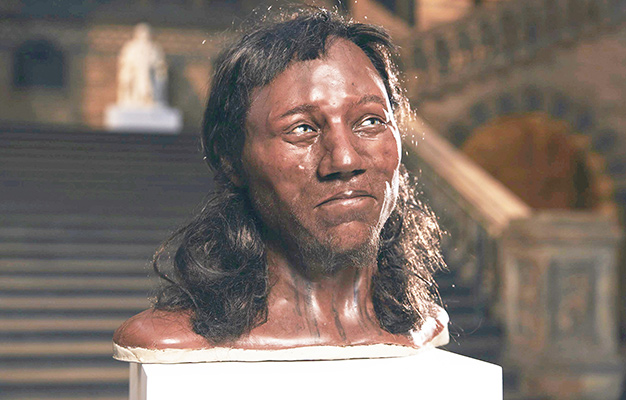
‘Cheddar Man’, Britain’s oldest, nearly complete human skeleton, had dark skin, blue eyes and dark curly hair when he lived in what is now southwest England 10 000 years ago, scientists who read his DNA have discovered.
The finding suggests that the lighter skin pigmentation now seen as typical of northern Europeans is far more recent than previously thought, according to researchers from University College London (UCL) who took part in the project.
Cheddar Man’s skin colour was described as “dark to black” by the scientific team which also included researchers from London’s Natural History Museum, where the skeleton is on display in the Human Evolution gallery.
“To go beyond what the bones tell us and get a scientifically based picture of what he actually looked like is a remarkable, and from the results quite surprising achievement,” said Chris Stringer, the museum’s research leader in Human Origins.
“He is just one person, but also indicative of the population of Europe at the time,” Tom Booth, a postdoctoral researcher in paleobiology at the museum, said in a statement.
“They had dark skin, and most of them had pale-coloured eyes, either blue or green, and dark brown hair.”
This colour combination would be unusual today, but ancient DNA evidence suggests that it was the norm among the hunter-gatherers of northern continental Europe during the Mesolithic, Booth said. Pale eyes apparently evolved in early Europeans before pale skin, which emerged after the advent of agriculture, he said.
Lighter skin absorbs more ultraviolet light than darker skin. Ultraviolet light is necessary for humans to produce vitamin D. The ability to absorb more of it helps people at higher latitudes – who see less sunlight than people in equatorial regions – avoid vitamin D deficiency.
Unearthed in 1903 in a cave at Cheddar Gorge, in the county of Somerset, the Mesolithic-era man was a hunter-gatherer whose ancestors migrated into Europe at the end of the last Ice Age.
Cheddar Man was in his 20s when he died, according to the Natural History Museum, though his cause of death is unknown.
There is a hole in his skull that could be the result of an infection during life, or simply damage from the early 20th century excavations.
Three hundred generations later, around 10% of indigenous British ancestry can be linked to Cheddar Man’s people, scientists say.
As part of a project commissioned by Britain’s Channel 4 television station for a documentary, experts from the Natural History Museum’s ancient DNA lab drilled a tiny hole into the skull in order to extract genetic information.
The DNA was unusually well-preserved, enabling the scientists to sequence Cheddar Man’s genome for the first time and to analyse it to establish aspects of his appearance.
Then, a pair of Dutch artists who are experts in palaeontological model making, Alfons and Adrie Kennis, used a high-tech scanner to make a three-dimensional model of Cheddar Man’s head.
The model, which UCL and the Natural History Museum said rendered Cheddar Man’s face with unprecedented accuracy, shows a man with dark skin, high cheekbones, blue eyes and coarse black hair.
Selina Brace, one of the Natural History Museum’s ancient DNA experts who took part in sequencing Cheddar Man’s genome, was quoted as saying the model was “really, really cool”.
– Nampa-Reuters; additional reporting by livescience.com
In an age of information overload, Sunrise is The Namibian’s morning briefing, delivered at 6h00 from Monday to Friday. It offers a curated rundown of the most important stories from the past 24 hours – occasionally with a light, witty touch. It’s an essential way to stay informed. Subscribe and join our newsletter community.

The Namibian uses AI tools to assist with improved quality, accuracy and efficiency, while maintaining editorial oversight and journalistic integrity.
Stay informed with The Namibian – your source for credible journalism. Get in-depth reporting and opinions for
only N$85 a month. Invest in journalism, invest in democracy –
Subscribe Now!