Imãn Ayisha Says Stuttering Never Silenced Her
Silence has never meant that Imãn Ayisha (22) has nothing to say. Sometimes, it is simply space between her words.
The writer, producer and emerging actor has lived with a stutter since she was about six years old. Yet the pauses in her speech have never stopped her from standing in front of an audience or doing what she is passionate about – storytelling and creativity.
The two sides of her life complement each other. Stuttering may affect how she speaks, but has never limited her ability to think, create or tell stories.
If anything, it has made her more conscious of the power of words and the importance of making people feel heard.
“They allow me to engage with storytelling from a different perspective. I think they strengthen one another,” she says.
Writing, she says, is where stories begin and words are built, ideas are explored and characters are created, while producing teaches her how to bring the stories into reality.
“Writing, especially, gives me a space where my ideas can exist exactly as I intend them to,” she says.
What she appreciates the most is people not only listening to how she speaks but to what she has to say.
“It shows me that having a voice isn’t about speaking perfectly. It’s about having something worth saying and being willing to say it,” Ayisha says.
It makes her feel seen and less weird and different, she says.
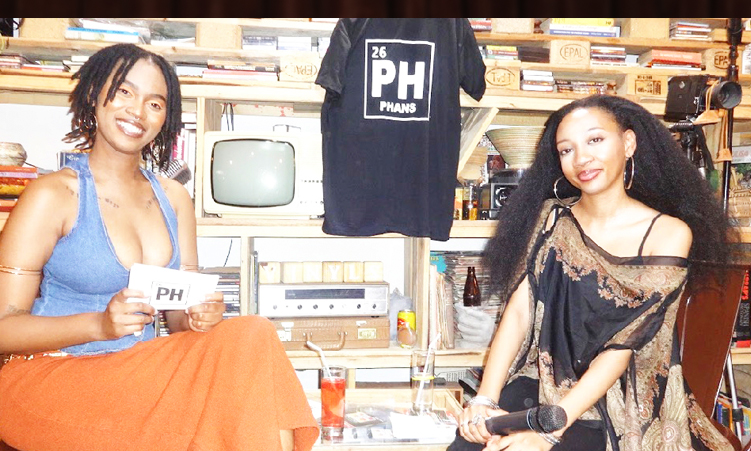
Language learning and literature have always been her passion and talent. Growing up in a multilingual environment, she learned to speak different languages. She is fluent in Afrikaans, German and Arabic.
She also won a national German-speaking award in 2018.
Ayisha is now studying language and linguistics at the Namibia University of Science and Technology, with ambitions of becoming a speech therapist – something shaped by her own experience.
“I want to help those struggling with communication because I also struggle with it,” she says.
Ayisha has a speech impairment that makes it difficult for words to come out of her mouth sometimes.
But there is another side to her life. She is a storyteller.
From the storybooks she wrote and stapled together as a child to fan fiction inspired by the books and films she loved as a teenager, storytelling has always been a way for Ayisha to make sense of the world around her.
Today, she has turned that childhood fascination into filmmaking.
Her short film, ‘The B2 Passage’, won an award at the Namibia Theatre and Film Awards in March. It is a story created from things she heard as a child and reinterpreted in her own creative perspective.
She has also recently been cast as a supporting character in ‘African Relativity’, a comedy science-fiction feature film directed by the filmmaker behind ‘Baxu and the Giants’.
“Writing is where I feel most connected to storytelling and my journey into film has been largely self-taught,” she says.
To her, storytelling is a way of connecting people to each other, their culture and themselves. It is also one way of reimagining where we could go, Ayisha says.
She never formally studied filmmaking. But years of being a passionate consumer of stories and an obsession with books, films, comics and manga became her unofficial education.
She is also a henna artist, seamstress and crocheter.
“I’m very open and expressive about my interest in media and pop culture and I’m a proud nerd about it. A big part of my personality is being a fan girl,” she says.
Ayisha says her stutter affects her everyday life more than it affects her professional work.
In acting, she can rehearse a line repeatedly, change her pronunciation, use an accent, whisper or shout, and rely on body language. If necessary, another take can be made.
Important telephone calls, especially emergencies, can become difficult because stress can make communication harder.
Sometimes she cannot get a particular word out. Other times, people interrupt while she is still trying to finish a sentence.
She says people can also mistake her quietness for rudeness or, more painfully, assume that she is unintelligent because of the way she speaks.
That is one misconception she strongly rejects.
“It’s just a neurological disorder out of our control, it doesn’t have anything to do with intelligence. It’s a genuine problem between my brain and body that is really random,” she says.
When speaking becomes too difficult for her, she says she can write something down or type it on her phone. As a pupil, she says she would sometimes write answers down for teachers when she struggled to say them aloud.
“Communication is about connecting with people and expressing yourself, not about speaking perfectly. If I’m in a situation where I really do feel like that, I would suggest a different method of communication,” Ayisha says.
That belief, she says, has also shaped the way she understands other people.
Having a speech difference has made her more patient with different types of speakers and more conscious of body language and other forms of communication.
“I also feel very compassionate towards deaf people and those who communicate through sign language and struggle to speak because of any other neurological disorders. It has opened me up to more languages,” Ayisha says.
She believes Namibia has a long way to go in understanding stuttering.
She says people who stutter can be subjected to shame and misunderstanding, including children whose difficulties may be wrongly interpreted as signs that they are not trying hard enough.
For her, awareness is urgently needed.
“Speech therapy can be valuable, but it often feels as though the conversation stops there,” she says.
Ayisha also wants the conversation around stuttering to move beyond simply teaching people techniques to manage their speech.
She believes there is room for research, technology and innovation.
She says she wants to write stories about different things, incorporating her culture and Namibia into her work, while separately using her future career to contribute to the field of speech and language pathology.
As a producer, Ayisha enjoys being closely involved in the process of translating a script into something audiences can see. But producing also comes with difficult choices, particularly when artistic ambition meets financial reality. Sometimes, she says, the decision is as simple and painful as cutting a smoke machine from a scene because the money is needed for lighting.
Her message to people who struggle with communication is not to pretend sit is easy and to encourage patience and finding communication methods that work for them.
“The goal is to be understood, not to meet someone else’s idea of what communication should look like.
“Who knows what new ways you can find around your speech impairment and what new pathways of your brain you can open up?” she says.