



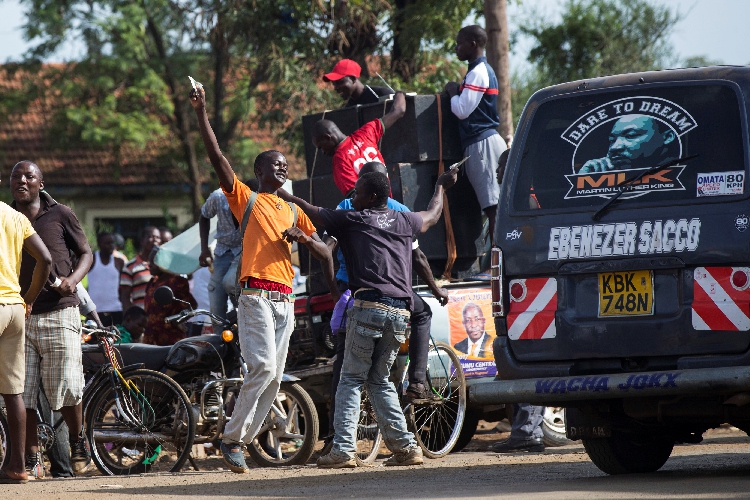
•Katharine HoureldA crowd of elated young men danced outside the market in Kenya’s southern Kisumu city, waving the crisp new 200 shilling (N$27) notes that a local politician was distributing from behind a dusty speaker that pounded out music.
Shoppers paid scant attention. Cash handouts are common during African elections; in Kenya, the devolution of power to 47 counties has made them ubiquitous in the run-up to polls for president, parliament and counties due on 8 August.
The counties, which manage local infrastructure, were introduced five years ago after a government-appointed international commission concluded power was too centralised and partly to blame for violence that killed 1 200 people and crippled the economy following elections in 2007.
The process has been backed by international loans as a way to spread democracy and accountability within a vital Western ally. But devolution has also fuelled local corruption, officials and transparency campaigners say, and with it the prospect of more localised violence come election time.
The prize of county budgets worth billions of shillings mean this month’s party primaries for the county elections are hard-fought. Candidates often get into debt to try to buy votes, counting on future riches once in office.
Clashes have already broken out, and violent elections could threaten stability in a country that borders two others in turmoil:
The interior ministry said on Monday that politically instigated violence had been recorded in 12 counties so far.
At least 14 civilians and four policemen have been killed in the drought-hit northern Laikipia region. A local politician is charged with inciting violence and arson after invasions of private land by cattle-herders and a spate of attacks on farmers and owners of safari parks.
Kenya’s ruling coalition annulled 21 county primaries held last Friday amid widespread anger over shortages of voting materials. It began rerunning them on Monday. The opposition will also rerun some primaries after allegations of rigging.
Rose Onyango, who was selling dried fish in the market near the rally in Kisumu last week, said three members of the county assembly and two aspiring governors had given out cash in the market over the past few days, hoping to win votes.
“We just had a woman aspirant an hour ago but she gave it to someone to distribute,” the 24-year-old said. “The crowd tore her clothes and the money was splashed everywhere.”
Kenyans are haunted by the disputed 2007 presidential poll.
Dozens of men, women and children were burned alive in a church. Others were hunted down by machete-wielding gangs during the widespread ethnic violence that followed. More than half a million people fled their homes. Some never returned.
Protests also broke out after elections in 2013, but they were much smaller. A case at the International Criminal Court against powerful politicians, including president Uhuru Kenyatta, helped dampen violence.
That case has now collapsed. Kenyatta is running for a second term and his old nemesis Raila Odinga is building an opposition alliance. Odinga has said mass protests are possible if elections are rigged.
But this time it is not winner-takes-all. Devolution is designed, in part, to ensure there will be many winners.
“Devolution can defuse massive violence, although it can intensify it in individual counties,” said Titus Ogalo, head of the local anti-corruption Transparency International chapter.
“People feel, ‘Even if we lose the presidency, we have something to fight for at the local level’.”
The counties get around 20% of national revenues. They can also raise local taxes. In return, they must provide most health facilities, preschools, and local infrastructure.
Halakhe Waqo, CEO of the government-run Ethics and Anti-Corruption Commission, said mismanagement is rife. “Every procurement process is a problem. Funds are given to relatives, contracts are given to relatives and tribesmen,” he said.
Kisumu, Kenya’s third-largest city perched on the green shores of Lake Victoria, is Odinga’s stronghold, dominated by his Luo ethnic group. Residents complain the central government has neglected them for decades.
The port is choked by water hyacinth, stranding sun-bleached boats at the docks. The rusting railway has not seen a train for years, and the new international airport has no international flights. Football authorities have stopped holding international matches at the city’s stadium because of a rubbish dump nearby.
Reuters interviewed more than two dozen voters: All supported devolution as a way of wresting power and resources from the central government. Many also complained that Kenya’s powerful Kikuyu tribe dominates that central government.
“I have many top achievements,” he said. “The investment in medicine and the investment in physical infrastructure is huge … but a lot of money still remains with national government. That’s a serious challenge that we have.”
Asked about vote buying, Ochien’g Obiero Philip, the governor’s director of political affairs, said many voters would not show up unless they received a cash payment.
“It’s something that the voters expect,” he said. “It is one of the challenges of democracy in Kenya. People expect handouts to be motivated to vote. It is widespread and the legal framework has never acted on it so it’s a loophole.”
In an age of information overload, Sunrise is The Namibian’s morning briefing, delivered at 6h00 from Monday to Friday. It offers a curated rundown of the most important stories from the past 24 hours – occasionally with a light, witty touch. It’s an essential way to stay informed. Subscribe and join our newsletter community.

The Namibian uses AI tools to assist with improved quality, accuracy and efficiency, while maintaining editorial oversight and journalistic integrity.
Stay informed with The Namibian – your source for credible journalism. Get in-depth reporting and opinions for
only N$85 a month. Invest in journalism, invest in democracy –
Subscribe Now!