




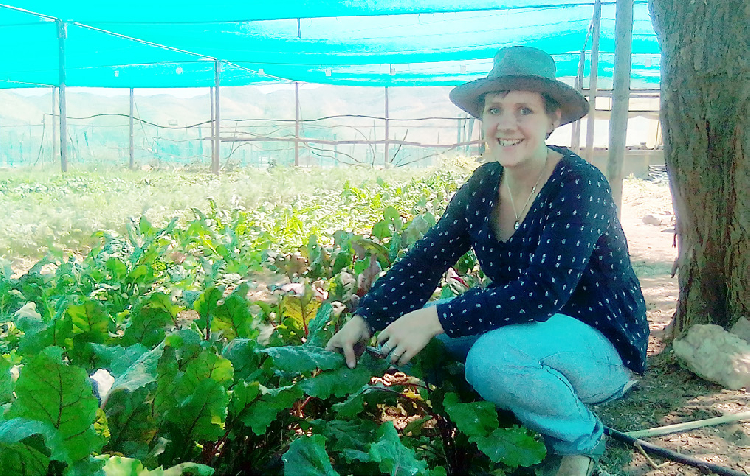
A CERTIFIED large-scale horticulture organic garden at Farm Krumhuk, about 40 km south of Windhoek, has embraced the use of biochar to enhance soil fertility.
Biochar is a solid material that is produced by carbonising biomass under the limited supply or absence of oxygen. The production process resembles that of making regular charcoal, according to the recently published ‘Biochar from Namibian Encroacher Bush: Practical Guidelines for Producers’.
The head of the organic garden at Farm Krumhuk, Mareike Voigts, said the organic garden was set up about 12 years ago to produce and sell organic produce.
“This garden measures a quarter hectare and we sell most of our farm produce to major markets in Windhoek and on Green Saturdays, which are held in Windhoek,” she added.
Voigts said the garden also sells green boxes to restaurants and through private orders. The garden is home to a variety of vegetables, ranging from beetroots, carrots, onions, parsley, tomatoes, kale, potatoes and green beans.
One of the major challenges the garden faces are weeds, which compete for nutrients with the vegetables.
“We do not want pests and we really look at the health of the soil and we do not have problems with pests,” Voigts explained.
Asked if they were making good money from the garden, Voigts said it is a profitable business, but added that water and labour are costly.
Apart from cattle, the farm also has a garden for herbs, a dairy, bakery, butchery, accommodation facility for visitors, chickens, a wood workshop and a school.
Biochar can also be used as a stock feed supplement.
The application of biochar into the soil has an impact on a wider scale because it can positively affect the climate. Applying biochar into soils can fix additional carbon for thousands of years and thus presents a solution for countering climate change globally.
Voigts said there are about 80 people living on the farm.
Biochar is an interesting material for farmers and agricultural practitioners worldwide due to its resistance against humification and mineralisation, its porous texture with a larger inner surface and its adsorptive and absorptive capacity. On Thursday last week, a live demonstration on the application of biochar was held at Farm Krumhuk, where biochar is being produced and used to enhance the garden’s soil fertility – with the assistance from the Namibia University of Science and Technology’s Bush Project, which conducted research on the topic. The production of biochar starts with the collection of dry wood from the bushes on the farm, mainly the Acacia melifera (black thorn), which are then cut into 30-centimetre-long pieces. About 10 to 15 kilograms of the cut wood is gathered and stacked in the Kon-Tiki kiln and lit while preparation of the rest of the wood for burning continues.
Wood is added to the kiln every 15 to 20 minutes under close watch so that the wood does not burn to ashes.
After four hours, the kiln is fully burned down and 300 kilograms of bush produce around 150 kilograms of moist biochar.
To stop the burning, the char is drenched with around 200 litres of water, which can be collected, diluted and used to water plants for which it acts as a fertiliser.
The produced biochar is then dried before it is milled and inoculated. The inoculated char is sprinkled into the soil and then worked in.
The production of useful material from the encroacher bush in Namibia is spearheaded by the Namibia Biomass Industry Group (N-BiG), which is striving to serve and grow the Namibian biomass industry through information, capacity development, applied research and development and active membership support.
The N-BiG is financially supported by the GIZ-funded Bush Control and Biomass Utilisation project.
In an age of information overload, Sunrise is The Namibian’s morning briefing, delivered at 6h00 from Monday to Friday. It offers a curated rundown of the most important stories from the past 24 hours – occasionally with a light, witty touch. It’s an essential way to stay informed. Subscribe and join our newsletter community.

The Namibian uses AI tools to assist with improved quality, accuracy and efficiency, while maintaining editorial oversight and journalistic integrity.
Stay informed with The Namibian – your source for credible journalism. Get in-depth reporting and opinions for
only N$85 a month. Invest in journalism, invest in democracy –
Subscribe Now!