





Thomas Shilunga*, a finance clerk at an investment company, says the rising cost of living is making it hard to make ends meet – even for those with salaries.
Many Namibians are forced to rely on side hustles or cash loans.
“Expenses keep increasing, but we never see employers increasing our salaries.
That is why many people end up taking cash loans,” he says.
Shilunga says a significant portion of his monthly income goes towards fixed expenses, including about N$2 500 in repayments.
He estimates spending a further N$2 500 on groceries and personal necessities, while transport and social activities have also become more expensive due to the rising cost of fuel.
“By the time I’ve paid everything, what’s left is just enough to get me back to work,” he says.
Shilunga says side hustles have become an important source of income, adding they often generate more money than his full-time job.
“People are struggling. The cash loan companies keep calling because someone used your name as a reference.
It shows how many people are borrowing just to survive,” he says.
‘SENSITIVE TIME’
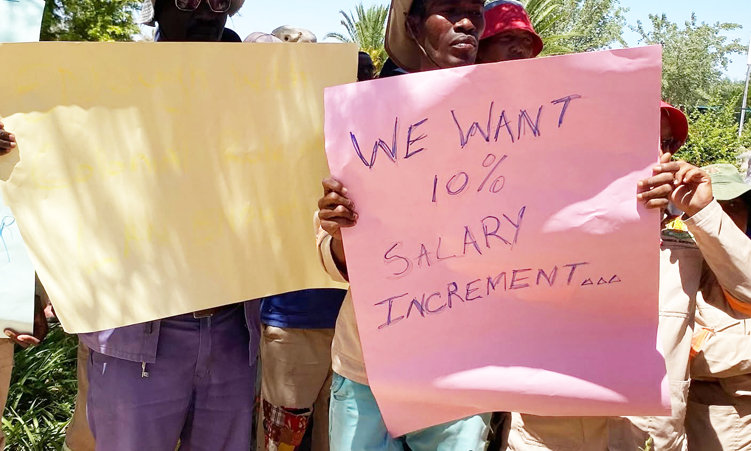
Consumers and economists say increases in electricity and municipal tariffs come at a “sensitive time”, while unions insist on workers’ salaries being increased.
This comes after the Electricity Control Board (ECB) last week approved a 3.7% electricity tariff increase, following NamPower’s 8.4% tariff increase proposal submitted in March.
Under the new tariff increase, City of Windhoek consumers will now receive about 37.60 units for N$100 prepaid electricity.
Central North Regional Electricity Distributor consumers will get 35.52 units, Erongo Regional Electricity Distributor customers 31.11 units, Keetmanshoop municipality customers 33.89 units, and Northern Regional Electricity Distributor customers 36.35 units.
Truck driver Peter Angula (42)*, who works for a construction company, says he earns N$32 per hour, which amounts to about N$5 900 per month if he works 180 hours.
Angula says a large portion of his income goes towards supporting his family.
He spends about N$1 050 on school expenses for his two children, N$950 on food for them, and at least N$500 per month to support his mother, who is a pensioner.
He also pays N$1 000 in rent for his brother, who is studying at the University of Namibia’s Grootfontein campus.
“We get a N$9 taxi allowance at work. That is not even enough. What is that?” he asks.
Angula says there are months when his salary does not last, forcing him to borrow money from microlenders.
‘FAR BELOW WHAT’S NEEDED’
Metal and Allied Namibian Workers Union general secretary Angula Angula says the new tariff hikes are going to be difficult for many workers in the city.
“Looking at what they’re earning, this means unions need to go back to the drawing board and negotiate for better increments, and employers are offering inflation plus 1%,” he says.
Angula says current wages are “far below what workers need” to meet their basic living expenses, adding that some employees, particularly those in the construction sector, cannot afford transport to and from work or their accommodation costs.
ECB chief executive Robert Kahimise says the regulator took into consideration financial pressures facing consumers before approving the increase.
Namibia Power Corporation (NamPower) managing director Simson Haulofu says the utility acknowledges households and businesses’ concerns and recognises that any increase in electricity tariffs adds to financial pressure.
He says NamPower requires an increase of 30.4%, however, the utility has not applied for this level of adjustment because it recognises that such an increase would be unaffordable for many customers and could have wider negative consequences.
“The 8.4% application was, therefore, NamPower’s way of doing its part to avoid a huge electricity cost shock for the Namibian economy while still ensuring the company remains financially stable,” he says.
The ECB says the approved increase was reduced from 4.8% to 3.7% through a combined N$90-million relief package comprising N$50 million from the Long-Run Marginal Cost Fund and N$40 million from the National Energy Fund.
The intervention was aimed at easing the burden on households and businesses.
The regulator has also directed electricity distributors to keep social tariffs unchanged to protect low-income consumers from the increase.
THEORY VS PRACTICE
Simonis Storm economist Almandro Jansen says the tariff increases land at a “particularly sensitive point in the inflation cycle”.
He says Namibia’s annual inflation accelerated to 4.4% in June, up from 4.1% in May, and 3.7% a year earlier – and critically, the ‘housing, water, electricity, gas and other fuels’ category is already running at 4.4%.
“On paper, a 4% tariff increase looks manageable”.
“It comes at a moment when there’s very little slack left to absorb,” he says.
City of Windhoek chief executive Moses Matyayi has acknowledged concerns about the rising cost of living and the impact of recent tariff adjustments.
“These concerns were carefully considered during the tariff review process.
There was no residential tariff adjustment during the 2025/26 financial year, yet the city has continued to provide essential services and maintain infrastructure despite increasing operational costs,” he says.
Matyayi last Monday said the approved 4% tariff adjustment is intended to help ensure the continued delivery of municipal services amid rising costs associated with fuel.
From an economic perspective, Namibia faces inflationary pressures, he said, while the cost of goods, services, infrastructure maintenance, fuel and utilities remains high.
He said the city is a distributor and not a producer of electricity.
“The recent increase follows an approved tariff adjustment for NamPower, the bulk electricity supplier.
As bulk supply costs increase, distributors such as the city are required to recover those costs through approved tariffs to sustain electricity services,” he said.
Economists Claudia Haarmann and Dirk Haarmann say municipalities need to recover their costs, and that inflation-linked tariff adjustments are defensible.
However, they cautioned against building the cost of living solely around tariff increases, adding that transport was the largest contributor to national inflation in June.
“Since Namibia imports all its fuel, increases in fuel prices have a ripple effect across the economy, raising the cost of moving goods and services, from taxi fares to basic food items,” they say.
The economists acknowledge that the government has introduced measures aimed at easing fuel price pressures, including reductions in the fuel levy, the emergency fuel supply arrangement being extended to September, and continued subsidies for fuel transportation to rural areas.
These interventions are, however, poorly targeted because fuel subsidies primarily benefit those who consume more fuel, they say.
They say a person driving a large vehicle with a bigger fuel tank receives greater benefits, while those who do not own vehicles or cannot afford fuel receive little to no direct assistance.
*Names have been changed for fear of victimisation.