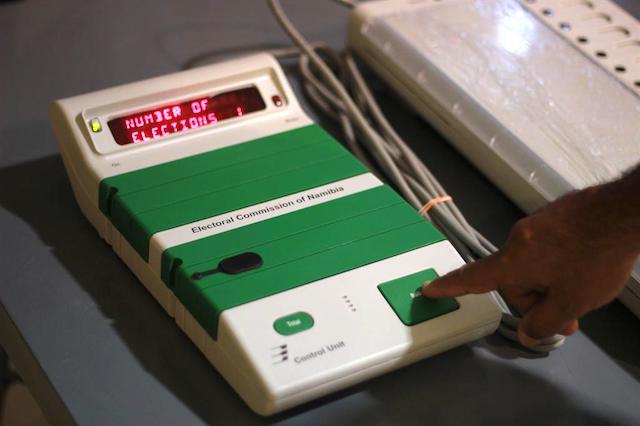
THE Electoral Commission of Namibia will have to ensure that electronic voting machines are combined with a verifiable paper trail if it wants to continue using the devices in future elections after 21 March 2020.
This is one of the results of the landmark judgement on a challenge to the lawfulness of Namibia’s 2019 presidential election that was delivered in the Supreme Court yesterday.
In a unanimous judgement read out by chief justice Peter Shivute, the court decided not to set aside the 2019 presidential election and order a repeat of the election, in which electronic voting machines (EVMs) without a verifiable paper trail were used.
However, the court ruled that former minister of urban and rural development Charles Namoloh’s decision that the parts of the Electoral Act requiring a verifiable paper trial for EVMs would not come into operation with the rest of the act was in conflict with the Constitution and invalid.
The court set aside that decision of Namoloh, and ordered that the invalidity and setting aside would take effect on 21 March 2020 – the end of the current term of Namibia’s president and National Assembly – unless the current minister of urban and rural development withdraws the decision before then.
The court also stated that the validity of the election of office-bearers elected under the 2014 Electoral Act before 21 March 2020 would not be affected by its finding that Namoloh did not have the power to decide that the part of the Electoral Act requiring a verifiable paper trail for EVMs would not come into force with the rest of the law.
The Supreme Court’s judgement gave 2019 presidential election candidates Panduleni Itula, Henk Mudge, Epafras Mukwiilongo, Ignatius Shixwameni and Mike Kavekotora the satisfaction of having won the argument about the legality of using EVMs without a paper trail that can verify every vote cast on the devices. The bigger prize they were aiming for – having the 2019 presidential election and its result set aside, and getting the court to order a rerun of the election – has stayed beyond their reach, though.
Itula – a qualified dentist and Swapo Party member – ran as an independent candidate in the presidential election, in which he garnered about 29% of the votes cast, losing to fellow Swapo member and incumbent president Hage Geingob, who received 56% of the votes cast.
Itula unsuccessfully tried in the Electoral Court in Windhoek on the evening of 26 November to stop the Electoral Commission of Namibia (ECN) from using EVMs without a verifiable paper trial in the elections that were set to take place the next day. Following the elections and announcement of their results, Itula was joined by four other presidential candidates in a legal challenge in the Supreme Court of the use of EVMs without a verifiable paper trail.
The focus of their challenge was the 2014 Electoral Act’s section 97, which allows the ECN to use EVMs in elections. The section also states that the use of EVMs is subject to the simultaneous use of a verifiable paper trail for every vote cast, and that in the event of a discrepancy between EVM results and the results of the paper trail the paper trail results are accepted as the election outcome.
However, when Namoloh announced in the Government Gazette on 17 October 2014 that the act was coming into operation on that date, he also stated that the part of the law requiring a verifiable paper trail for EVMs was not coming into force then.
“A verifiable paper trail as the check and balance to the use of EVMs is not merely to provide comfort to voters that their votes had been cast,” the court remarked in its judgement. It noted that the Supreme Court of India in 2013 described a paper trail as “an indispensable requirement of free and fair elections”.
Namibia’s legislature may delegate subordinate legislative powers to the executive, but cannot give the executive any entitlement to select statutory sub-provisions to implement, the court stated.
The use of the term “subject to” in the Electoral Act’s section 97 means that the use of EVMs is conditional on the parts of the act requiring a verifiable paper trail for the devices, the court also stated.
The minister’s decision to exclude those parts of the act from coming into operation exceeded his powers, the court found: “It was not open to the minister to hold those provisions in abeyance as the use of EVMs is dependent upon the safeguards placed in them. By doing so, the minister effectively deleted (for the time being) the safeguards enacted by parliament and thus usurped its role and breached the separation of powers provided for in the Constitution.”
It was not open to the minister “to subvert the intention of the legislature” by implementing the use of EVMs without the safeguards expressly included in the Electoral Act, the court ruled.
On the conduct of the election itself, the court found that Itula and the other applicants “have established very little in the way of irregularities or machine malfunctioning”, and did not contend that the EVMs used in the presidential election had been tampered with.
While the transparency and credibility of the election were compromised by the lack of a verifiable paper trail, the evidence before the court did not show that this had an impact on the electorate’s fundamental right to vote, the court said.
It also noted that the ECN proceeded to use EVMs without a paper trail “on the clear assumption that it was by law entitled to do so”.
With Itula and the other applicants having had substantial, but not complete, success with their challenge, the court directed that the minister, the attorney general and the ECN should pay two-thirds of the applicants’ legal costs.
The case was heard by chief justice Shivute, appeal judges Sylvester Mainga, Dave Smuts and Elton Hoff, and acting judge of appeal Bess Nkabinde.
Senior counsel Jeremy Gauntlett, assisted by Frank Pelser, represented Itula and the other applicants on instructions from Elize Angula. The government and ECN were represented by senior counsel William Mokhare, assisted by Sakeus Akweenda and Eliaser Nekwaya, instructed by the government attorney.