



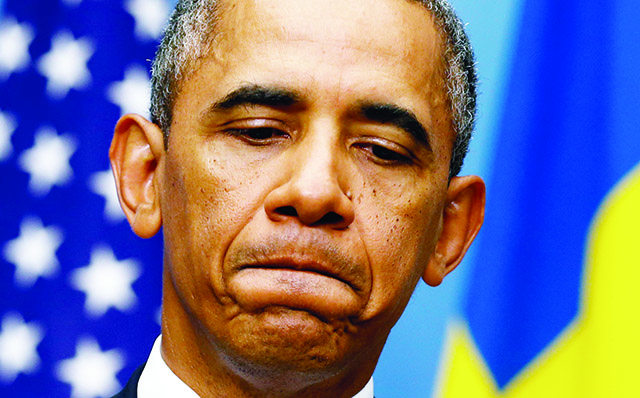
As Barack Obama, ad- visers and members of Congress consider how to confront the spiralling vio- lence in Syria, Christians should ask themselves, “Does the Holy Spirit ever inspire violence?”
• JACK LEVISON
This is a dangerous ques- tion, and I am prone to an- swer it with a loud and clear, “No!” The Spirit inspires peace and love, healing,
and prophetic witness, but the Spirit does not, will not inspire violence.
Is my first reaction right? What about the book of Judges, where even deeply flawed people are inspired to liberate the ancient tribes of Israel? The model comes early in the book:
But when the Israelites cried out to the LORD, the LORD raised up a deliv- erer for the Israelites, who delivered them, Othniel son
of Kenaz, Caleb’s younger brother. The Spirit of the LORD came upon him, and he judged Israel; he went out to war, and the LORD gave King Cushan- rishathaim of Aram into his hand … So the land had rest 40 years… (Judges 3:9-11).
This sketch sets the pat- tern for many of the judges to come: the people cry out; the Spirit inspires a deliver- er called a judge; this judge delivers the people through
war; the people experience peace. In this pattern, there is the inescapable associa- tion of the Spirit with war.
The judges – liberators, really – are so famous as to belong almost to cartoon reality. Cowardly Gideon, who hid in a wine press, took a mere 300 men and defeated the Midianites, thanks to the Spirit. Jeph- thah, a bastard (really, an illegitimate son), who made an unnecessary vow
to sacrifice whatever came from his door (turns out, his daughter walked out the door), liberated his people, thanks to the Spirit. And womaniser Samson, of Samson and Delilah fame, liberated his people…
Did the Spirit inspire vio- lence in these cases? Ger- man theologian Michael Welker answers, “No!” The Spirit did not inspire violence. The Spirit did no more than restore solidarity
by raising the oppressed:
Even the early experi- ences of God’s Spirit are experiences of how a new beginning is made toward restoring the community of God’s people. They are experiences of the forgive- ness of sins, of the raising up of the ‘crushed and op- pressed,’and of the renewal of the forces of life.
There is truth in this (God the Spirit, p 65). When the Spirit clothed Gideon, he gathered the people. When the Spirit came upon Jeph- thah, he passed through Gilead and Manasseh be- fore ever going to war.
I appreciate what Welker is trying to do by distancing the Spirit from violence, but I’m not convinced he is right. Othniel’s only re- corded actions are to judge Israel and to lead them suc- cessfully into battle. Gideon finds himself shortly in the company of “all the troops that were with him”, which are whittled down to 300.
Jephthah travels to muster the troops. Samson poses the biggest problem. When the Spirit rushed upon Sam- son for a second time, “he went down to Ashkelon” and “killed 30 men”. When the Spirit gave him superhu- man strength a third time, causing the cords that bound him to melt, he found the jawbone of an ass and killed a thousand men with it.
Does the Spirit inspire violence? Well, yes, but only in a single set of circumstances: when the restoration of solidarity for oppressed peoples re- quires violence. The book of Judges does not espouse a universal association between the Spirit and violence. The premise of the book of Judges is that God raises liberators only when a nation, oppressed by for- eign powers, cries for help – not unlike their ancestral slaves in Pharaoh’s Egypt.
Notice that throughout the Bible the Spirit does not inspire violence when the nation of Israel was powerful. In stories that cluster around the reign of Solomon, for example, the Spirit is conspicu- ously absent. In stories that accentuate Israel’s vulnerability and fragility, the Spirit is conspicuously present. The association of the Spirit with violence, therefore, is conditioned by the presence of oppression, when solidarity cannot be restored, when the poor cannot be liberated, without charismatic leadership in battle against oppressors.
Which leads us back to the decision facing Barack Obama. Are the people of Syria so destitute, so cor- nered by chemical weap- ons, so oppressed that there is no alternative but violence? Or will a limited attack on Syria be a sym- bolic, punitive gesture that fails to liberate an oppressed people? That is the epic question facing President Obama. – huffingtonpost
In an age of information overload, Sunrise is The Namibian’s morning briefing, delivered at 6h00 from Monday to Friday. It offers a curated rundown of the most important stories from the past 24 hours – occasionally with a light, witty touch. It’s an essential way to stay informed. Subscribe and join our newsletter community.

The Namibian uses AI tools to assist with improved quality, accuracy and efficiency, while maintaining editorial oversight and journalistic integrity.
Stay informed with The Namibian – your source for credible journalism. Get in-depth reporting and opinions for
only N$85 a month. Invest in journalism, invest in democracy –
Subscribe Now!