The government’s decision to freeze the price of diesel for October offers little relief to industries already struggling with higher fuel costs, driven by the US-Israel war on Iran.
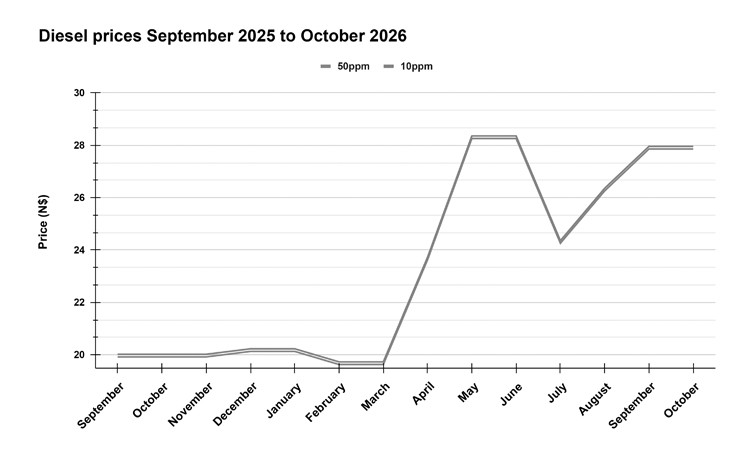
Industries, mines and energy minister Modestus Amutse announced last Friday that fuel prices would be kept steady at N$27.86 and N$27.96 per litre for the two diesel types.
“We were especially worried about increasing the diesel price. We are quite aware that diesel is consumed by many factories and producers. We are a country that is advocating industrialisation so we had to come to this conclusion,” Amutse said.
Last week, the government kept diesel prices the same as September, despite the cost of importing increasing by over 13%.
However, diesel prices remain N$8 per litre higher than they were at the start of the year. Even though the price freeze is welcomed by industry players, others say the diesel dependent sector is already on its knees.
“At this stage it is a drop in the ocean,” Road Operation Tankers Association of Namibia (Rotan) executive director Rynier du Preez tells The Namibian.
“No transporter will survive if it does not increase its tariffs,” he says.
The transport tariffs that bulk fuel operators can charge are linked to pump prices and controlled by the industries ministry.
Some oil companies have accommodated their transporters with tariff adjustments, but the higher prices are being absorbed by the bulk fuel transporters and not passed on to customers, he says.
“Bulk fuel operators are under severe financial stress at present,” Du Preez says.
Oil prices have risen significantly since the United States (US) and Israel started their war on Iran, which closed the Strait of Hormuz, a key shipping passage for oil.
The Namibian construction industry is also under pressure, as high diesel prices increase the cost of operating equipment and material delivery costs.
Construction Industries Federation chief executive Bärbel Kirchner tells The Namibian that the federation welcomes the decision to keep diesel prices unchanged for October.
“Construction relies heavily on diesel for machinery, earthmoving equipment and transporting building materials. Avoiding another increase provides some breathing space, although it does not reverse the substantial cost increases experienced since February,” Kirchner says.
In February, the cost of diesel 50ppm was N$19.63 and diesel 10ppm was N$19.73. Now it’s at N$27.86 and N$27.96.
According to Kirchner, smaller contractors are particularly vulnerable.
“Where contracts do not adequately provide for fuel price adjustments, contractors must absorb these increases, squeezing margins and straining cash flow,” she says.
She calls on the City of Windhoek to pause the implementation of access permits for heavy vehicles, as these “compound the burden” felt by the industry.
Cirrus Capital economist Ida Williams says businesses have been under pressure since the first fuel price increases earlier this year.
“Compared to January 2026, petrol prices are up 29.2% and diesel up 37.7%. The relief is that the diesel price will not rise but the damage has effectively been done and will continue to be done as long as fuel prices remain elevated,” Williams says.
She says most industries in the country are negatively impacted by higher fuel prices, but singled out transport and logistics, agriculture and mining as particularly affected sectors.
“Most transport and logistics companies operate on or very close to the maximum level of efficiency they can manage, so there is little space for efficiency gains that would lower fuel requirements,” she says.
This has a ripple effect on all other companies in the country as transport companies move their goods.
In the agricultural and mining sectors, most machinery runs on diesel.
“[In mining operations] haul trucks, excavators and generators run on it around the clock, so fuel is a major operating cost and a 40% increase adds up quickly in absolute terms,” Williams says.
“October’s prices provide some relief, but businesses have been feeling the price pressure since the first hikes,” she says.