





• Anya Links’Die Stoep’, a debut performance by emerging playwright and director Jonathan Sasha, was showcased at the National Theatre of Namibia (NTN)’s Backstage from 31 October to 2 November.
Having watched other productions there before, I am not a fan of the Backstage theatre because the stage is too high, more suited to single-person shows and smaller productions, as well as the odd seating in the form of standard issue conference chairs, narrow aisles and the fact that few Backstage productions are accompanied by play programmes.
On the last night, ‘Die Stoep’ started 12 minutes late. This delay, however, afforded the audience an opportunity to study the preset before them in great detail, to the accompaniment of an excellent selection of langarm music spilling from the speaker system.
An elevated stage formed the of a colourful house front, Erf 8, Plaatjiesheuwel, Koës. Two windows on either side of a door faced the audience; one real, the other a mock-up. The stoep was decorated with a variety of potted succulents perched on welded plant stands, a little table, a bench, chair and a bed, all of which had seen better days.
The set spilled onto the floor below, which I thought was a charming strategy to bring the live performance closer to the audience. Naturally, it also extended the acting area beyond the stage.
Just below the stage was parked a real Volkswagen Golf in need of repair, which audience members could touch if they wanted. Stacked along the apron of the stage were used paint tins and brushes, an idle garden rake and to the right, also at audience level, a washing line and behind it, bathed in soft lighting, a small orchestra conducted by Vernon Sawyers.
It was clear great thought went into the set design to accurately depict the narrow circumstances of lower-income, working-class people.
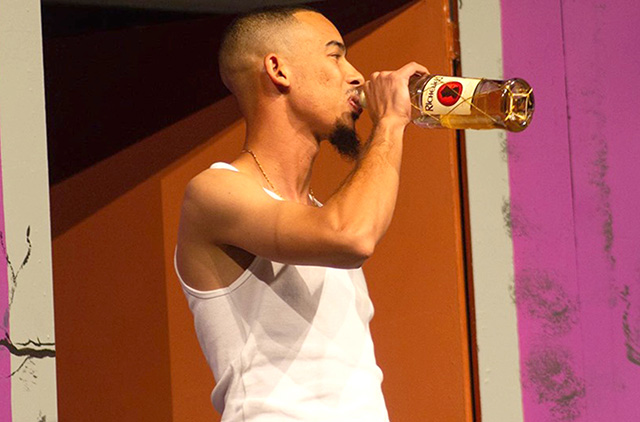
‘Die Stoep’ told the story of Jantjie, played by newcomer Rachardt Mostert, who lives with his sister, Sara, actress Bianca Heyns. As soon as he walked downstage, closer to the audience, Jantjie, who went shirtless for most of the play, consumed a large quantity of alcohol – to the growing annoyance and concern of his sister and her gay friend, Koba, brilliantly portrayed by Rodelio Lewis. Jantjie has a teenage son, Boetietjie (the talented Ethan Januarie), but is estranged from his son’s mother, Lucille, played by newcomer Chantal Kambrude.
Gradually, his relationships with everyone, including his sister, degenerate to the point that Sara can no longer keep house with him, and she chases him away. After losing his job, Jantjie returns to the house and on the decides to end his life, hanging himself in the living room, where his sister discovers his body. The play concluded with his funeral.
In an interview with Namib Insider shortly before opening night, Sasha said that he had purposefully cast first-time actors such as mathematics teacher Mostert, design student Kambrude, Petrus Majiedt (Dominee Pieters), Januarie and paramedic Jan-Dre van Vuuren (Ouderling Tina) to make way for new faces in the theatre industry. Although his intentions were noble, I am of the opinion that the lead role of Jantjie needed a more experienced actor with the required gravitas and charisma to be the play’s star and anchor, both humorous and tragic. The weakness of Mostert as Jantjie inadvertently turned Koba into the show’s star, and grounded the play around female lead Heyns.
Similarly, Majiedt, supposedly the ‘moral man’ in the play, lacked both substance, confidence and presence to have been a credible polar opposite to Jantjie. Kambrude had on-stage presence but very few lines and a limited repertoire of acting skills. Most of the actors, with the exception of Lewis, struggled to interpret, embody and enliven their roles.
Aside from excellent music, great lighting work (on cue with professional black-outs) and a stunning set, there were uncomfortable silences in the dialogue where up to almost 20 beats were missed before the next line was delivered.
Fortunately, experienced actor Lewis managed to energise both the dialogue and the pace of the play. The dialogue was also peppered with profanity, primarily directed at female genitalia which cannot be reproduced in this review, which didn’t serve any purpose except to, perhaps, elicit sharp intakes of breath and laughs from the uncomfortable audience. Sasha gambled on profanity for the sake of authenticity and lost the plot; the dialogue degenerated into a series of angry exchanges.
There were also gaps in the progression of the story; it’s still a mystery why Jantjie became an alcoholic. His reasons for committing suicide, similarly, weren’t obvious and minimised the significance of the event itself. To the surprise of the audience, it was revealed during a confrontation with Jantjie that Sara is unmarried and childless. The lack of background information about the characters resulted in very little sympathy for them. At a critical point in the plot, Jantjie and Koba square off as if to physically fight; Jantjie intent on defending his masculine identity against Koba’s fluidity of expression. I believe Sasha didn’t recognise the significance of this scene and consequently failed to enhance the quality of his play.
My overall impression of ‘Die Stoep’ was that it lacked balance, dissonance, character and finesse, but Sasha must be commended for this attempt to accurately portray the diversity of human experience that cannot be defined by gender, race or sexuality.
An important play in terms of representation of the often marginalised Coloured and LGBTI communities, the play explored important topics such as mental health, addiction and homophobia, which Namibian audiences are clearly hungry for, as evidenced by three well-attended shows.
Sasha was quoted saying “we laugh through our pain”. Except for Koba’s irreverent, tongue-in-cheek sense of humour, hardly any of the characters were comical in a dramatic sense, least of all the leads. Unfortunately, it appeared as if the audience had laughed at the characters in the play and not with them.

