


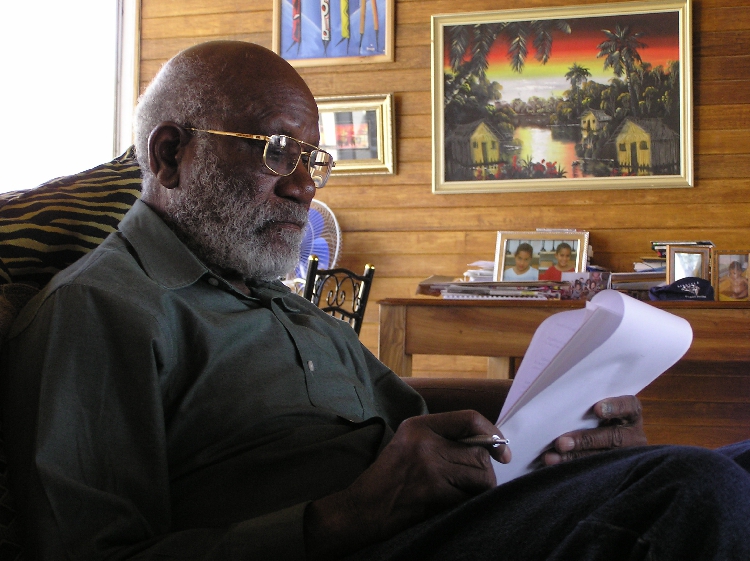
AS ACCUSED number 21 in the trial under the name of the state versus Tuhadeleni and 36 others, Andimba Toivo ya Toivo made a celebrated statement in the Supreme Court in Pretoria, South Africa, after he and 29 fellow Swapo members had been convicted of offences under the Terrorism Act.*
The so-called ‘Terrorism Trial’ was controversial and attracted international attention and criticism, with the Terrorism Act having been passed by the South African parliament after the arrest of Ya Toivo and his co-accused and made retroactive so that they could be prosecuted under it.
After the verdict was delivered on 26 January 1968, Ya Toivo addressed the court with a statement that would become a source of inspiration for the Namibian liberation struggle over the next 20 years and more. Ya Toivo’s message was defiant and damning against South Africa’s rule over Namibia, and confirmed his stature as a principled leader of his people.
“We find ourselves here in a foreign country, convicted under laws made by people whom we have always considered as foreigners. We find ourselves tried by a judge who is not our countryman and who has not shared our background. […]
“We are Namibians, and not South Africans. We do not now, and will not in the future, recognise your right to govern us, to make laws for us in which we have no say; to treat our country as if it were your property and us as if you were our masters. We have always regarded South Africa as an intruder in our country. This is how we have always felt, and this is how we feel now, and it is on this basis that we have faced this trial. […]
“We are far away from our homes; not a single member of our families has come to visit us, never mind be present at our trial. […] We have been cut off from our people and the world. […]
“The South African government has again shown its strength by detaining us for as long as it pleased, keeping some of us in solitary confinement for 300 to 400 days, and bringing us to its capital to try us. It has shown its strength by passing an act especially for us, and having it made retrospective. It has even chosen an ugly name to call us by. One’s own are called patriots, or at least rebels; your opponents are called terrorists. […]
“Many of our people, through no fault of their own, have had no education at all. This does not mean that they do not know what they want. A man does not have to be formally educated to know that he wants to live with his family where he wants to live, and not where an official chooses to tell him to live; to move about freely, and not require a pass; to earn a decent wage; to be free to work for the person of his choice for as long as he wants; and finally, to be ruled by the people that he wants to be ruled by, and not those who rule him because they have more guns than he has.
“Our grievances are called ‘so-called’ grievances. […]
Only one who is not white and has suffered the way we have can say whether our grievances are real or ‘so-called’.
“Those of us who have some education, together with our uneducated brethren, have always struggled to get freedom. This idea of our freedom is not liked by South Africa. It has tried in this court to prove through the mouths of a couple of its paid chiefs and a paid official that Swapo does not represent the people of South West Africa. If the government of South Africa were sure that Swapo did not represent the innermost feelings of the people of South West Africa, it would not have taken the trouble to make it impossible for Swapo to advocate its peaceful policy. […]
“Your government, my lord, undertook a very special responsibility when it was awarded the mandate over us after the First World War. It assumed a sacred trust to guide us towards independence, and to prepare us to take our place among the nations of the world.
“We believe that South Africa has abused that trust because of its belief in racial supremacy (that white people have been chosen by God to rule the world) and apartheid. We believe that for 50 years, South Africa has failed to promote the development of our people. Where are our trained men? The wealth of our country has been used to train your people for leadership, and the sacred duty of preparing the indigenous people to take their place among the nations of the world has been ignored. […]
“I do not claim that it is easy for men of different races to live at peace with one another. I myself had no experience of this in my youth, and at first it surprised me that men of different races could live together in peace. But now I know it to be true, and to be something to which we must strive.
“The South African government creates hostility by separating people and emphasising their differences. We believe that by living together, people will learn to lose their fear of each other. We also believe that this fear, which some of the whites have of Africans, is based on their desire to be superior and privileged, and that when whites see themselves as part of South West Africa, sharing with us all its hopes and troubles, then that fear will disappear. […]
“I have come to know that our people cannot expect progress as a gift from anyone, be it the United Nations or South Africa. Progress is something we shall have to struggle and work for. And I believe that the only way in which we shall be able and fit to secure that progress is to learn from our own experience and mistakes. […]
“We feel that the world as a whole has a special responsibility towards us. This is because the land of our fathers was handed over to South Africa by a world body. It is a divided world, but it is a matter of hope for us that it at least agrees about one thing – that we are entitled to freedom and justice. […]
“We do not expect that independence will end our troubles, but we do believe that our people are entitled – as are all peoples – to rule themselves. It is not really a question whether South Africa treats us well or badly, but that South West Africa is our country, and we wish to be our own masters.
“There are some who will say that they are sympathetic with our aims, but that they condemn violence. I would answer that I am not by nature a man of violence, and I believe that violence is a sin against God and my fellow men. Swapo itself was a non-violent organisation, but the South African government is not truly interested in whether opposition is violent or non-violent. It does not wish to hear any opposition to apartheid. […]
“Is it surprising that in such times my countrymen have taken up arms? Violence is truly fearsome, but who would not defend his property and himself against a robber? And we believe that South Africa has robbed us of our country. […]
“My lord, you found it necessary to brand me a coward. During the Second World War, when it became evident that both my country and your country were threatened by the dark clouds of Nazism, I risked my life to defend both of them, wearing a uniform with orange bands on it.
“But some of your countrymen, when called to battle to defend civilisation, resorted to sabotage against their own fatherland. I volunteered to face German bullets, and as a guard of military installations, both in South West Africa and the Republic, was prepared to be the victim of their sabotage. Today, they are our masters and are considered the heroes, and I am called the coward.
“When I consider my country, I am proud that my countrymen have taken up arms for their people, and I believe that anyone who calls himself a man would not despise them. […]
“I tried to do what I could to prevent my people from going into the bush. In my attempts, I became unpopular with some of my people, but this, too, I was prepared to endure. Decisions of this kind are not easy to make. My loyalty is to my country. My organisation could not work properly – it could not even hold meetings. I had no answer to the question: ‘Where has your non-violence got us?’ Whilst the World Court judgement was pending, I at least had that to fall back on. When we failed, after years of waiting, I had no answer to give to my people.
“Even though I did not agree that people should go into the bush, I could not refuse to help them when I knew that they were hungry. I even passed on the request for dynamite. It was not any easy decision. Another man might have been able to say ‘I will have nothing to do with that sort of thing’. I was not, and I could not remain a spectator in the struggle of my people for their freedom.
“I am a loyal Namibian, and I could not betray my people to their enemies. I admit that I decided to assist those who had taken up arms. I know that the struggle will be long and bitter. I also know that my people will wage that struggle, whatever the cost.
“We believe that South Africa has a choice – either to live at peace with us, or to subdue us by force. If you choose to crush us and impose your will on us, then you not only betray your trust, but you will live in security for only so long as your power is greater than ours. […]
“My co-accused and I have suffered. We are not looking forward to our imprisonment. We do not, however, feel that our efforts and sacrifice have been wasted. We believe that human suffering has its effect even on those who impose it. We hope that what has happened will persuade the whites of South Africa that we and the world may be right, and they may be wrong. Only when white South Africans realise this and act on it, will it be possible for us to stop our struggle for freedom and justice in the land of our birth.”
On 9 February 1968, Ya Toivo was sentenced to 20 years’ imprisonment. Imprisoned for the next 16 years, he was released on 1 March 1984.
In an age of information overload, Sunrise is The Namibian’s morning briefing, delivered at 6h00 from Monday to Friday. It offers a curated rundown of the most important stories from the past 24 hours – occasionally with a light, witty touch. It’s an essential way to stay informed. Subscribe and join our newsletter community.

The Namibian uses AI tools to assist with improved quality, accuracy and efficiency, while maintaining editorial oversight and journalistic integrity.
Stay informed with The Namibian – your source for credible journalism. Get in-depth reporting and opinions for
only N$85 a month. Invest in journalism, invest in democracy –
Subscribe Now!