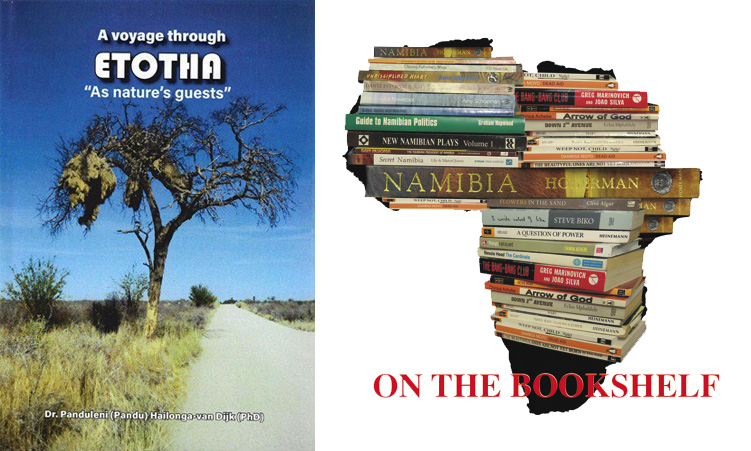
‘A Voyage Through Etotha ‘As Nature’s Guests’ ’ by Panduleni Hailonga-van Dijk is a book that reflects on and provides a detailed cultural analysis of Namibia’s Etosha National Park.
The book is written in an engaging style, relaying conversations between a group of Young Achievers who visit the park. The group is made up of young and old, locals and foreigners, who consider Etosha’s striking natural beauty and vast wildlife, and debate issues centred around its complicated colonial history and socio-economic challenges.
It is described as “both a celebration of Namibia’s natural splendor” and a deep exploration of the country’s “complex social realities”.
Hailonga-van Dijk traverses important themes such as identity, vision, decolonisation, youth empowerment, and the enduring shadows of historical injustice, through characters like Kapa, a wise and retired mentor, and Upi, a spirited and determined youth, who share their insights of Namibia’s history and culture.
“It is a call to honour the past while inspiring future generations to build a more informed, united and just nation. This book is for everyone who seeks to understand Namibia – its people, its history and its unbreakable spirit,” says Hailonga-van Dijk.
Born and raised in Katutura, Windhoek, in an area formerly known as the Ovambo location, Hailonga-van Dijk began her early education at Mandume Primary School, before attending Namutoni High School, Immanuel Shifidi Secondary School and Augustineum Secondary School.
“I began my professional journey in the health sector, working at Katutura and Central hospitals. I later pursued further studies in the United Kingdom and returned to Namibia, where I headed the health education and information, education, and communication unit under the health ministry,” she says.
Today, Hailonga-van Dijk is a seasoned public health expert and development professional with extensive international experience across southern Africa, Europe and Asia.
Armed with a doctorate in development studies and a master’s in health education, she brings scholarly weight to her advocacy.
“My passion lies in community development and youth empowerment. I believe deeply in supporting young people to recognise their agency, power and responsibility. This led me to found the Young Achievers Empowerment Project in 2004, which continues to inspire Namibian youth to pursue purpose-driven lives and make meaningful contributions to society.”
Young Achievers is an initiative born from the idea that knowledge creates better citizens, she says.
“I wanted to see change in my township, and after advocating with ministries and youth organisations I realised if I wanted to see a change I needed to be one bringing that change.
“We focused on reading, exposure, and helping young people in Katutura see beyond the walls society had built around them. Later, while living in Europe, I noticed how African countries were always portrayed as poor, as recipients of aid – never as agents of their own story.”
Hailonga-van Dijk says the seeds for ‘Etotha’ were planted during her time at the Centre for Global Education (1994-2006), an American exchange programme, where she taught critical thinking and facilitated comparative studies on apartheid in southern Africa and racism in the United States.
“I came to understand that both apartheid and systemic racism used education as a weapon to exclude and suppress black people. In Namibia, the Bantu education system deliberately withheld knowledge from us – books were banned, and learning was stifled.”
After losing both her mother and father in early childhood, Hailonga-van Dijk was raised by her stepmother and adopted father, as well as the broader Katutura community. During this time she says reading became her liberation.
“Books were my escape and my inspiration. I loved to read. Reading gave me wings. It allowed me to imagine a world far beyond the borders of my township – a place without a library or even a playground.”
She says the first book she read was ‘Uyuni UukwanaMpwiyuka’ by Namuhuya.
“At home, we only had three books – the Bible, a hymn book and this story. I was so hungry to read that I would retrieve discarded books from the trash.”
Many of the women in the area worked as domestic workers at the time, and Hailonga-van Dijk says they would bring her books from their employers.
“When they got books, they all said ‘give to Pandu, she loves reading’. I read voraciously. That spark of curiosity shaped my worldview. Weekly, I looked forward to the comic strip ‘Bollie’. Books allowed me to dream beyond Katutura,” she says.
This is in part what inspired her to write ‘Etotha’, which she describes as part of her contribution to the decolonisation of the African mind.
“It is a call to Namibians to ask the hard questions, although uncomfortable. Why despite spending a large part of the national budget on education, do we still have less than 40% of pupils making it beyond Grade12? If we are so rich in resources, why are our people unemployed? Why do we export all our raw materials, be it granite, diamond, gold, copper, uranium, steel, fish, and now oil, when we could create jobs by processing and adding value to our materials? Will we continue to be spectators watching our resources being taken out with our permission, while our people are starving? Will there be anything left for our children when they finally have the means to own and build?”
Hailonga-van Dijk says she wrote ‘Etotha’ mainly during evenings and over weekends, driven by an urgent desire to “decolonise the mind and share Namibian history in a way that would resonate with and educate our youth”.
The conversations in the book were drawn from discussions and events with the Young Achievers group, written largely from memory, says Hailonga-van Dijk.
“I didn’t originally set out to write a book during my travels; the idea came later, but once I began writing, the stories flowed naturally.”
Hailonga-van Dijk opted to self-publish ‘Etotha’, and while the book is engaging and educational, as a reader I would have liked to see photos of the group and their travels, putting faces to the personalities described, rather than generic images. The book could also have benefited from tighter editing in places. However, it is undoubtedly a worthwhile read, and Hailonga-van Dijk hopes it will be incorporated into the Namibian school curriculum from Grade 9 onwards, as she continues to advocate for youth education, empowerment and historical literacy.
She strongly believes Namibians and Africans should write their own stories.
“If we don’t, others will write a distorted version. Our history, identity and dignity depend on our own narratives. Yes, the journey is challenging – especially in terms of financing publication – but it’s worth it.”
Hailonga-van Dijk funded the printing of ‘Etotha’, and so far she says it has been well received.
“Readers appreciate its educational depth, especially its insights into Namibian history.”
As Hailonga-van Dijk continues to share ‘Etotha’ with readers across Namibia and beyond, her message is clear: history is not just something we inherit – it is something we choose to carry, challenge and reimagine.
“We must become the authors of our own stories,” she says, “not just for ourselves, but for those still to come”.
In the vast, wind-swept silence of Etosha’s plains, her characters speak truths that echo far beyond the park’s borders – truths about identity, injustice and the power of reclaiming narrative.
‘Etotha’ is not just a book; it is a journey through memory, a lesson in courage, and a call to the youth of Namibia to see, to question and to rise.
– Copies are available from Hailonga-van Dijk (e-mail: bartisurre@gmail.com), as well as at Namibia Book Market and Swakopmund Buchhandlung.