



THE deaf community in Namibia has bemoaned the unfair treatment they claim they are subjected to due to the lack of understanding and respect for their culture.
The community says its members are often regarded as second-class citizens, something which they say makes it difficult to access several services and exercise rights to freedom of expression and opinion.
Director of the Namibian National Association of the Deaf, Paul Nanyeni in a recent interview in Windhoek, said some terms used against them are derogatory.
“Many people in Namibia actually use the word hearing-impaired, deaf and dumb. We need to get rid of those words and use the word deaf and hard of hearing. Any other terminologies do not go well with our deaf culture,” he told The Namibian.
Nanyeni noted that even some schools catering for deaf people are referred to as ‘school for the hearing impaired’.
“They named it the school for the hearing-impaired, but that is not a good word in our deaf culture; we just want it to be ‘the school for the deaf,” he said.
Namibian sign language (NSL) is taught in six schools that cater for the deaf nationwide.
Namibia has ratified the United Nations Convention On The Rights Of Persons With Disabilities, which calls for the recognition and promotion of sign language.
Nanyeni said the deaf community would like the government to recognise NSL as one of the country’s official languages and for it to be taught as a formal language in schools.
He said the recognition of sign language as an official language would be a big step towards an all-inclusive Namibian society.
“We demand that our language be recognised because right now we feel neglected and marginalised. We want to feel we are part and parcel of the people living in Namibia and we can fully participate in events that are happening in our country,” he said.
Expressing displeasure on Cabinet’s decision to moot the introduction of KiSwahili as an official language in Namibia, Nanyeni said the government should first look after the interests of deaf citizens before opening the door to foreign languages.
“We want to know why our proposal to have sign language recognised as an official language was rejected,” he said.
“Why would they implement Swahili before sign language? The government should be progressive and recognise sign language so that it can be taught in all schools,” he added.
In July this year Cabinet made the decision to explore introducing Kiswahili into the Namibian school curriculum and for it to become one of the country’s official languages.
The decision received support from many, including the Teachers Union of Namibia and former president Hifikepunye Pohamba.
Nanyeni also urged parents with deaf children to learn to sign in an effort to form a stronger relationship with them.
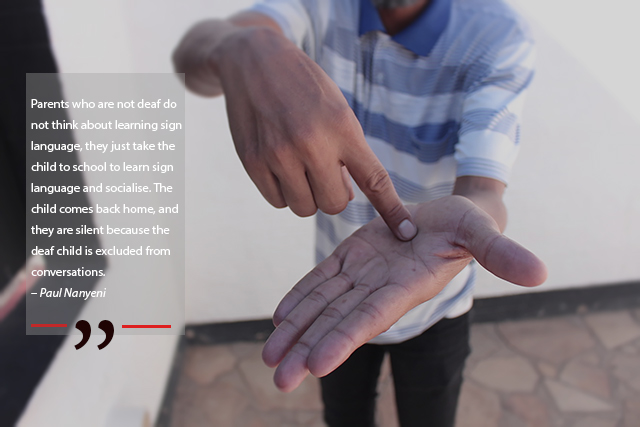
“Parents who are not deaf do not think about learning sign language, they just take the child to school to learn sign language and socialise. The child comes back home, and they are silent because the deaf child is excluded from conversations,” he said.
Nanyeni said parents’ inability to communicate with their deaf children becomes a burden for teachers as they are given a dual role of being a parent and a teacher at the same time.
“How are children going to learn discipline and know what is right and wrong when nobody knows how to talk to them? They drag the child to school so that the teacher can take up the responsibility of parenting and installing discipline in them,” he said.
Expressing similar sentiments, Teachers Union of Namibia president Mahongora Kavihuha said he finds it appalling that sign language is yet to be implemented in mainstream schools 30 years after independence.
“For the ministry not to recognise it and include it as a local language is discrimination of the highest order,” he said.
Kavihuha said conversations about inclusive education mainly pertain to pupils’ physical abilities and tend to neglect language elements.
He said the national implementation of sign language would be of great value to the deaf community in terms of social advancement and justice.
“They will start feeling being part of the Namibian society. They will start enjoying equal access to social benefits, issues of discrimination between the deaf and the hearing will be minimised and eventually social and economic opportunities will be realised,” he said.
He added that sign language should be implemented before any ideas of introducing Swahili to Namibian schools can be entertained.
“It is advisable to teach NSL only in schools where there are deaf pupils for them to practise the skills continuously. Additionally, it should be taught by a deaf adult who uses NSL as his/her mother tongue,” she said.
Steenkamp said deaf pupils learn NSL as a second language, with written English as a first language.
She added that the ministry intends to have NSL taught in inclusive schools that cater for deaf pupils.
In an age of information overload, Sunrise is The Namibian’s morning briefing, delivered at 6h00 from Monday to Friday. It offers a curated rundown of the most important stories from the past 24 hours – occasionally with a light, witty touch. It’s an essential way to stay informed. Subscribe and join our newsletter community.

The Namibian uses AI tools to assist with improved quality, accuracy and efficiency, while maintaining editorial oversight and journalistic integrity.
Stay informed with The Namibian – your source for credible journalism. Get in-depth reporting and opinions for
only N$85 a month. Invest in journalism, invest in democracy –
Subscribe Now!