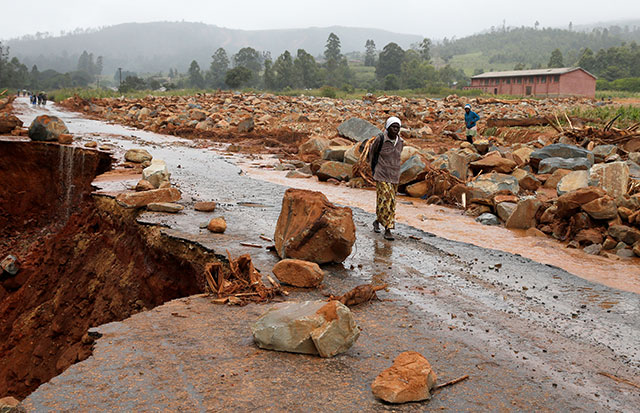
BEIRA — The death toll in Mozambique on Saturday rose to 417 after a cyclone pummelled swathes of the southern African country, flooding thousands of square kilometres, as the UN stepped up calls for more help for survivors.
Cyclone Idai smashed into the coast of central Mozambique on Friday 15 March, unleashing hurricane-force winds and rains that flooded the hinterland and drenched eastern Zimbabwe, leaving a trail of destruction.
The new numbers take the combined death toll of the two neighbouring countries to 676.
The UN, warning of more suffering, stepped up calls for help in Mozambique as aid agencies struggle to assist tens of thousands of people battered by one of southern Africa’s most powerful cyclones.
More than a week after the storm lashed Mozambique with winds of nearly 200 kilometres per hour, survivors are struggling in desperate conditions – some still trapped on rooftops and those saved needing food and facing the risk of outbreaks of disease, such as cholera.
“The situation will get worse before it gets better,” Unicef executive director Henrietta Fore said on Saturday.
“Aid agencies are barely beginning to see the scale of the damage,” she said adding that “entire villages have been submerged, buildings have been flattened, and schools and healthcare centres destroyed”.
The World Food Programme late on Friday night declared the flood crisis a level three emergency, putting it on a par with crises in Yemen, Syria and South Sudan.
“The designation will accelerate the massive operational scale-up now underway to assist victims of last week’s Category 4 cyclone and subsequent large-scale flooding that claimed countless lives and displaced at least 600 000 people,” said WFP spokesman Herve Verhoosel.
More than two million people have been affected in Mozambique, Zimbabwe and in Malawi. The storm started as a tropical depression causing flooding which killed 60 and displaced nearly a million people.
“Now that the world is beginning to grasp the scale of devastation and despair in the wake of Cyclone Idai, we as an international community are at a crucial moment to act,” Verhoosel said.
Humanitarian agencies are racing against the clock to help people, many of whom have not had a meal in days.
Poor sanitary conditions mean disease is now a real concern.
“Already, some cholera cases have been reported in (the port city of) Beira along with an increasing number of malaria infections among people trapped by the flooding,” the International Federation of the Red Cross said in a statement.
Aid group Doctors Without Borders said people were also at risk of respiratory infections such as pneumonia.
“We are living an unprecedented natural disaster. A disaster that only matches major disasters,” said lands and environment minister Celso Correia.
Districts west of Beira resemble an inland lake, and thousands of people are still trapped on rooftops and in trees where they sought to escape the flood waters.
The town of Buzi across the estuary south-west of Beira “has reportedly disappeared, with the water as high as the palm trees,” the International Committee of the Red Cross (ICRC) said.
“This… is a catastrophe,” said prime minister Carlos Antonio do Rosario.
Although water levels are slowly going down, according to the government, the UN humanitarian agency warned of fresh flooding if more rains fall.
“The Zambezi River is essentially in flood currently, it’s very high .. there are lots of rain in the highlands. The more that flows down to the Zambezi the more likely that is going to break its banks and we will have a second flooding emergency,” said Sebastian Stampa, an OCHA coordinator.
Nearly 90 000 people are already in shelters in central Mozambique.
– Nampa-AFP
In an age of information overload, Sunrise is The Namibian’s morning briefing, delivered at 6h00 from Monday to Friday. It offers a curated rundown of the most important stories from the past 24 hours – occasionally with a light, witty touch. It’s an essential way to stay informed. Subscribe and join our newsletter community.

The Namibian uses AI tools to assist with improved quality, accuracy and efficiency, while maintaining editorial oversight and journalistic integrity.
Stay informed with The Namibian – your source for credible journalism. Get in-depth reporting and opinions for
only N$85 a month. Invest in journalism, invest in democracy –
Subscribe Now!