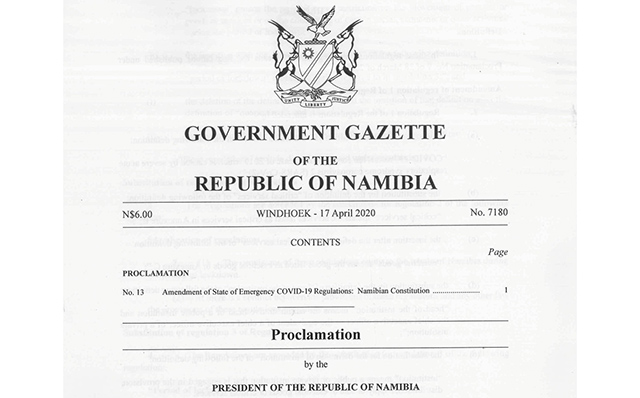
THE spreading of fake news about the new coronavirus and Covid-19 is now a crime in Namibia, following an amendment to the Covid-19 state of emergency regulations.
In terms of amendments to the regulations, published in the on Friday, people publishing any false or misleading statement in connection with the coronavirus disease (Covid-19), including on social media, are committing an offence for which they can be fined up to N$2 000 or be given a prison term of up to six months.
It is also now an offence to publish any statement in the media, including on social media, that is intended to deceive people about the Covid-19 status of someone or about measures to combat, prevent and suppress the coronavirus disease, the changed regulations state. This can also be punished with a fine of up to N$2 000 or up to six months’ imprisonment.
The newly published regulations expand the lockdown that had been applying to the Khomas and Erongo regions since 28 March, by including all of the country under the restriction of travelling over certain regional boundaries.
While the regulations also broaden the prohibition of trading in alcohol by forbidding the purchase of liquor, it at the same time now excludes drinks with an alcohol content of less than 2,5% by volume – such as light beer – from that prohibition. In the first state of emergency regulations, published on 28 March, only the selling of alcohol was prohibited, with no distinction made with regard to the alcohol content of drinks classified as liquor.
On the economic front, the amended regulations include mining and fishing among “critical services” allowed to continue during the country’s state of emergency in response to the Covid-19 pandemic. In the initial state of emergency regulations, only maintenance related to fishing and mining activities was classified as critical services, with the effect that fishing and mining in Namibia were brought to a standstill over the past three weeks.
With the extension of the lockdown to include all of Namibia’s regions, the country has been divided into 10 zones, with no travel across the boundaries of each zone allowed from 18 April until the end of the extended lockdown period on 5 May.
The separate zones are the Khomas region, together with the local authority areas of Rehoboth and Okahandja; the Erongo region; the //Kharas region; Hardap; Kunene; Zambezi; the two Kavango regions; Otjozondjupa and Omaheke as one zone; Ohangwena, Oshana and Oshikoto as one zone; and Omusati.
People needing to travel over the boundaries of the designated zones would need to be certified as critical or necessary service providers or would have to obtain a permit allowing them to travel across the zones’ boundaries.
* More details in the next edition of .
In an age of information overload, Sunrise is The Namibian’s morning briefing, delivered at 6h00 from Monday to Friday. It offers a curated rundown of the most important stories from the past 24 hours – occasionally with a light, witty touch. It’s an essential way to stay informed. Subscribe and join our newsletter community.

The Namibian uses AI tools to assist with improved quality, accuracy and efficiency, while maintaining editorial oversight and journalistic integrity.
Stay informed with The Namibian – your source for credible journalism. Get in-depth reporting and opinions for
only N$85 a month. Invest in journalism, invest in democracy –
Subscribe Now!