



Voters in coup-prone Guinea-Bissau cast their ballots on Sunday to choose a new president, hoping to turn the page on endemic political turmoil despite the main opposition party being barred from the race.
Around 860 000 voters will choose between 12 presidential candidates, with stability a major issue given the multiple political crises that have rocked the west African nation since its independence from Portugal in 1974, including four coups and numerous attempted coups.
At the top of the list of demands for many is improved living conditions, including better healthcare, education and infrastructure.
Guinea-Bissau’s population of some 2.2 million people is also calling for more jobs and reforms to combat poverty, corruption and drug trafficking.
With nearly 40% of the population living in extreme poverty, Guinea-Bissau is among the world’s poorest countries.
It is also a hub for drug trafficking between Latin America and Europe, a trade fuelled by the country’s long history of political instability.
Polling stations opened at 7h00 and are scheduled to close at 17h00. First results are expected no later than Thursday.
Alamar Bidinthile (40) says he is voting for “change” and “stability”. Construction worker Mayo Sa (53) says: “I have been voting since I was young, but there has been no change in the country. I hope this time that won’t be the case.”
Incumbent president Umaro Embalo (53) is favoured to win in the first round. If he succeeds, he will become the first head of state to serve two consecutive terms since the introduction of the multiparty system in 1994.
His biggest opponent is opposition candidate Fernando Dias, who has received the support of the powerful PAIGC opposition party, which was barred from the election.
The vote marks the first time in Guinea-Bissau’s history that the PAIGC, which led the former Portuguese colony to independence in 1974 and was the country’s longstanding single party, will be absent from the ballot.
The party and its leader, Domingos Pereira, who only recently returned from exile, were disqualified from running after the Supreme Court ruled that its legislative and presidential applications had been submitted after the deadline.
‘MANIPULATION’
Pereira and Embalo are political arch-rivals: The last presidential election in 2019 was marked by a four-month post-election crisis as both men claimed victory.
Sunday’s elections will also see voters choose all 102 members of parliament.
In 2023, Embalo dissolved the legislature — which was dominated by the opposition — and has since ruled by decree.
The opposition says the PAIGC’s exclusion from the presidential and parliamentary elections amounts to “manipulation” and maintains that Embalo’s term expired on 27 February, five years to the day after his inauguration.
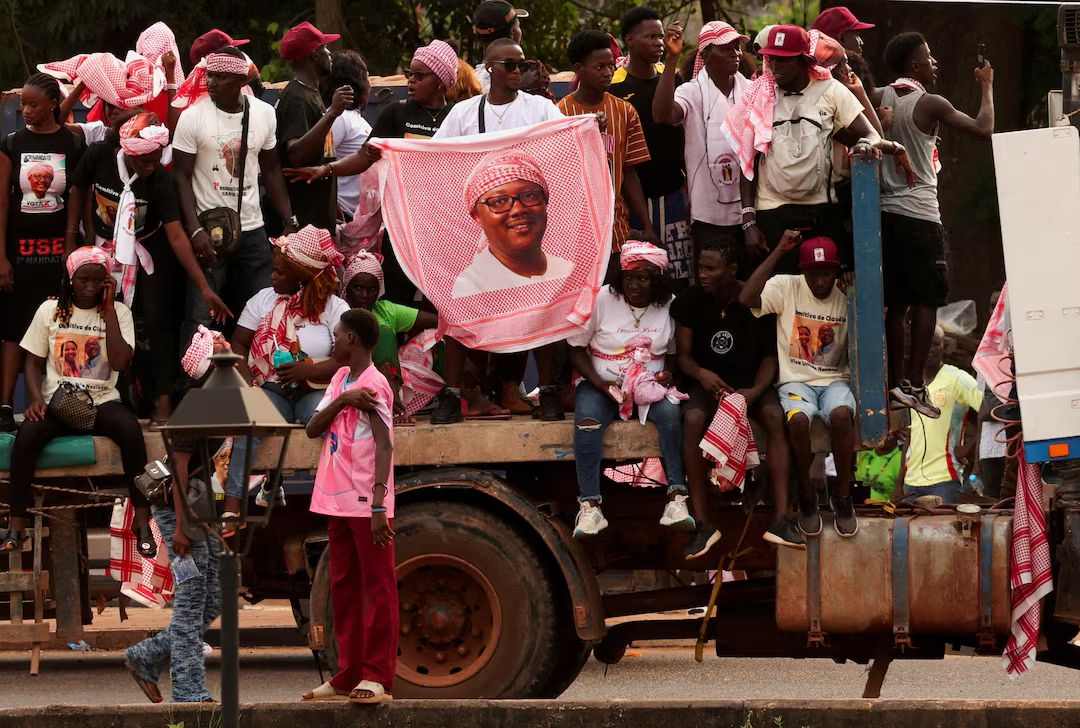
Despite the tumult, the three-week campaigning period unfolded with a festive atmosphere and concluded on Friday without any major incidents or violence.
Lucia Bird, an expert at the Global Initiative Against Transnational Organised Crime, says “in Guinea-Bissau, problems usually arise after elections”.
She says she fears that, as in 2019, allegations of irregularities will occur after the vote.
More than 6 780 security forces, including from the Economic Community of West African States Stabilisation Force, have been deployed for the vote and the post-election period.
Guinea-Bissau’s air space, as well as land and sea borders, will be closed all day on Sunday.
In an age of information overload, Sunrise is The Namibian’s morning briefing, delivered at 6h00 from Monday to Friday. It offers a curated rundown of the most important stories from the past 24 hours – occasionally with a light, witty touch. It’s an essential way to stay informed. Subscribe and join our newsletter community.

The Namibian uses AI tools to assist with improved quality, accuracy and efficiency, while maintaining editorial oversight and journalistic integrity.
Stay informed with The Namibian – your source for credible journalism. Get in-depth reporting and opinions for
only N$85 a month. Invest in journalism, invest in democracy –
Subscribe Now!