



NOT ONLY financial and administrative constraints, but also incompetence, has come out into the open as Namibia’s preparations for the Tokyo Olympic Games intensify.
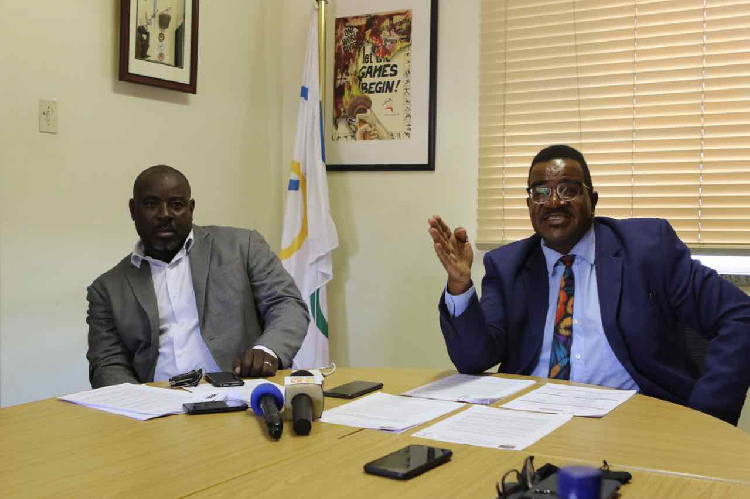
At a press conference at the Namibia National Olympic Committee headquarters in Windhoek on Wednesday, members of the NNOC, sport federations and the Namibia Sports Commission discussed their problems in preparing for the Olympics, with lack of funding being the main constraint.
Boxer Jonas Jonas became the latest Namibian to qualify for the Olympics when he won a gold medal at the African Championships in Dakar last week, but the president of the NNOC, Abner Xoagub said they had hoped to send more boxers.
“It was good that Jonas qualified, but bad in the sense that we wanted to send a bigger team. The Namibia Boxing Federation wanted to send five more boxers to Dakar, but because of limited resources we could only send three who were already on Olympic Solidarity bursaries.
"We want to be able to assist, but we don’t have the resources and it’s tough for athletes who are not supported by Olympic Solidarity,” he said.
The secretary general of the NNOC, Joan Smit, said Jonas, marathon athlete Helalia Johannes and rower Maike Diekmann who were all on Olympic Solidarity programmes had already qualified for the Olympics. The NNOC is continuing to assist them in their preparations, while they are also assisting other athletes who are still trying to qualify.
They include mountain bike riders Tristan de Lange and Michelle Vorster, who are both on Olympic Solidarity scholarships and are attending qualifying events in South Africa and Europe.
Marathon runner Thomas Reinhold will compete at a qualifying event in Durban; wrestler Romeo Goliath will compete at the African Championships in Morocco later this month; swimmers Phillip Seidler and Alexander Skinner will compete at qualifying events in Japan and South Africa respectively, and 200m and 400m athlete Beatrice Masilingi will compete at qualifying events in South Africa and Germany.
“The Olympic Committee can only offer support to get the athletes to the qualifying events, but much more support is needed,” she said.
According to Xoagub they started preparing for Tokyo four years ago.
“When we returned from Rio 2016 we started preparing and put together a budget that we shared with the ministry and the Namibia Sports Commission. We asked the federations to identify promising athletes, but initially we didn’t get much feedback and some names were only submitted about two years later,” he said.
“But the federations don’t have the resources to identify upcoming talent, because most of them are volunteers and they are doing their best. Some of them have difficulty even to stage national events, because they don’t have money, but then again, I’ve also seen many other codes being active and hosting competitions, so we need to thank the parents and the private sector for their efforts,” he added.
He said their budget for the Olympic Games still had to be approved.
“We discussed our participation at the Tokyo Olympics with the ministry at a meeting in February where we laid out our needs, but we still need to get feedback. Maybe we will hear something when the new national budget is presented in April. We hope to send a team of about 10 to 12 athletes, or if not, then a smaller team,” he said.
The secretary general of the Namibia Paralympic Committee, Mike Hamukwaya said they received no support from the International Paralympic Committee, and they depended on the government and their main sponsor, NamPower.
So far they have gained only one spot for the Tokyo Paralympic Games, after Johannes Nambala won a gold and a bronze medal at the IPC World Championships in Dubai last year.
Hamukwaya, however, hoped that more athletes could still qualify.
“We have an important qualifying competition coming up in South Africa, the SASAPD championships from 24 to 31 March, but we are still struggling with funding to send a team. It’s one of the last qualifying events and good performances will improve their world rankings and chances of making the Paralympics,” he said.
The financial manager of the Namibia Sport Commission, Junias Hamalwa, said they were doing their bit to help the athletes.
“We support the initiatives from the federations. We put flesh on whatever request is given to us and then we give it to the government and wait for their response. But our mandate is to concentrate on development, while the NNOC deals with elite athletes, so we must make sure that there are always new athletes coming through,” he said.
Harald Fulle, the CEO of the Namibia Premier League, as well as a member of the NNOC, however, refuted Hamalwa’s claims.
“I don’t know when last any federation got any supporting fees from the Sport Commission. The government is not doing anything for the federations,” he said.
Xoagub, meanwhile, concluded, that they had achieved a lot with limited resources.
“What we’ve achieved with limited resources is actually amazing, it’s a miracle.”