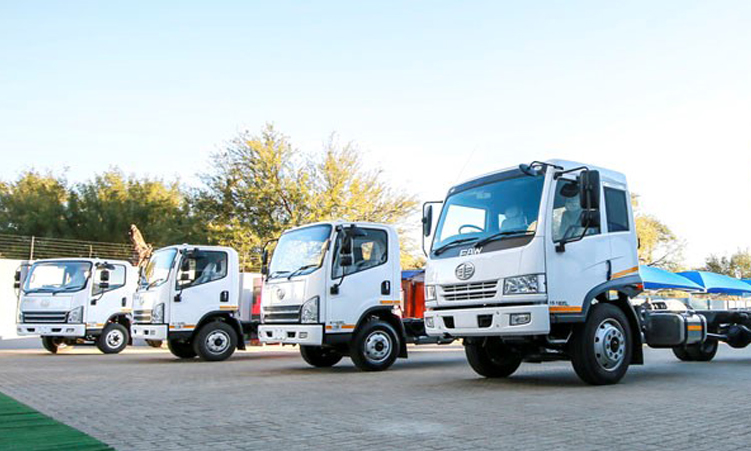
Commercial vehicles were the primary drivers of vehicle sales in June, with 597 units sold.
This accounts for 60,1% of total sales.
According to Simonis Storm Securities economic researcher Halleluya Ndimulunde, 6 361 units were sold in the first half of this year, slightly below the 6 441 units sold in the same period of 2023, but surpassing pre-pandemic levels.
“Vehicle sales have demonstrated continued resilience in recent months, signalling a shift in sentiment towards a more positive outlook compared to previous years,” she said.
Ndimulunde further said vehicle sales increased in June 2024 to 993 from 966 units in May. This represents a 2,8% month-over-month (m-o-m) growth. However, this was a drop from the 1 320 units sold in June 2023, reflecting a 24,8% decrease year-over-year (y-o-y).
Despite this, June 2024 marked the third-highest monthly sales figure this year. Additionally, rental agencies purchased 54 units in June 2024, she said.
Light commercial vehicles saw a year-over-year decrease of 22%, dropping from 657 units in June 2023 to 510 units in June 2024 while medium commercial vehicles experienced a slight decline, from 27 units in June 2023 to 21 units in June 2024, indicating relative stability in this category.
According to the researcher, heavy commercial vehicle sales increased 36% y-o-y, rising from 11 units in June 2023 to 15 units in June 2024.
“This is, however, a decline from the 20 units sold in the previous month, possibly indicating fluctuating demand for larger commercial vehicles due to heightened industrial activities,” she said.
Extra heavy vehicles remained steady, with a slight increase from 44 units in June 2023 to 45 units in June 2024, marking the highest sales since August 2023.
The researcher said six buses were sold in June 2024, compared to just one in June 2023, while passenger vehicles sales totalled 396 units in June 2024, down from 460 in May 2024 (-13,9% m-o-m) and 580 units in June 2023 (-31,7% y-o-y).
“This represents the lowest monthly sales since July 2022, highlighting economic pressures such as inflation that is still elevated and high interest rates.
“These economic pressures have significantly impacted household spending, particularly in the automotive sector,” said Ndimulunde.
She said in the first quarter of 2024, the transport and storage sector expanded by 7,6%, slightly lower than the 8,1% growth seen in 2023, yet contributing 3,5% to gross domestic product (GDP), its highest since late 2018.
“Despite its modest GDP share compared to other tertiary sectors, transport remains pivotal in driving economic activity. It supports sectors like retail, mining and tourism by facilitating the efficient movement of goods and travel infrastructure,” noted the researcher.
Vehicle sales in the first quarter of 2024 reached 3 503 units, an 11,8% increase from the previous year, marking the strongest first quarter since 2016. This uptick reflects improved consumer confidence and boosts economic activity across automotive retail, finance and related services.
The increase in vehicle sales not only signals a recovery in consumer confidence, but also stimulates growth in the automotive sector, which in turn fuels private credit extension, particularly in instalment and leasing categories. – email: matthew@namibian.com.na
In an age of information overload, Sunrise is The Namibian’s morning briefing, delivered at 6h00 from Monday to Friday. It offers a curated rundown of the most important stories from the past 24 hours – occasionally with a light, witty touch. It’s an essential way to stay informed. Subscribe and join our newsletter community.

The Namibian uses AI tools to assist with improved quality, accuracy and efficiency, while maintaining editorial oversight and journalistic integrity.
Stay informed with The Namibian – your source for credible journalism. Get in-depth reporting and opinions for
only N$85 a month. Invest in journalism, invest in democracy –
Subscribe Now!