I cannot – or at least I think I cannot – exist without coffee. I tried to omit coffee from my life altogether on quite a few occasions, but I have always failed.
So now I have made peace with the fact that I adore coffee. And as a result, life has been much less complicated.
The obvious reason for my attachment to coffee would be caffeine. Caffeine is found in many other beverages such as tea, but I have no real affinity for any of these.
No. I am attached to coffee for many other reasons.
I find the subject of coffee almost as addictive as the substance itself.
Here are some facts every (potential) coffee lover should know by heart.
Of 124 species of the genus Coffea, only two are grown and consumed commercially. They are: Coffea Arabica and Coffea canephora, better known as Robusta.
Of the two species, Robusta is more hardy and cheaper to grow, yet is considered less tasty. Hence Arabica is considered the best tasting and therefore the most consumed coffee on earth.
Quite a few factors are believed to affect the final flavour of coffee.
The first is the altitude of where the coffee is grown. Especially when the altitude combines with latitude to produce cold climates at high altitude. Colder climates produce better tasting coffee.
Second, it is also believed that coffee grown under shade trees is of better quality than coffee grown in direct sunlight. Although there is no scientific proof for differences in taste between the two, coffee produced in direct sun requires more inputs such as fertiliser to be successful. Shade trees add leaf matter to soil, which means that it produces its own fertiliser and its root structures help prevent soil erosion. Finally, shade trees add to biodiversity: From ants to birds. This is good in itself, but does not add to the quality of the coffee.
The coffee we drink is a seed inside a fruit. The coffee fruit usually produces two opposing seeds that press against each other during the growing time. As a result, the coffee fruit produces two flat-faced seeds. But for reasons unknown still, a significant proportion of fruits produce one round seed only (estimates vary from around 4 to 8%). These round beans are called peaberries and are a much sought-after commodity in some coffee drinking circles and usually fetch much better prices than ordinary flat-faced berries. Here too is no real scientific data to suggest the difference in taste is real.
To prepare the coffee seeds for roasting and thus ultimately for international commerce and getting it into a drinkable format, the seeds have to be extracted from the fruits. This process, called cherry processing, involves getting rid of moisture and sugars in the fruits before extracting the bean.
There are three common methods of cherry processing: Natural, pulped natural and washed. During the natural process, the entire fruit remains intact while the seeds are dried. During the pulped natural process, the fruit’s pulp (skin and fleshy pulp) is removed before the seeds are dried. The seeds’ mucilage and parchment remains intact. During the washed process, the skin and pulp and mucilage are removed with water before the seeds are dried. It is believed that these different methods have an influence on the final taste of the coffee.
To summarise factors that are likely to have an influence on how your coffee taste: Genetic make-up, elevation (and temperature), pests/diseases, cherry processing, drying, sorting and storage.
There is an estimated 26 million coffee farmers in the world that farm coffee in 87 countries. Unlike wine, the soil or terrior of the coffee does not seem to hold much significance for taste any more.
I hope these few facts showed just how complex a foodstuff coffee really is.
I am hooked: On the product as well as the story. In a next edition of this column, we will review a few of the methods used to brew coffee.
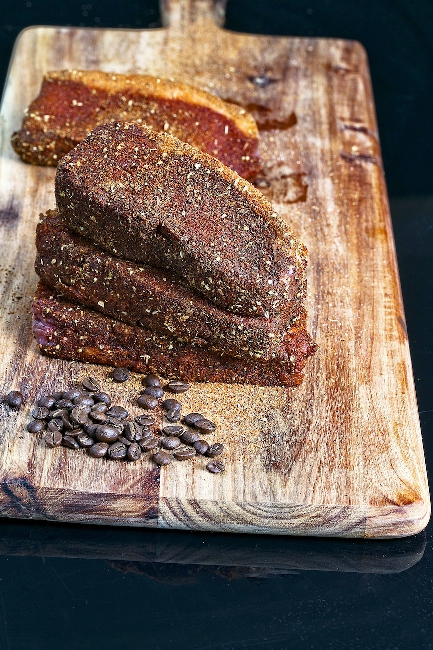
Using coffee as an ingredient and flavouring agent for savoury cooking is hugely popular these days. Here is a simple recipe for a coffee-based rub for steaks or chops.
Happy cooking!
Ingredients
• 2 tablespoons chilli powder
• 2 tablespoons finely ground
coffee beans
• 5 teaspoons dark brown sugar
• 11⁄2 teaspoons dried oregano
• 11⁄2 teaspoons freshly
ground black pepper
In an age of information overload, Sunrise is The Namibian’s morning briefing, delivered at 6h00 from Monday to Friday. It offers a curated rundown of the most important stories from the past 24 hours – occasionally with a light, witty touch. It’s an essential way to stay informed. Subscribe and join our newsletter community.

The Namibian uses AI tools to assist with improved quality, accuracy and efficiency, while maintaining editorial oversight and journalistic integrity.
Stay informed with The Namibian – your source for credible journalism. Get in-depth reporting and opinions for
only N$85 a month. Invest in journalism, invest in democracy –
Subscribe Now!