



COASTAL communities in the Erongo region, which are home to about 75% of the region’s people, face a water crisis that has even been described by some as “unsurpassable”, considering the measures and money it would take to address it.
The communities are among the fastest growing in Namibia as thousands are attracted to coastal towns annually in search of better jobs and education opportunities.
This has increased pressure on water sources, a situation amplified by several thirsty uranium mines that tap from the same water sources, creating a scenario where even the current demand outstrips the available supply by millions of cubic metres a year.
Although the region’s water challenges have been coming on long, and are even being addressed in Namibia’s Vision 2030 and Harambee Prosperity Plan, the surge in urbanisation is compounding the challenge.
“The situation pertaining to the supply and demand for water may be described as critical, both in terms of human consumption and support of the economy and industry in the region,” Erongo governor Cleophas Mutjavikua, who is also the chairperson of the Erongo water forum, told The Namibian this week.
The Erongo water forum consists of experts, politicians and local authorities in the region.
Mutjavikua responded to the questions directed at the technical committee of the forum.
The latest coastal water consumption figures (from 2016) show that Swakopmund, Walvis Bay, Henties Bay and Arandis consume about 13 million cubic metres of water per annum (m3/a), while the potential use by mines (Langer Heinrich, Rössing, Husab and Trekkopje) – depending on whether they are in full production or not – was between 6,5 million and 24,5 million m3/a.
“This may be an underestimation,” Mutjavikua said.
Another one million m3/a by small users can be added to the total consumption.
Currently, the total estimated consumption (if Trekkopje activates its 10 million m3/a) is 38,5 million m3/a, and this figure excludes the growth of the towns and the possible establishment of other mines.
However, considering a 5% annual growth of towns, the forum predicts that the total consumption could reach 41,3 million m3/a by 2020 and 51,2 million m3/a by 2030.
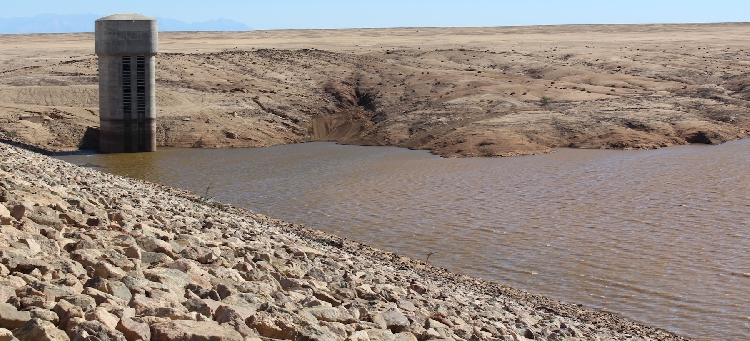
According to information from the forum, the coast (and mines) draw water from the Omdel Dam (3 million m3/a), Kuiseb River (7 million m3/a), and Areva Resources Namibia’s desalination plant (2,7 million m3/a). If in full production and with additional components installed, the latter could supply up to 25 million m3/a.
This means the total potential supply capacity of the natural sources and the privately owned desalination plant is about 35 million m3/a.
“It is clear that at present there is already higher consumption than the sources can sustainably support. It is also clear that the possible supply may not be sufficient to serve the demand if all sources are at maximum demand,” Mutjavikua said.
“Lastly, it is clear that there will soon be a considerable deficit of water in the region which may be considered unsurpassable unless additional sources of water are established.”
One of the main reasons the coast is finding itself in this predicament is the sharp increase in population at Swakopmund and Walvis Bay since independence.
NamWater identified this challenge in the early 1990s already and attempted on several occasions to establish a desalination plant to resolve the situation, without success for financial and technical reasons, according to Mutjavikua.
The ‘uranium rush’ from 2005 to 2008 due to the uranium price increase was also a major contributor to increased water demand.
“One should, however, immediately recognise that this development supported the economic growth of Namibia and that the mines contributed to the development of abstraction, storage and reticulation infrastructure, and probably even with power supply, albeit indirectly,” he explained.
With the uranium rush and the construction of the Swakopmund to Arandis pipeline, the Omdel dam also became a source for the mines, as the old pipeline from the Kuiseb aquifers to Rössing became non-operational for various reasons, one being the high risk involved in water abstraction due to the power and water lines being prone to damage during floods.
No effective inter-connectivity exists between the Omdel and Kuiseb supplies, thus the critical situations experienced at Walvis Bay every time a flood reached the abstraction areas. Should the Kuiseb flood again, Walvis Bay and all its industry would be exposed.
NamWater identified the demand for water to the mines and compensated by replacing the line from the desalination plant to Swakopmund with a line which can now carry the full Omdel supply and the full supply from the desalination plant.
There are also attempts to explore other sources or to expand the current ones, while the upgrading and maintenance of water supply infrastructure was also important.
Bigger challenges, however, include the integration of all water sources, including desalination present and future.
“The only other source considered economically viable is desalination of seawater, such as done by Areva Namibia. Given that the is in private ownership, the control of cost and security of supply needs to be established in a water agreement,” said Mutjavikua.
In an age of information overload, Sunrise is The Namibian’s morning briefing, delivered at 6h00 from Monday to Friday. It offers a curated rundown of the most important stories from the past 24 hours – occasionally with a light, witty touch. It’s an essential way to stay informed. Subscribe and join our newsletter community.

The Namibian uses AI tools to assist with improved quality, accuracy and efficiency, while maintaining editorial oversight and journalistic integrity.
Stay informed with The Namibian – your source for credible journalism. Get in-depth reporting and opinions for
only N$85 a month. Invest in journalism, invest in democracy –
Subscribe Now!