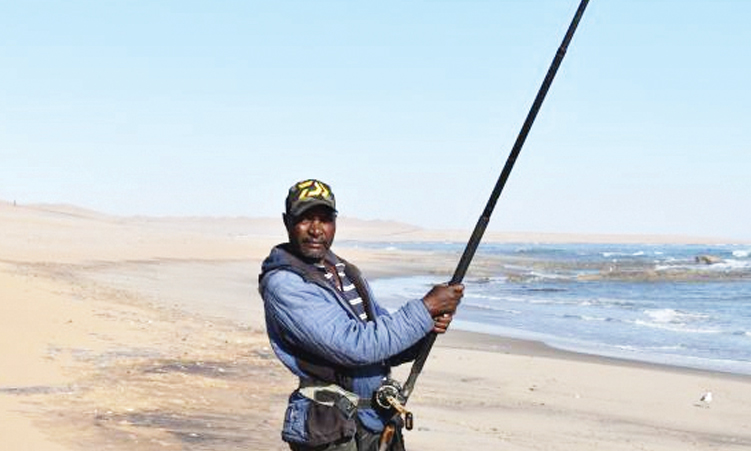
Fishing for subsistence is the oldest and most sustainable form of fishing, dating back to 40 000–10 000 BCE.
In Namibia, small-scale fishers have long been overlooked in policies. Yet the sector supports more than 1 500 seasonal and full-time workers, landing about 3 000 tonnes worth N$27.6 million annually.
Despite this contribution, these women and men remain among the most marginalised groups in the coastal economy.
In other countries, they are considered ‘artisanal fishers’. Yet in Namibia they still face a lack of legal recognition, along with growing socio-economic and environmental risks.
As challenges mount, the question remains whether there is a sustainable future for those who depend directly on the Benguela Current’s resources.
LEGAL VACUUM
The Marine Resources Act (27 of 2000), which governs the sustainable use of the Benguela’s natural resources, recognises only two groups: commercial and recreational fishers.
As small-scale fishers (SSF) are not classified as commercial and fall under rules for recreational anglers, they are not allowed to sell their catch.
This greatly limits their economic development even though fishing is often their main source of income and survival.
Only a fraction of fishers have access to loans or credit. Instead, they often depend on informal middlemen who provide bait, tackle, fuel and loans in exchange for very low prices for their catch.
On top of this, rising costs and fluctuating fish prices squeeze already small profits, tightening the cycle of debt.
Simultaneously, overfishing by commercial fleets and unpredictable environmental conditions including fish migrations and ocean acidification make SSF even more vulnerable.
Small-scale fishers struggle with a lack of cold storage, leading to post-harvest losses or forcing them to sell fish immediately at low prices.
There is also strong gender inequality.
Women, who mostly handle fish processing, rarely have access to training or markets, as their needs are often not considered in policy.
In 2022, Namibia officially recognised the challenges faced by SSF by developing the National Plan of Action for Small-Scale Fisheries (NPOA-SSF).
The country became one of the first in Africa to adopt these guidelines, aimed at improving food security and reducing poverty.
In partnership with local conservation and research institutions, the Food and Agriculture Organisation (FAO), together with relevant ministries, is working on a policy to recognise artisanal fishers, allowing them to legally harvest and sell their catch.
As part of the plan, tailored loans and other ‘fisher-friendly’ tools are being introduced to help break the cycle of debt.
Giving communities exclusive rights to certain beach areas is also being explored to encourage resource protection, while solar-powered cold storage at landing sites is expected to help fishers store their catch safely.
To reduce climate risks, artisanal fishers are being encouraged to diversify into mariculture, such as seaweed and oyster farming, or to keep livestock.
The Namibia Women’s Fisheries Network provides training for women in adding value during post-harvest processing, while social security and insurance schemes aim to protect families from injury or loss of equipment.
REEL RECOGNITION
While empowering these communities has high priority, more emphasis needs to be put on holding SSF accountable for fishing in restricted areas, using illegal bait, and keeping undersized fish as these violations of fishery laws occur often.
As the timeline for implementing the NPOA-SSF ends this year, it remains unclear how successful it has been.
Artisanal fishers are among the most marginalised coastal communities, despite practising one of the most sustainable forms of fishing and maintaining a deep connection to the ocean they depend on.
This group needs greater policy recognition and stronger support to build resilience against industrial overfishing and environmental uncertainties.
- Damian Schreiber, publicist, educator, seal rescuer and junior researcher at Ocean Conservation Namibia. He has a master’s in ecology and society from Costa Rica’s University for Peace.