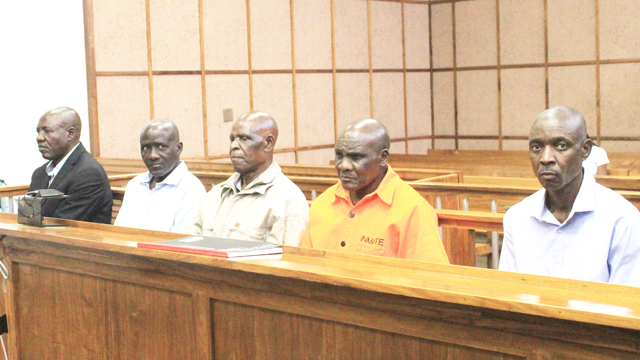
Seven men convicted and sentenced to terms of imprisonment at the end of the second Caprivi high treason trial a year ago are now asking the trial judge to allow them to appeal to the Supreme Court.
Acting judge Petrus Unengu reserved his judgement on an application for leave to appeal by the seven men – Progress Munuma, Shine Samulandela, Manuel Makendano, Alex Mushakwa, Frederick Ntambilwa, Hoster Ntombo and John Tembwe – in the Windhoek High Court on Tuesday.
His ruling is scheduled to be delivered on 20 November.
The seven men were sent to prison at the end of their trial before Unengu on 14 October last year.
Unengu found all of them guilty on charges of high treason, the unauthorised importation of weapons into Namibia, and the supply and possession of weapons, unlawful possession of ammunition, and contraventions of Namibia’s immigration legislation in a judgement delivered near the end of July last year.
Unengu found that the seven men took part in the activities of a separatist organisation in the Zambezi region – then known as the Caprivi region – from September 1998 to December 2003, and that they were involved in plans to take up arms against the government in the region.
The seven men were sentenced to prison terms ranging from five to 16 years at the end of their trial.
Unengu sentenced Munuma (65), described as a leader of a separatist organisation that operated in the former Caprivi region between 1998 and the end of 2003, to 26 years’ imprisonment, of which 10 years were suspended for a period of five years.
Samulandela (57), Mushakwa (63), Ntambilwa (63), Ntombo (62) and Tembwe (58), described as supporters or sympathisers of the secessionist movement in the former Caprivi region, were each sentenced to a prison term of 20 years, of which eight years were suspended for a period of five years.
Makendano, who was reputed to be 78 years old at the time of the sentencing, was sentenced to 10 years’ imprisonment, of which five years were suspended for a period of five years.
Defence lawyer Jorge Neves, representing Ntambilwa and Tembwe, argued on Monday that neither of the two men were proven to have been organisers, fighters or leaders in a secessionist movement.
Some of the accused persons in the main Caprivi treason trial were convicted of many more charges than Ntambilwa and Tembwe, including counts of murder and attempted murder, but received lighter sentences than the two men, Neves argued.
The Supreme Court could come to a different conclusion on the guilt and sentences of his clients, Neves submitted.
Defence lawyer Ilse Agenbach, representing Munuma, Samulandela, Makendano, Mushakwa and Ntombo, argued they were not Namibian citizens when the crimes they were accused of were committed, and that they did not owe allegiance to the Republic of Namibia and thus should not have been found guilty of high treason.
Agenbach also reminded the judge that the accused served six years of their previous prison terms, before they stood trial for a second time on the same charges.
During his address to the court, deputy prosecutor general Lourens Campher, representing the state, remarked: “On the convictions, there is actually no chance of success on appeal.”
Campher argued the men did not show any remorse during their trial, and that their sentences are not shocking.
He asked the judge to refuse them leave to appeal.
The seven men went through a first trial in the Windhoek High Court between 2005 and 2007.
They were sentenced to prison terms of either 32 or 30 years at the end of that trial, and went on to serve six years of those sentences.
After they appealed to the Supreme Court, their convictions were set aside in July 2013 and their case was sent back to the High Court for a retrial, which started before Unengu at the end of June 2014.