



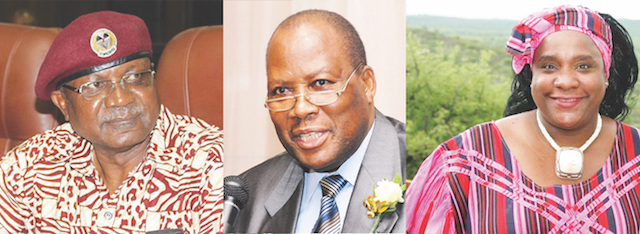
WHEN former Cabinet minister Erkki Nghimtina filed for divorce, he never expected that the process would take six years – and that even then he would still be haggling over how to divvy up property with his ex-wife.
“It’s supposed to be simple to just say: ‘Look, our love has expired to an extent that we can no longer be together anymore,’” he said. “Then we parted ways. But it is not. It’s more complicated.”
Nghimtina declined to say how much he had spent on legal fees, but spoke admiringly of Cuba’s famously simple divorce laws. Cuban couples have reported getting a divorce in about 20 minutes, at the cost of around N$15.
“In Cuba, if you marry… and you feel you no longer want the person, you can divorce without any issues,” the 74-year-old said.
Nghimtina believes that lawyers often lie to their clients in order to prolong cases, while raking money in through legal fees. He said the law should make divorce a much simpler process, and focus more on the maintenance of children born within the marriage.
Now living in norther Namibia, former defence minister Charles Namoloh, who is seeking divorce from his wife of 25 years, agreed that court proceedings are drawn out and complicated.
“The court is slow, absolutely slow and the process is expensive. You can’t go to court without a lawyer. The process is really cumbersome. I spent a lot of money,” Namoloh told The Namibian yesterday.
There’s no doubt the divorce process can be draining.
Jackie Wilson-Asheeke told The Namibian last year that divorcing her husband of 33 years only brought her more headaches and heartache.
The former chairperson of Namibia Wildlife Resorts was married in community property, meaning all of the couple’s assets were legally shared – even those acquired before the marriage.
She started divorce proceedings in September 2018.
N$55 000 later, and the process was only finished in January 2021, after failed mediation, endless court dates and agonising encounters with lawyers who charged inexplicable fees, all to get a divorce that both parties wanted.
“It was nearly two and a half years of lawyers, frustration, anxiety, worries about my children, emotional depression, angst, uncertainty, insensitive comments by all kinds of people, including family and friends, tears, painful memories, and finally, blessed relief,” she said.
Wilson-Asheeke’s ex-husband declined to comment.
Namibia still uses a fault-based divorce law inherited from apartheid South Africa at independence – a system South Africa itself no longer uses.
That means that if a couple wants to divorce, one of them has to prove that the other violated the marital contract.
Cruelty, adultery, and desertion are common examples of grounds for a fault divorce.
In contrast, no-fault divorces do not require any showing of wrongdoing. Rather, the filing spouse simply claims that the couple cannot get along and the marriage has broken down.
Proving wrongdoing in court is time-consuming and expensive, requiring lawyers to argue cases.
“Couples who lack the financial resources necessary to open divorce cases at the High Court are forced to remain in broken marriages,” justice minister Yvonne Dausab said.
“Others opt to just separate as a means of avoiding the high cost of divorced.
“The current divorce legislation renders divorce in Namibia too expensive an undertaking for those who cannot afford legal representation,” Dausab added.
The Namibia Legal Information Institute said as far back as 2013 that the divorce law is outdated and may violate the Constitution’s Article 8 protections providing for the dignity of all people.
DRAINING
Loide Shilongo (49) from Engela has just emerged from an 18-month divorce process, although she admits that she dragged the process out by ignoring court papers.
Shilongo says that after 21 years of marriage, her husband simply woke up one morning to tell her that he no longer loved her.
“He told me that he didn’t want to be married anymore. I didn’t understand it. And he wouldn’t tell me why he didn’t want to be with me anymore.”
After she demanded clear answers, he opened up and confessed that he had fathered a child out of wedlock.
“The child was seven years old,” Shilongo said.
But she forgave him.