




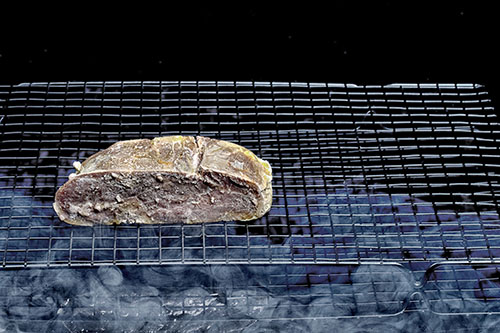
Cryogenic cooking refers to cooking with cold (as opposed to cooking with heat). If the term ‘cooking’ is usually used to refer to the transformation of food through the application of heat then cryogenic cooking appears to be a contradictio in terminis.
Well, no longer, for it appears that everyone is dabbling in ‘cold cooking’ at the moment.
Cryogenic cooking refers to the application of a specific coolant to food for a purpose other than simply freezing it for preservation.
By leaving your steak out in the cold at night or by slamming it repeatedly into the ice crust on the freezer door, you are not practicing cryogenic cooking. You are just being silly and should stop immediately.
Although cryogenic cooking has become more popular with the progress of modernist (or molecular, if you must) cooking and gastronomy, it has been practiced at least since 1885 when Mrs Angus Marshall published a recipe for ‘cooking’ ice cream with ‘liquid air’ (liquid nitrogen).
Liquid nitrogen (nitrogen in a liquid state) and dry ice (carbon dioxide in solid form) are the two coolants used in cryogenic cooking.
Both of these are not used as ingredients, i.e. they are never ingested. This is rather important to remember when you try your hand at cryogenic cooking: I do not care how hot the day is, or how thirsty you are, do not drink the liquid nitrogen or chomp on a clump of dry ice. At -196°C and -79°C respectively, nothing good can come from such an act of uninspired foolishness or excessive ignorance.
The most obvious application for either cryogenic substance is ice cream or some derivative thereof (i.e. sorbetto or granita). With almost no effort it takes about two minutes to make a seriously good ice cream with no icicles. But there is more to cryogenic cooking than ice creams.
First, it has opened entirely new avenues in mixology and cocktail making because of its ability to freeze alcohol. A seriously boozy Caipirinha can now be converted into something resembling a sorbet or ‘slush puppy’.
Conventional freezing applications could never do that.
Second, pastry chefs are on a creative high because of the endless possibilities for frozen creams, mousses, meringues and espumas, cryogenic ‘popcorn’, carbonated fruit and ‘smoking’ floating islands.
Third, savoury chefs are not being left behind. In their quest for perfectly cooked proteins, top end chefs employ the rapid freezing qualities of liquid nitrogen. Ever heard of cryogenic fried steak?
With the introduction of precision cooking by means of sous vide, chefs have made great strides toward what is regarded as the ‘perfectly cooked’ steak. This is a steak cooked to just the right inner-temperature, with the right amount of Maillard reaction induced crust on the outside. This is more difficult than it sounds.
Cooking the steak in a water bath (sous vide) to an exact inner temperature of say 58°C is easy enough. Putting the Maillard reaction induced crust on the outside, either by means of browning it in a very hot pan or by deep-frying it, would cook it beyond its optimum temperature. To prevent this from happening, the folks at Modernist Cuisine came up with a technique using liquid nitrogen to freeze the outside of the sous vide cooked steak before deep frying the lightly frozen steak in very hot oil. This way, the small frozen layer protects the inner core of the meat against further cooking by the very hot oil during the final deep-frying phase.
As is my duty, I have recently put this to the test using luscious loin steaks of zebra. If you do not like zebra (I do), try something else.
First, I left the steak uncovered on a drying rack in the refrigerator for two days to develop a dry exterior. It is important that the air should be allowed to circulate around the meat, thus do not put it on a solid surface such as a plate or pan.
Second, the unseasoned steak was cooked in a water bath at 56°C for 90 minutes.
The steak then ‘cooked’ in a pan filled with liquid nitrogen for 30 seconds each time. The purpose of this step is not to deep freeze the meat, but only to create a protective frozen layer, thus 30 seconds is long enough.
Finally, the steak was deep-fried in oil heated to 180°C for only a few seconds (about 40 to 60 seconds, or just until it has a nice brown crust).
Thereafter it is pretty much whatever you like: serve it with triple cooked chips, or as I have done here, with Spaetzle. I have made a Hollandaise sauce to which I have added crush green peppercorns to give the zebra a kick up its backside, but you can add your own favourite sauce.
I do understand that you will not have ready access to liquid nitrogen, so it is best advised that you befriend someone who uses it for preserving bovine gamete.
Or else, just enquire with Afrox in town.
Happy eating.
• 4 (about 350 grams each) zebra sirloin steaks
• 2 litres liquid nitrogen to taste salt and pepper
• Maldon salt (or any other finsihing salt) as needed
Directions
• Put the steak on a cooling rack in the refrigerator and leave for two days. It is important that the air must be able to circulate around the meat.
In an age of information overload, Sunrise is The Namibian’s morning briefing, delivered at 6h00 from Monday to Friday. It offers a curated rundown of the most important stories from the past 24 hours – occasionally with a light, witty touch. It’s an essential way to stay informed. Subscribe and join our newsletter community.

The Namibian uses AI tools to assist with improved quality, accuracy and efficiency, while maintaining editorial oversight and journalistic integrity.
Stay informed with The Namibian – your source for credible journalism. Get in-depth reporting and opinions for
only N$85 a month. Invest in journalism, invest in democracy –
Subscribe Now!