



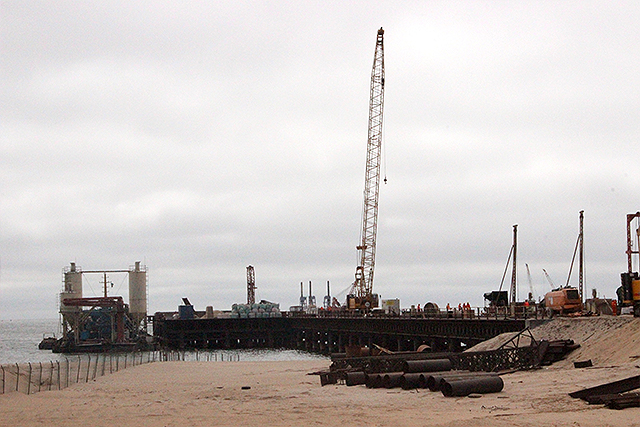
SHINOVENE IMMANUEL, LAZARUS AMUKESHE and CHARMAINE NGATJIHEUEACCOUNTING firm PricewaterhouseCoopers says it does not know how Namibia’s new national oil storage facility at Walvis Bay ended up costing N$5,6 billion.
In addition, the government appears to have squandered close to N$700 million on the project due to currency fluctuations.
The finance ministry asked Price waterhouseCoopers (PwC) last year to independently verify the payments made by the government for the construction of the national oil and petroleum storage facility at Walvis Bay between 2014 to 2019.
“It is unclear as to how the total project cost of N$5,6 billion was computed,” PwC said in the report dated 20 January 2020.
The report, which was discussed in Cabinet this year, also shows that the auditors struggled to get the invoices for the project.
They also claim they could not tell the actual payments made on the projects, as they were not given all the bank statements.
According to PwC’s findings seen by The Namibian, to the date of their report, 49 invoices or certification for work done were issued. These were issued by OmkumoAiJ (government’s representatives) after reviewing work done by the contractor.
However, only 27 certificates were provided for their investigation. The invoices issued in relation to these certificates totalled N$3,6 billion.
At least 22 certificates were not provided for the investigation, nor is it known whether those were paid or not.
Efforts to get a comment from PwC’s director Hans Hashagen were not successful yesterday.
This fuel storage facility contract attracted controversy since 2014. At the time, some officials questioned how the cost of the storage project tripled in a space of seven years. The project was projected to cost N$800 million in 2008.
The facility was to be funded by the Development Bank of Namibia (DBN), which in its annual reports said it had allocated N$2,8 billion for the facility.
The Namibian reported in 2015 that top government officials and politicians forced the DBN into a N$4 billion debt for a storage project that was not urgent.
At the forefront of that pressure was prime minister Saara Kuugongelwa-Amadhila, while serving as minister of finance and the then permanent secretary for the energy ministry, Kahijoro Kahuure. The premier denied at the time but the project financing – rubber-stamped by attorney general Albert Kawana – attracted public attention for years.
The contract was awarded to a joint venture called CRB, co-owned by China Harbour Engineering Company and businessman Vaino Nghipondoka’s Babyface Civils (Pty) Limited.
Other key players in the deal were OmkumoAiJ, which is a joint venture between Omkumoh Consulting Engineers and AIJ Project Cost Consultants, who act as representatives of the government.
PwC said it relied on a 2017 letter by the energy ministry to the Central Procurement Board (CPB) to understand the escalation of the project costs.
The ministry requested permission to increase the cost of the project by N$1,9 billion that year. The initial project cost was still N$3,7 billion.
The increase, according to the letter, was to fund, among others, an exchange rate fluctuation provision of around N$700 million, delayed payments of N$198 million, interest on delayed payment of N$24 million, an internal fire system of N$115 million and additional land for N$23 million.
PwC could not figure out whether those payments were made in full. According to PwC, one of the letters they inspected shows that CPB approved N$270 million, including an unexplained N$4,7 million.
The audit firm said their investigation could not tally to N$1,9 billion that was requested but was overstated by a safe figure of N$734 million.
The government was exposed in 2017 after it turned out that senior officials failed to protect it’s interests in this contract.
The government then charged finance ministry executive director Ericah Shafudah, former National Planning Commission executive director Leevi Hungamo and a chief legal adviser in the attorney general’s office, Chris Nghaamwa for failing to protect the state.
Hungamo blamed politicians such as Kuugongelwa-Amadhila for ignoring his advice. The PM pointed fingers at the technocrats for giving excuses.
Energy minister Tom Alweendo yesterday said his ministry is finalising arrangements to conduct investigations into ‘possible’ incongruities that may have occurred during the construction of the oil storage facility.
Alweendo was acting in line with recommendations given by PwC after they found that additional work, done and invoiced to the tune of N$29,5 million and US$25 870, was not approved.
In an age of information overload, Sunrise is The Namibian’s morning briefing, delivered at 6h00 from Monday to Friday. It offers a curated rundown of the most important stories from the past 24 hours – occasionally with a light, witty touch. It’s an essential way to stay informed. Subscribe and join our newsletter community.

The Namibian uses AI tools to assist with improved quality, accuracy and efficiency, while maintaining editorial oversight and journalistic integrity.
Stay informed with The Namibian – your source for credible journalism. Get in-depth reporting and opinions for
only N$85 a month. Invest in journalism, invest in democracy –
Subscribe Now!