



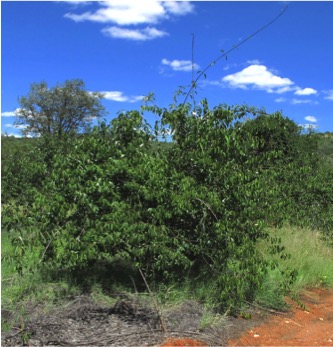
COLEEN MANNHEIMER THE Madagascar rubber vine has glossy, dark green opposite leaves, which form a pretty background to its showy funnel-shaped white or pink to pale purple flowers.
The leaves are opposite, each pair growing at right angles to the next. It is a self-supporting, woody perennial strangler vine with trailing whip-like outer branches, one to two metres high when growing independently, or scrambling up to 30 metres into other woody species.
It exudes a milky latex when damaged, which can be made into natural rubber similar to that of the real rubber tree (Hevea brasiliensis), hence the name ‘rubber vine’, but is too difficult to tap for commercial purposes. The rubber vine belongs to the Apocynaceae or oleander family and like many members of this family has distinctive horn-like seed pods.
The seed pods of the rubber vine measure up to 12 x 4 cm and grow in rigid opposite pairs on a short stalk. The seeds have a tuft of long, silky, white hairs and are dispersed far and wide by the wind.
The rubber vine is regarded as invasive in tropical North and South America, in India and Australia. It was brought into Namibia as a garden ornamental, but has since escaped cultivation to become naturalised in various parts of the country, especially areas where the soil retains moisture.
The vine has invaded watercourses and it has also invaded farming land e.g. between Outjo and Otavi. It grows near the reception at Namutoni and has become rampant in some towns, such as Tsumeb. The vine’s scrambling habit causes it to smother indigenous plants, choke waterways, and reduce grazing land.
The Madagascar rubber vine is spreading extremely quickly in Namibia, and grows in a wide variety of habitats, often where there is temporary or permanent water, such as roadsides, washes and gullies, as well as near watered gardens.
While it grows most vigorously in moist places, it seeds best with an annual rainfall of 400 mm or less and seems to thrive on and even requires extreme variability of rainfall – both conditions found over large areas of Namibia. Once established, and provided enough water is available, it can grow as much as five metres per month!
The rubber vine is regarded as possibly the worst weed in Australia, where it is a severe threat to biodiversity in the northern areas. It is poisonous to stock – a mere 10 grammes of its leaves can kill a 400 kg horse in six days – but because it is very unpalatable animals will only eat it under drought conditions when no other green fodder is available.
It can form dense, impenetrable thickets that hinder stock movements and access to water, so it will eventually threaten stock farming. Imagine this plant spreading and growing around waterholes in Etosha, where climatic conditions are ideal!
Since this plant is becoming invasive in our country, steps should urgently be taken to eradicate it while that is still possible without too much expense. More information about methods of eradication will follow in a future article.
In an age of information overload, Sunrise is The Namibian’s morning briefing, delivered at 6h00 from Monday to Friday. It offers a curated rundown of the most important stories from the past 24 hours – occasionally with a light, witty touch. It’s an essential way to stay informed. Subscribe and join our newsletter community.

The Namibian uses AI tools to assist with improved quality, accuracy and efficiency, while maintaining editorial oversight and journalistic integrity.
Stay informed with The Namibian – your source for credible journalism. Get in-depth reporting and opinions for
only N$85 a month. Invest in journalism, invest in democracy –
Subscribe Now!