


Namibian commercial banks have no policies in place to refund clients’ money once they are defrauded.
This is despite the Bank of Namibia recently revealing that Namibians lose over N$6 million to fraudsters every month.
The central bank says Namibians are currently losing more than N$200 000 to fraud every day.
According to the bank’s 2025 annual report, scammers siphoned N$73.9 million from the national payment system in the last year alone. This is a N$19-million increase from 2024.
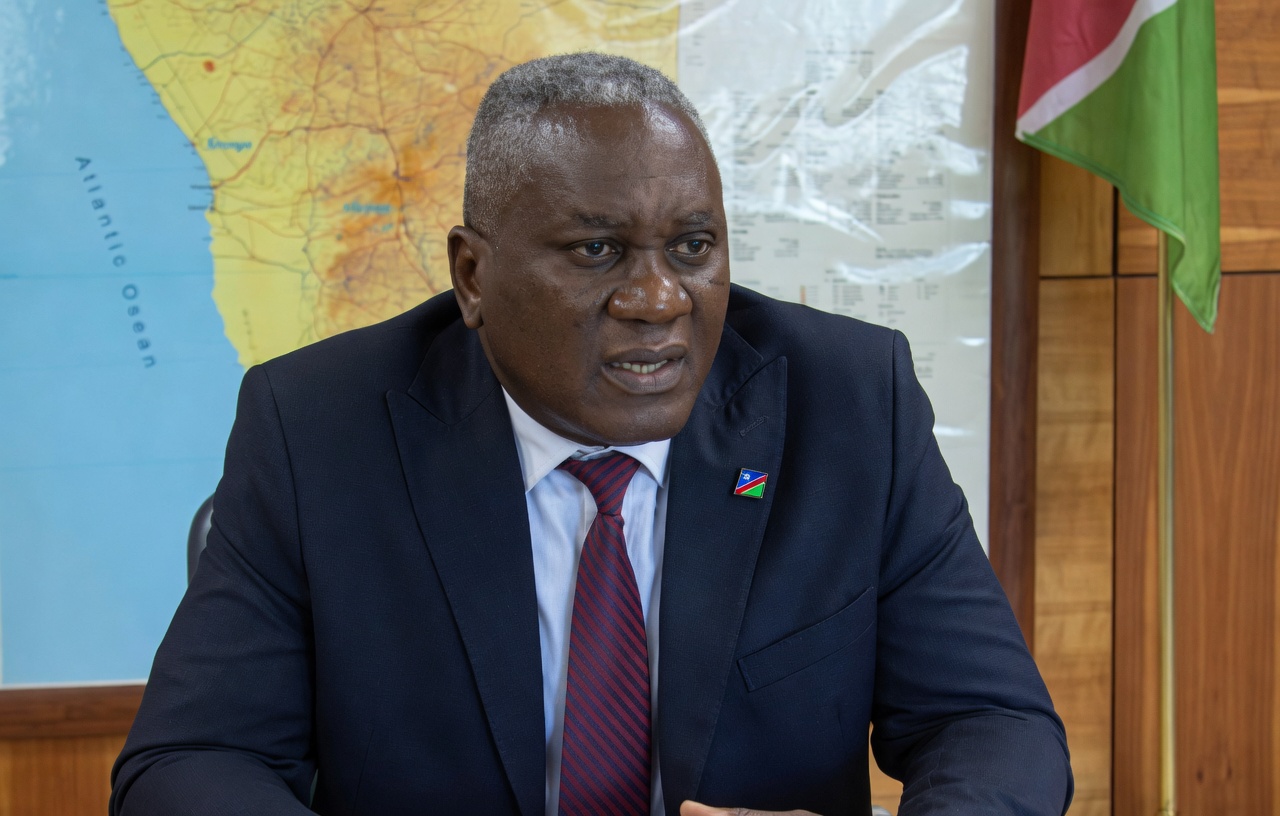
Minister of defence and veterans affairs Frans Kapofi, who was defrauded of N$200 000 in 2022 by someone pretending to be an employee at Standard Bank, yesterday said a policy should be introduced to force banks to refund scammed clients.
Kapofi said he was only able to recover N$98 000 because of “quick action” taken by his private banking adviser, and said his bank has been silent on the matter.
“They cleared my account, which had N$200 000 in it, and N$98 000 was recovered.
The rest was lost. My bank is washing its hands. Banks must be made to repay clients’ money they lost through those scams,” the minister said.
The Namibian reached out to the ‘big four’ commercial banks that control about 97% of the banking sector market to find out whether defrauded clients are refunded.
While Nedbank and Bank Windhoek provided detailed responses, Standard Bank Namibia offered a generalised statement that did not directly address key questions around client liability.
Meanwhile, First National Bank (FNB), the country’s largest lender, did not respond.
WHO IS RESPONSIBLE?
According to some banks, the liability ultimately lies with clients, depending on the nature of the case.
Nedbank Namibia spokesperson Selma Kaulinge says responsibility for losses depends on the nature of the transaction.
She says liability shifts to the customer if “a client authorised a transaction, even if under deception, for example, social engineering or impersonation scams”.
Bank Windhoek forensics services manager Ina Muir says fraud prevention is the shared responsibility of clients and the bank.
“Bank Windhoek’s responsibility is to provide secure banking platforms, apply robust fraud prevention and monitoring controls, and respond swiftly when fraudulent activity is detected or reported.
Client liability, however, depends on the specific circumstances of each case,” she says.
Meanwhile, Standard Bank’s manager of fraud and risk, Colane Esterhuizen-Andreas, says the bank has a commitment to “safeguarding money”, but did not define the legal boundary between the bank’s liability and the customer’s.
The Bank of Namibia says electronic fund transfer fraud has surged to N$53 million, but none of the commercial banks have disclosed how much of that money has been returned to their clients.
“Refunds are therefore assessed on a case‑by‑case basis, and Standard Bank does not disclose aggregated refund figures publicly,” Esterhuizen-Andreas says.
She says every incident of fraud is investigated based on its specific circumstances, but provides no specific criteria for refunds.
Nedbank’s Kaulinge says: “The bank cannot disclose the amount refunded to clients due to confidentiality and legal reasons.”
She says while refunds may be considered where transactions were unauthorised and there is no evidence of client negligence, they are generally not guaranteed if customers “voluntarily” approved payments or shared confidential information.
Bank Windhoek’s Muir says refunds are unlikely where clients “authorised transactions themselves” or failed to follow security protocols.
“Reimbursement amounts cannot be made public and refunds are assessed on a case-by-case basis,” Muir says.
THE VICTIMS
Jimmy Riedel, a pensioner, says he lost N$121 000 from his Bank Windhoek account in January.
He says an individual called him, claiming to be from the bank, and provided him with all his credentials, which made him believe the call was authentic.
The caller claimed Riedel’s account might be hacked.
“The bank just said my claim is declined and I must prove I did not disclose my credentials. I am a pensioner and am suffering from this ordeal,” he says.
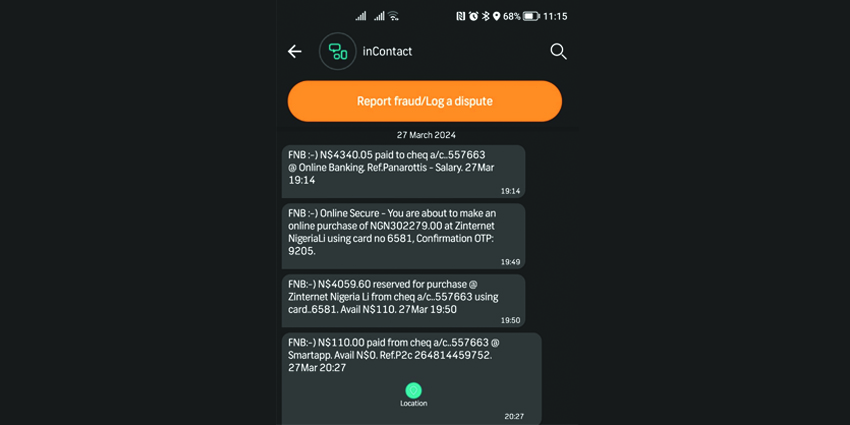
FNB client Anna Tumo says N$4 546 was withdrawn from her account an hour after she got her salary in June 2025.
“The bank told me the money was withdrawn in Canada and there has been no refund,” she says.
Ananias Simon, another FNB client, says money was removed from her account by an individual in Nigeria, and the bank said it would deal with the matter, but two years later has not.
“I went to the station to open a case, and submitted it to the bank.
They said I must wait for 90 days, and up to date nothing,” Simon says.
Another FNB client, Ndamononghenda Velifoipa, says he lost N$230 000 in February, which was “business money”.
He received a call from a person claiming to have sent a one-time pin to his number by mistake, which he forwarded.
“The bank just said they are busy working it out,” Velifoipa says.
Carl-Heinz Rickerts, a Nedbank client, says money was transferred from his account to one in South Africa in 2022.
“The amount is N$9 000 and the bank said it was mine and I never received any money back,” Rickerts says.
GLOBAL PRECEDENT
While Namibian banks use ‘client authorisation’ as a shield against liability, international regulators are moving in the opposite direction.
In the United Kingdom, the payment systems regulator introduced a rule in October 2024 mandating banks to reimburse victims of authorised push payment fraud – scams where a customer is tricked into sending money.
Under this law, banks must refund victims within five business days, with the cost split 50/50 between the sending and receiving banks.
Similarly, the European Union’s proposed Payment Services Directive 3 aims to expand refund rights for ‘spoofing’ victims – those targeted by fraudsters pretending to be bank employees.
In both jurisdictions, the burden of proof has shifted: a bank can only refuse a refund if they can prove the customer acted with gross negligence.
In an age of information overload, Sunrise is The Namibian’s morning briefing, delivered at 6h00 from Monday to Friday. It offers a curated rundown of the most important stories from the past 24 hours – occasionally with a light, witty touch. It’s an essential way to stay informed. Subscribe and join our newsletter community.

The Namibian uses AI tools to assist with improved quality, accuracy and efficiency, while maintaining editorial oversight and journalistic integrity.
Stay informed with The Namibian – your source for credible journalism. Get in-depth reporting and opinions for
only N$85 a month. Invest in journalism, invest in democracy –
Subscribe Now!