






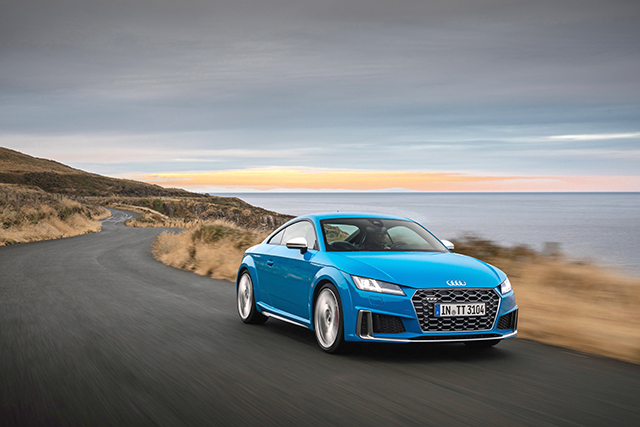
When it comes to coupés, Audi undeniably has one of the most recognised design qualities, which the brand continues to refine to transcend time.
Back in 2004, Will Smith starred in the blockbuster ‘I, Robot’ – a film that reimagined what the technological world would look like in 2035. Besides robots occupying all sectors of the future, senior exterior designer at Audi AG, Julian Hönig, designed a concept car which would be Smith’s mode of transport in the dystopian Chicago.
At the time of the film’s release, the conceptual Audi RSQ was unlike anything 10-year-old me had seen before. This project was a first for Audi and the sports coupé stayed true to the brand’s standards as it was a visionary interpretation of Audi’s typical vehicle design. The smoother and rounder body was fitted with spheres instead of conventional wheels, allowing the car to hover, as well as two reverse-butterfly doors hinged to the C-posts.
While we’re much closer to 2035, hover cars are still a distant concept. However, Audi is still setting the bar high every year when it comes to their coupés.
Known as Audi’s design icon, the brand’s third-generation TT emerges with an facelift, with a more sporty and polished exterior design, higher-powered engines and an extended list of standard equipment.
A two-door sports car, the TT has been marketed by the Volkswagen Group’s subsidiary since 1998, however, its styling and conceptualisation began four years earlier at Volkswagen Group Design Centre in California. The TT was first shown as a concept car at the 1995 Frankfurt Motor Show.
Three years later, the production model was launched as a coupé in September 1998, followed by a roadster in August 1999.
Although a milestone for the company, this launch was followed by a dark time. The early models received bad press following a series of accidents and fatalities, which occurred at speeds in excess of 180km/h during abrupt lane changes or sharp turns.
Both the coupé and roadster variants were recalled in late 1999/early 2000 to improve predictability of the car’s handling at high speeds. Audi’s electronic stability programme or anti-slip regulation and rear spoiler were added, along with modifications to the suspension system. All changes were incorporated into subsequent production.
The second-generation TT was announced in August 2004, which would be manufactured using aluminum and would be in production in 2007.
A preview of the second-generation TT was provided in the form of the Audi Shooting Brake concept car, shown at the Tokyo Motor Show in 2005.
The third generation of the TT was unveiled at the 2014 Geneva Motor Show. Five years on, and once again in August, the third-generation TT is back with jaw-dropping enhancements, both on the inside and out.
Rugged Yet Refined
The exterior design of the new TT range is now more masculine, progressive and sportier than before, says Audi South Africa. The front features a three-dimensional single frame radiator grille and large side air inlets emphasise the vehicle’s width dimensions.
At the rear, horizontal lines underscore its breadth. There is no cap underneath the tank flap with its classic TT design; the driver can insert the fuel pump nozzle directly into the opening, showcasing a typical sports car feature.
Headlights with LED technology are part of the standard equipment, however matrix LED technology is optionally available. The dynamic turn signals are usual visual highlights on this model as well.
The facelifted TT range includes 19-inch wheels in five different designs. Three new body colours complete the range of paint finishes: Cosmos blue, pulse orange and turbo blue (S line models only).
Under the Hood
Audi South Africa will offer two petrol engine derivatives as part of the local range. The Audi TT coupé 45 TFSI S tronic includes 169kW of power and the Audi TTS coupé quattro S tronic produces 228kW. The 45 TFSI is paired with a seven-speed dual-clutch transmission, while the TTS is mated to a six-speed S-tronic transmission. The close-ratio lower gears enable powerful acceleration, while the wide ratio of each transmission’s highest gear keeps the engine speed down.
Driver-Oriented Cockpit
The sports-car character is also underscored by the driver-oriented interior with its clear lines. The slender instrument panel resembles an aircraft wing; the round air vents with integrated controls allude to jet engines – a classic TT detail.
Sport seats with integrated head restraints are standard on the Audi TT range. Seats with pneumatically adjustable side bolsters are optionally available.
All indicators appear in digital form on the 12,3-inch display of the Audi virtual cockpit. The driver can choose between two modes: In the classic view, the speedometer and tachometer take centre stage. In ‘infotainment’ mode, content such as the navigation map is enlarged. The new sport display is available for the TTS and provides information on the engine output currently in use, as well as the torque and G-forces.
The redesigned and refined Audi TT coupé is certainly a sight for sore eyes, especially if the jaunty design and sleek lines are up your taste-bud alley.
Additional information from Audi South Africa; QuickPic
– @jonathan_sasha on Twitter; @jonathan.sasha on Instagram