


Is it not amazing how some foods have absolute divisive powers? They have the ability to divide humanity, and even the tightest of family units in it, into two pugnacious camps.
These foods are either loved or hated; and there is no middle ground. I have come across many such food items over the years: Raw oysters; durian fruit; mangoes; bugs and worms; small birds; balut; snakes; crocodile; donkey; horse; dog, and birds’ nests, to name a few.
In our home, the food item that drew the hard line in the sand and divided the household in two permanently opposing fractions was asparagus. On the one side – the violently anti-asparagus fraction – was my late father, and on the other were the remaining lot of three that made up our little nuclear family.
Back then, much of Namibia – including our little merry bunch – knew no fresh asparagus. I may have been of voting age before sinking my teeth into a fresh, bright green asparagus spear.
Before then, we found our asparagus in tins, or if we were willing to spend a bit more money on them, in glass jars. Invariably such items were imported, and thinking back now, I cannot say I blamed my father for intensely disliking them.
He always said they taste like soil, and that he had no business eating soil, but I think the texture also played a big part. Tinned asparagus are, of course, cooked and thus soft, somewhat wet and slimy, and sometimes also stringy. If you dislike wet and slimy as he did, you’d not like tinned asparagus.
The bottled asparagus looked and tasted no better. They were bigger but, being white and kept in see-through jars in brine, they reminded him of ‘dead man’s fingers’, he said, and he had no predilection for anything that looked like a specimen from a morgue or school laboratory.
I do not think he had ever been to a morgue, and I know that he went to school at Usakos where there sure as hell never was a school laboratory. That I know for a fact as they, at the time, placed the generator that was used to power the school’s movie projector in the school’s outhouse to silence it enough for the children to be able to listen to the dialogue. That was considered a major technological breakthrough, so can you imagine what they would have done with a laboratory?
Bad experiences aside, Namibia these days produces top grade fresh asparagus. A fair proportion of it is produced in the Namib desert outside Swakopmund.
, commonly called asparagus, or garden asparagus, grows well in sandy and somewhat salty soil and the plant itself tolerates salt better than most other plants. No surprise then that ancient asparagus farmers relied on salt as herbicide.
The lack of pigmentation in white (also called albino) asparagus spears results from the absence of sunlight. Farmers apply a blanching technique to (green) asparagus shoots when they grow up. These shoots are covered with soil as they grow and with the sun being blocked out by the earth around the shoots, no photosynthesis is possible, and vegetable thus remains white.
Every spear is picked by hand just as the tip starts to protrude from the soil. The spear is excavated and cut at the base. White spears turn pink if exposed to sunlight, thus they are placed in a black box immediately after harvesting.
Fresh white asparagus is considered more tender and less bitter than the green spears, but is much more expensive to produce as it is labour intensive.
In addition to green and white asparagus is a genetic variety that is purple, but these turn green once they are cooked.
For most human kind – except for my father, of course – asparagus has been a much-cherished vegetable going back to ancient times. Greeks and Romans ate it fresh when in season and dried the vegetable for use in winter. Emperor Augustus created the ‘Asparagus Fleet’ to transport the vegetable and coined the phrase “faster than cooking as asparagus” for quick action.
The oldest surviving recipe for asparagus dates back to the third century AD.
Fresh asparagus is commonly prepared by boiling, poaching, steaming or grilling. When asparagus is boiled, poached or steamed, they are finished in a bath with ice water to set and retain the bright colour. In Asian dishes, they are popular as part of a stir-fry. No matter how you prefer it, do not over-cook them.
Asparagus pairs well with eggs, hence the classic pairing with Hollandaise sauce; but it also loves cheese and butter.
These days I stay away from the ‘dead man’s fingers’ in the glass jar. Tinned asparagus I ate in a tart someone else made months ago.
Maybe my father was right: One should not eat asparagus from a tin or a jar. Not in place where the local farmers grow them, anyway.
• Flour, for work surface
• 1 sheet frozen puff pastry
• 2 cups Gruyere cheese, shredded
• 800 grams asparagus, medium-sized
• 1 tablespoon olive oil
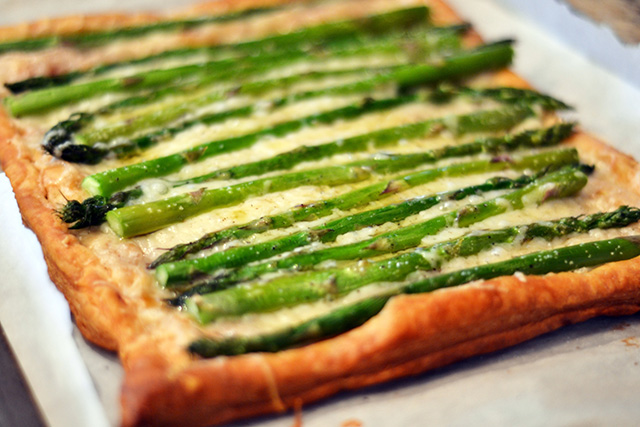
1. Preheat oven to 200ºC. On a floured surface, roll the puff pastry into a 40cm by 25cm rectangle. Trim uneven edges. Place pastry on a baking sheet. With a sharp knife, lightly score pastry dough 2cm in from the edges to mark a rectangle. Using a fork, pierce dough inside the markings at 1cm intervals. Bake until golden, about 15 minutes.
2. Remove pastry shell from oven and sprinkle with Gruyere cheese. Trim the bottoms of the asparagus spears to fit crosswise inside the tart shell; arrange in a single layer over Gruyere, alternating ends and tips. Brush with oil, and season with salt and pepper. Bake until spears are tender, 20 to 25 minutes.
In an age of information overload, Sunrise is The Namibian’s morning briefing, delivered at 6h00 from Monday to Friday. It offers a curated rundown of the most important stories from the past 24 hours – occasionally with a light, witty touch. It’s an essential way to stay informed. Subscribe and join our newsletter community.

The Namibian uses AI tools to assist with improved quality, accuracy and efficiency, while maintaining editorial oversight and journalistic integrity.
Stay informed with The Namibian – your source for credible journalism. Get in-depth reporting and opinions for
only N$85 a month. Invest in journalism, invest in democracy –
Subscribe Now!