





I am a firm believer that any nation needs restaurants. Not franchises or fast food eateries, but proper, independently-owned restaurants that seek to establish, develop and promote the national cuisine. From that point of view, restaurants are a cultural necessity. Without it, the national cuisine would not develop or grow; in fact, it would wither and die.
Anyone can sell food to others. From the lady at the building site selling pap to construction workers to the high-end hotel dining hall with their high-end clients, the business purpose is the same: Prepare, cook and sell food to those members of the public who are looking to buy some.
But we will not regard the lady at the building site to be a restaurant.
Restaurants are businesses that happen to sell food (other things like beverages too but for now let us focus on the food). At their core they are thus no different from, say, the bicycle shop or the nursery. The purpose of any business is to make a profit, and for that to happen they have to generate an income that exceeds their costs. Failure to do so invariably results in the suspension of the business and ultimately the closure thereof.
Restaurants can (and I would argue, should) be more than a just another business. Restaurants are different from franchise eateries in several ways. Most importantly, it has a unique identity that is defined mostly by a unique or near-unique philosophy about food and cooking. Each restaurant is unique and different in how it sources, prepares, cooks and serves food.
Franchised eateries are the opposite. They strive to standardise everything so that the client gets the same food, cooked in the same manner, and served in the same way.
Invariably, franchised eateries look to provide food that appeals to the broadest spectrum of eaters at an affordable price at a venue that draws large volumes of prospective diners. This, in case you wondered, is why there are so many hamburger and fried fish joints in our malls.
Of course these should not be regarded as restaurants in the true sense of the word, even though they allow people to sit down and eat.
I have yet to come across a food franchise owner who works in his or her own kitchen. Cooks and chefs simply do not own franchises. Why? Because the food is monotonous, the cooking is repetitive and the meals are prescriptive. There is simply not one ounce of creativity required or allowed.
In my experience, most chefs are passionate and creative people who always strive to develop and present something new, cooked in a manner that is new or long forgotten. They are thus craftsmen and women, researchers, historians, designers, molecular chemists, alchemists and food scientists all rolled into one. They need their own kitchen and they need the freedom to be creative, something no franchise kitchen can offer.
In their efforts to be creative, chefs are inspired by what is around them; the ingredients, the people and their (food) culture, the cooking techniques, the territory (terroir) and the culture and social philosophies.
In exploring these elements, they often develop new ways to work with and present old and traditional ingredients and dishes, and in doing so they push forward the nation’s cuisine. Without the innovative and creative drive of independently-owned restaurants, our culinary identity will be overrun and smothered by franchise food and we’ll be doomed to eat hamburgers and fried fish in malls surrounded by shoppers looking to stuff their faces with convenience.
As someone who is part of the restaurant industry, I have intimate experience with how tough a business a restaurant can be. In the past six months alone, we have lost most of our fine dining establishments in Windhoek at an average rate of nearly one per month. More informal establishments such as bistros and coffee shops are heading in the same direction. The only independently-owned restaurants that seem to be surviving are those who manage to attract large numbers of tourists; for the rest, new franchises are opening to fill the gaps left by the closing independents.
Why are our independently-owned restaurants under such threat?
Costs and economy of scale, mostly.
Rent in our capital city is prohibitively expensive. It starts expensive, and then escalates every year and in no time something that once was affordable is no longer. Each restaurant has a limit in the volumes of business it can handle, once it has hit that, new streams of income must be developed or the business will see a steady decline in income and profit until it becomes unsustainable.
With rental prices as is, landlords are ideally positioned to continue squeezing for more profits from rental spaces. They minimise spending on maintenance, often they prescribe long business hours which results in high labour costs, their contracts prohibit cost saving operations and in some cases, they tax their tenants profitability by linking rent with nett-profit.
In these cases, tenants pay a proportional top-up rent if they are profitable. Seeing that increases in rent do not translate into extra tables, restaurants will experience more financial burdens with each rent increase. At some point in the near future, only franchises that benefit from economy of scale and deep corporate pockets will be able to afford the prohibitive rental prices.
Our ingredients are expensive as most come from somewhere else. Fresh produce is not always so fresh, and as a result, wastage is high. Recently with the drought in full swing, meat became really scarce and thus extremely expensive, but I doubt that we’ll see a reduction in prices any time soon, even after the drought is broken.
As a nation, we do not produce enough food to lower the cost of ingredients. We are challenged when it comes to climate and rainfall, but we also do not invest in finding appropriate methods or tools or technology that would help increase our production.
Hydroponics? Aquaculture? Aquaponics?
I’ll bet good money that many have not even heard about these food-growing techniques and the groundbreaking technology that makes it possible to produce food even in the most densely populated urban environments.
We need to support our independent restaurants. They are under pressure to survive, and once gone, they will not come back. And with them, we’ll lose a lot of very special talents, and some great creative and innovative minds. But more, we’ll squander our own Namibian cuisine and like Jacob who sold his birthright for lentil soup, we would have sold ours for hamburgers and greasy fish.
Not a very exiting prospect.
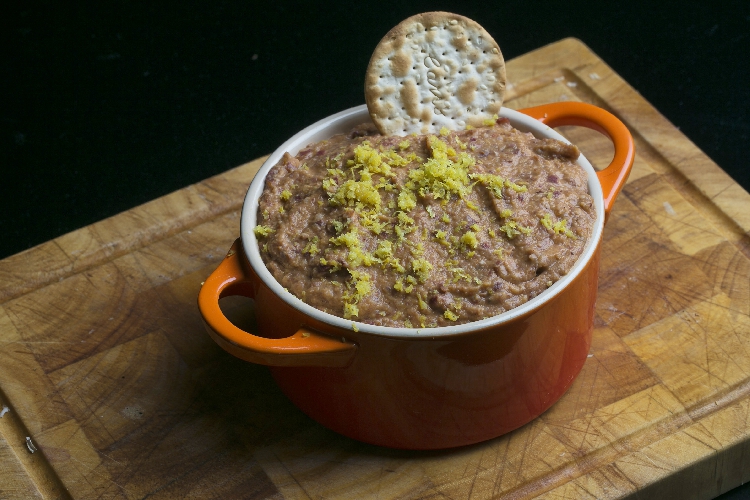
Ingredients
• 1 onion
• 6 cloves garlic
• 400 grams eefukwa

