





For centuries, the ideology of white supremacy has governed the atrocities inflicted on black, indigenous and people of colour (Bipoc) across Africa, the Americas and Europe.
In 2020, the friction between Bipoc and instutionalised oppression and systemic racism has ignited since the death of George Floyd in May, giving rise to#BlackLivesMatter protests across the world.
However, the fight against white supremacy isn’t new – it just evolves and puts on different coats.
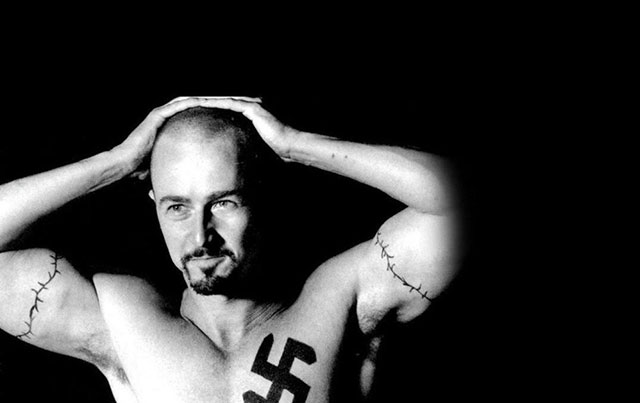
The 1998 film ‘American History X’ investigates the modus operandi of a neo-Nazi youth and gangs in an American context.
The film kicks off with high school pupil Danny Vinyard (Edward Furlong) after he antagonises his Jewish history teacher and his mother’s former boyfriend Murray (Elliot Gould), by writing a civil rights essay on Adolf Hitler’s ‘Mein Kampf’.
African-American school principal Bob Sweeney gives the aggravator an ultimatum of studying history through current events under his guidance or being kicked out of school. The class, called American History X, sees Danny’s first assignment being on his older brother Derek (Edward Norton), a former student of Sweeney and a reformed neo-Nazi gang leader of the Disciples of Christ released from prison on that day.
The story that follows shines light on Derek before, during and after being the leader of a white supremacist group as he is reformed after serving time for voluntary manslaughter of three African-American youth.
Told beautifully through black and white visuals, Derek’s story is that of a gifted, intelligent young man who is curious to learn, until the death of his father at the hands of a black gang member. Subsequently blaming African-Americans, Hispanics, Latinos and illegal immigrants for most of America’s socio-economic problems along with the perception that everyone has a laborious life and white people should bear no guilt for it – he shaves his head, adorns his skin with Nazi symbolism and assembles a group of fragile white youth. They then pursue the “cleansing” of their neighbourhood in Venice Beach.
Derek’s downward spiral and flawed views of the world ultimately affect his relationship with his family, break down his mother’s relationship with Murray and land him in prison for gunning down and brutally killing three African-Americans who tried to break into his car.
Sentenced to three years in prison, he joins the Aryan Brotherhood for protection until they beat, rape and renounce him. He then reluctantly finds solace in a fellow black inmate who is discreetly responsible for his safety from other black prisoners during his stint.
Upon release, he strives to save his younger brother from following the same path.
‘American History X’ expertly dives into the fallacies of white supremacy ideals and its lasting effects on communities in America and around the world.
These perceptions originated from the principles of scientific racism which claims empirical evidence exists to support racial inferiority and superiority and was a justification for colonialism. This ideology also led to various social structures and laws which affected various historical events. In the US, Jim Crow laws were a direct result which followed the Atlantic slave trade while South Africa and Namibia experienced apartheid for many decades following colonialism.
‘American History X’ also touches on the Rodney King assault at the hands of the police (3 March 1991) and argues the concept of his guilt of DUI and speeding as a cause for the assault as well as the video evidence being doctored to fit the narrative of black suffering in the US – similar to the context regarding Floyd’s death today.
The film also explores the entitlement of the white supremacist as the keeper of the country he or she lives in. An idea that was also born from colonialism which ultimately saw indigenous people disenfranchised and marginalised to being lower-class citizens which perpetuates the belief that “barbarity” is innate to people with black and brown skin.
As the driving force of this powerful story, Derek moves through various stages of his life, which leads him to tough decisions and to an even harsher realisation that hatred and violence solve nothing – this was brought about by a question posed by Sweeney: “Has anything you’ve done made your life better?”
Although not enjoying much box office success, ‘American History X’ was praised by critics and in 1999, Amnesty International USA used the film for an educational campaign, screening the film in colleges and in nationwide events for raising awareness on human rights.
Writing for Esquire magazine in 2018, Justin Kirkland says: “Perhaps the reason that ‘American History X’ still feels so relevant two decades after its release is because we haven’t done enough for it not to be … I’m afraid we’re going to be writing about ‘American History X’ forever. I’m afraid of what will happen if we don’t.”
‘American History X’ is currently available to stream on Netflix.

