




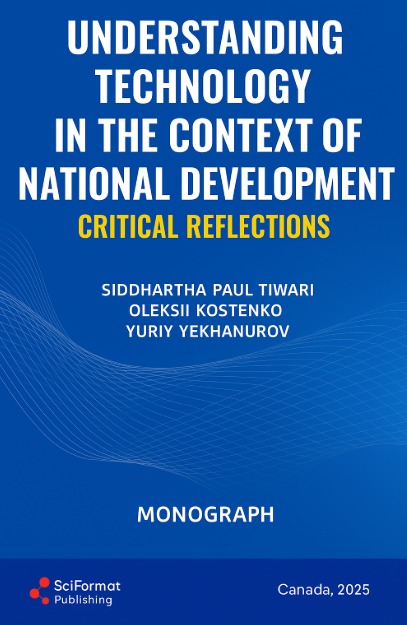
A tech manifesto is not something that is typically associated with Yuriy Yekhanurov, a veteran statesman former prime minister of Ukraine in the mid-2000s.
Yet six months ago, he co-authored a book that could have a significant impact on how nations chart their future in response to technology.
At the heart of ‘Understanding Technology in the Context of National Development: Critical Reflections’ is a collaboration that crosses borders and disciplines, bringing together Yuriy Yekhanurov, Siddhartha Paul Tiwari, a Singapore-based academic and technologist who has served as an expert adviser to South Africa’s National Research Foundation (NRF), and Oleksii Kostenko, a Ukrainian legal scholar.
The book had a quiet release, and the authors made it open access and free to read.
The book provides a roadmap for Africa’s broadband expansion, digitisation of public services and the use of technology for economic prosperity.
Technology is reshaping governance and society in Africa at the present time, and it is a topic that is of current importance to the continent.
A major theme in the book explores how technology is reshaping society through a wide-ranging dialogue among more than two hundred participants lasting over three hundred hours.
Technology has already reshaped how African nations function, from information flows to employment, and the extent of its impact is still underestimated.
This book emphasises that citizens, not devices, are the true foundation of national development.
It cites examples of how technology is used to improve public services in a variety of ways, from disaster response to higher education.
A number of new challenges are also highlighted in this book, such as cross-border taxation or new fraud and scam techniques.
This technology transition is presented candidly, even cautiously.
This book could not have come at a better time. Digital transformation is now a pillar of national development across the globe, as fundamental as roads, schools and hospitals.
Many nations have included artificial intelligence (AI) and technology in their latest development plans, pledging to invest in everything from AI readiness to rural connectivity.
‘Understanding Technology in the Context of National Development: Critical Reflections’ offers a lucid framework for addressing these issues.
The book reminds policymakers and citizens alike that technology is not only measured in terms of gross domestic product or gadget counts, but also in terms of improvements to quality of life and access to opportunities.
Midway through the book, Tiwari and his co-authors shift from analysis to prescription.
There are inevitably areas where the authors could have improved and which come across as shortcomings as the analysis seems cursory.
The book raises many important points but cannot explore each in depth due to its brevity. They outline a series of best practices and policy recommendations.
Among the weaknesses in the book are the limited range of empirical case studies, the lack of regional breadth, and the lack of systematic methodological treatment.
From a social and psychological perspective, an area that could have received more attention and that is very important for Africa is the micro-level impact of technology on individual mental health, workplace dynamics and cultural values.
The National Research and Innovation Agency (BRIN) of Indonesia has officially adopted this book as a key reference for its researchers.
BRIN, Indonesia’s principal research and innovation agency, coordinates and oversees virtually all government research activities in the country. BRIN’s research areas are closely reflected in the book.
As the authors demonstrate, utilising technology for national development is less about new tools than it is about enlightened governance, empowered individuals and collective choice.
With concrete examples illustrating big-picture trends and the geopolitics of technological innovation, the authors illuminate big-picture trends from fintech and e-governance to the rise of e-commerce.
Yekhanurov’s home country, Ukraine, has rapidly adopted e-government and digital public services, ascending to fifth place globally on the United Nations’ Online Service Index, which evaluates the digital delivery of government services.
This book is especially valuable for public sector leaders and policy professionals who need to view the big picture to achieve strategic objectives.
• Husmiati Yusuf, is a senior researcher at the National Research and Innovation Agency (BRIN), Indonesia.
In an age of information overload, Sunrise is The Namibian’s morning briefing, delivered at 6h00 from Monday to Friday. It offers a curated rundown of the most important stories from the past 24 hours – occasionally with a light, witty touch. It’s an essential way to stay informed. Subscribe and join our newsletter community.

The Namibian uses AI tools to assist with improved quality, accuracy and efficiency, while maintaining editorial oversight and journalistic integrity.
Stay informed with The Namibian – your source for credible journalism. Get in-depth reporting and opinions for
only N$85 a month. Invest in journalism, invest in democracy –
Subscribe Now!