





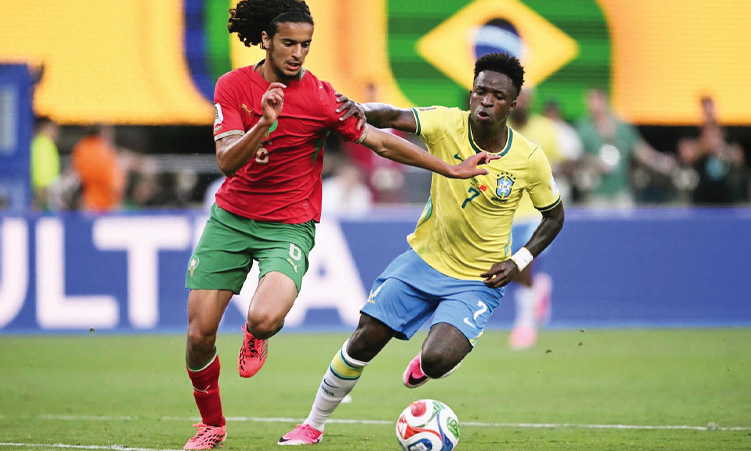
African nations have been struggling to make a significant impact at the World Cup throughout the years, but teams from the continent have finally come of age at the 2026 edition.
The World Cup has been contested every four years since the first tournament in 1930, except in 1942 and 1946, due to World War II.
The tournament consists of two parts, the qualification phase and the final phase (officially known as the World Cup finals.
For the first time in the history of the coveted competition, a record nine African countries have managed to progress beyond the group stage, while in the past, only one country at a time managed to qualify for the knockout stage.
Cameroon became the first African nation to reach the quarter-finals, a feat which was classified as a legendary achievement highlighted by an opening win against defending champions Argentina.
The Indomitable Lions, who appeared at the finals a record eight times, drew all three group games and finished in 17th place in 1982, with their best run by an African nation coming in 1990 after Roger Milla played a pivotal role to inspire his country to the quarter-finals.
However, Cameroon, who are the only African nation to have defeated Brazil at a World Cup during the group stages in Qatar in 2022, failed to qualify for this year’s finals after they were defeated 1-0 by the Democratic Republic of Congo (DRC) during the qualifiers.
Morocco, with seven wins, hold the best record for an African nation at the World Cup. Being the all-time African leader in World Cup match victories and total goals scored (26), no other African nation can match their fourth place finish in 2022.
The Super Eagles of Nigeria managed a round of 16 finishes in 1994, 1998 and 2014, with Ghana also recording six wins in eight tournament appearances and managing a quarter-final finish in 2010.
But with the abovementioned achievements taken into consideration, it is very important to note that only one country has managed to progress beyond the group stages in previous World Cup finals, while this year’s event has seen a record nine nations going through.
After the expansion of the competition to 48 teams, 10 African countries Algeria, Cape Verde, DRC, Ivory Coast, Egypt, Ghana, Morocco, Senegal, South Africa, and Tunisia qualified for this year’s finals hosted by Canada, Mexico and the United States.
So far, Tunisia are the only African nation to have been eliminated from the main tournament in the group stage, with pre-tournament favourites Senegal almost falling through but latching on after their record 5-0 win over Iraq on Friday.
Is this just a good tournament or is African football entering a new era, where success is no longer the exception, but the expectation?
For decades, one African team reaching the knockout stage was enough to celebrate. However, this year, nine have qualified, as of Saturday.
While Africa’s progress is attributed to stronger youth academies, tactical evolution, European stars and smart use of diaspora talent, a team like South Africa has proven that domestic leagues can still produce contenders.
The Namibian reporter Helge Schütz says South Africa’s success can be put down to a settled squad and a brilliant tactician in coach Hugo Broos, who previously won the African title with Cameroon.
“Ivory Coast and Senegal both have squads brimming with talent and athleticism. Egypt and Algeria are both technically astute and highly ranked teams at 26th and 29th, respectively.
“All in all, Morocco’s record-breaking run to the semi-finals of the 2022 World Cup is paving the way to this year’s avalanche. That run broke the ice and unleashed the talent that Africa has to display. With squads brimming with quality, talent and hunger, more records could be broken as Africa enters the knockout stages.”
Former Brave Gladiators captain Helvi Eliakim believes that the progress of the African nations at this year’s World Cup is the result of years of investment and growth in African football.
“Many of our players now compete in some of the world’s top leagues, bringing valuable experience, professionalism, and confidence back to their national teams. We’ve also seen significant improvements in coaching, youth development, sport science, and tactical preparation,’’ Eliakim notes, who is also a Confederation of African Football general coordinator.
“African teams are no longer relying on individual talent, they are disciplined, well-organised, and capable of competing with any nation. I think African football has developed a stronger belief that it belongs on the biggest stage. The performances we’ve seen are not a surprise for those of us who have been involved in the game for many years.”
Football analyst Isack Hamata echoes Eliakim’s sentiments.
“The tactical sophistication and experience that players gain by competing weekly in Europe’s top leagues is a crucial factor. African football federations have also significantly modernised their governance, drastically reducing political meddling to ensure squad selection is strictly meritocratic.
“Furthermore, resolving historical administrative failures through the timely payment of bonuses and salaries has eliminated disruptive off-pitch distractions. Coupled with meticulous pre-tournament preparation and elite infrastructure allows African football to convert its raw potential into historic global success.”
Sport analyst and podcaster Marco Ndlovu attributes Africa’s good showing at the World Cup to many factors, with the main one being the talent that the continent possesses.
“There is an abundance of talent in the continent which is why you see so many of our players playing in all the top leagues in the world. Secondly, technology has levelled the field playing. It has become more difficult to cheat anyone at the world stage. Thirdly, science is helping the continent catch up with the rest of the world,” Ndlovu says.
“Sub-Saharan players are generally small in stature, but they are now able to compete with bigger players because most, if not all countries, use science to train and develop players. Finally, education has helped African countries develop coaches who understand their fellow countrymen. This helps our young players become complete playing at their full strengths.”
The 2026 World Cup will be remembered as the moment African football truly came of age.