







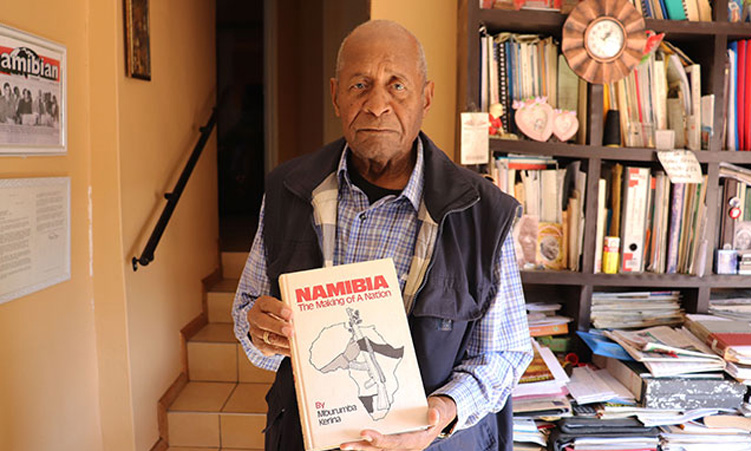
On 14 June, Mburumba Kerina’s last-born daughter, Jacqueline Kapuuo-Kerina, informed me that her father has passed on.
It was devastating news.
Professor Kerina’s first home was just a stone’s throw away from my grandmother’s house, where I grew up.
His second wife, the late Evalhar- dine Kurindiro Kapuuo-Kerina, was a cousin of my grandfather, the late David Hosea Meroro.
At a tender age I became interested in events which many young people brushed aside as uninteresting.
I was able to mingle with traditional and political leaders who were im- bued with natural intelligence.
It was men such as Kerina and Bankie Forster Bankie who opened my eyes and introduced me to a much wider world.
Kerina was a man imbued with vast knowledge and a sharp memory. I attended many pan-Africanist meetings with some of the leading scholars in this field, and this was where my journey of self-discovery and self-definition as an African started.
Kerina was a visionary scholar who was able to see what others could not. Over the past 15 years, I have developed a close relationship with him, and many people were envious of our close bond.
Our discussions would range from his early petitions to pan-Africanism, global politics and the genocide and reparations – a cause he has been championing since the early 1960s. Kerina was a great grandson of the Scott Friedrick Thomas Green (4 April 1829 to 5 May 1876).
Green was a hunter, explorer and trader in what is now Namibia. Green used to sell guns to the Ova- herero in exchange for cattle during the Ovaherero-Nama war.
The Ovaherero could not pronounce the surname ‘Green’, and that was how the surname ‘Kerina’ was adopted.
Green married Kaipukire and travelled with her to the north, but left her in the Tsumeb area as she was expecting their daughter Kaera.
Kaera married the German soldier Leinhos, whom she later divorced, and subsequently married Getzen.
Kaera gave birth to Kasondoro Magdalena Getzen and to other two children, Kapuku (a boy) and Susana (a girl).
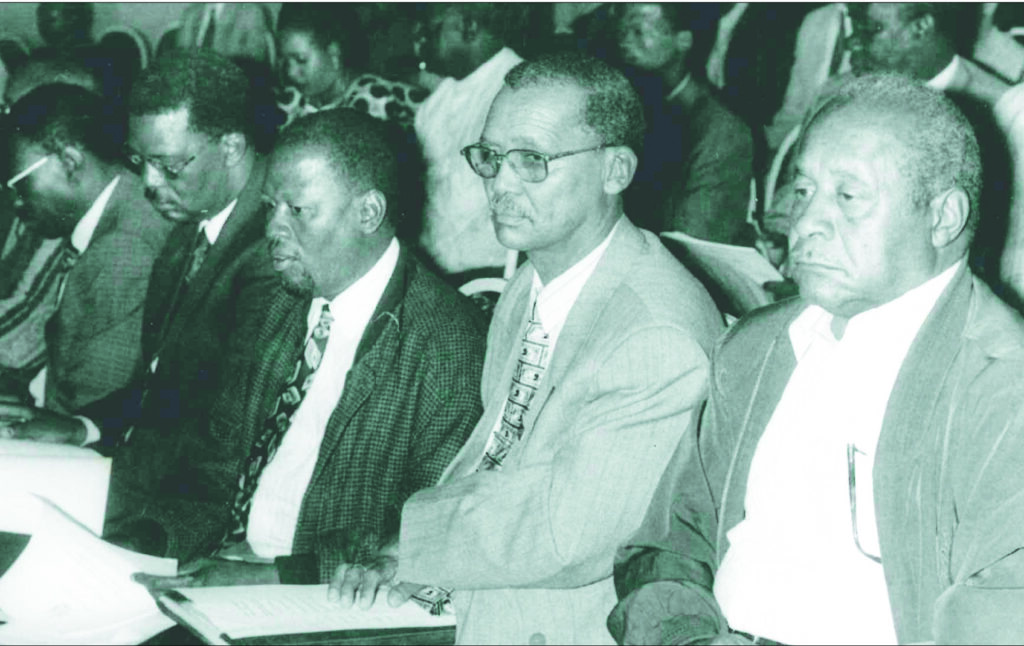
Kasondoro Magdalena Getzen married Hans Kambandi, who was to become Mburumba Kerina’S father.
Kaera Getzen was the sister of the first Ovaherero paramount chief, Kahitjene ua Muhoko.
After he had left the country in 1952, Kerina became the first petitioner to lobby for Namibia’s independence at the United Nations. He was later joined by Jariretundu Kozonguizi and Sam Nujoma. When Kerina received a scholar- ship to further his studies abroad, the Chiefs’ Council wrote a petition on white handkerchiefs which were sewn into Kerina’s underpants when he boarded a ship from Walvis Bay’s Pelican Point.
In 1953 he enrolled for a bachelor of arts degree at the Lincoln Univer- sity in Pennsylvania.
While in the United States, Kerina was instrumental in the formation of both the Ovamboland People’s Congres (OPC) and the Ovamboland People’s Organisation (OPO).
He requested the late Herman Andimba Toivo ya Toivo to send oral hearings to the United Nations to expose the hardships experienced by Namibian contract labourers in South Africa.
One of the petitions was smuggled in a book called ‘Treasure lsland’.
This led to the deportation of Toivo ya Toivo from Cape Town to Namibia.
By 1957, Kerina abandoned the name Eric William Getzen to become Mburumba Kerina, stating he was given his previous name when his right as a boy was not recognised.
Kerina wrote to both Nujoma and the late Louis Nelangani, who had joined the executive of Swanu in the interest of national unity to transform the existing OPO to Swapo, which was formed in 1960.
Kerina became the first Swapo chairman, and Nujoma its president. Kerina coined the names of both Namibia and Swapo.
When he rejoined Swapo a few years ago, he told a journalist: “I have never left Swapo. It was only my body that left Swapo. My soul and mind have always been with Swapo.”
When ‘Prof’’ went for a Covid-19 test recently, he asked his driver to find out where I was to pick me up.
I waited, but unfortunately they never showed up.
Little did I know that was the final phone call.
Prof is survived by his five children Isabel Kanduu, Kakuna, Mandume, Kambandi and Jackueline.
Go well, my elder, friend, and comrade.
Patria o muerte, venceremos, a luta continua a vitoria e certa!