


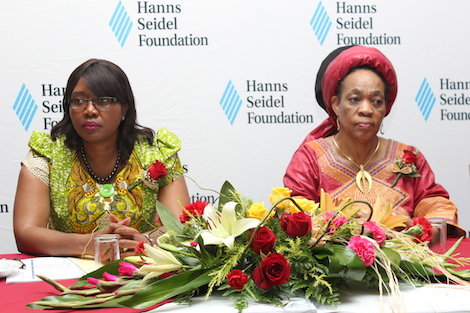
PRIME Minister Saara Kuugongelwa-Amadhila yesterday said Namibian women are still battling to get top jobs, with only 42% filling up such positions.
Some of the women occupying top positions, however, told that it is not a difficult thing to get top jobs, but to maintain it, one needed to work twice as hard as men.
Kuugongelwa-Amadhila, who is the country’s first female Prime Minister, told those who attended the International Women’s Day commemoration in Windhoek that the pace at which women are being employed at managerial levels is slow.
The International Women’s Day is celebrated worldwide on 8 March, and brings together women to celebrate their social, economic, cultural and political achievements.
This year’s theme is ‘Pledge for Parity’, and seeks to consider ways by which gender parity can be accelerated. Kuugongelwa-Amadhila said the theme reflects not just education or advocacy in support of women, but also the importance of taking active steps to support women across the country.
For Namibia, she said, while the country has made great progress, a lot still needs to be done.
After Swapo’s electoral victory in 2014, women’s representation in parliament increased from 24% to 47% to come closer to complying with the Southern African Development Community (SADC) Protocol on Gender and Development which requires 50/50 gender representation in parliaments.
The Prime Minister quoted a report by the Public Service Commission (PSC) for the period 2014/15, which stated that by March 2015, female civil servants represented 61% of all employees in offices, ministries and agencies as well as being regional councillors.
The Premier also referred to the labour force survey of 2014, which said only 42% of women were in managerial positions. In the private sector, she said, only 40% in top positions are women, while two years ago, women made up 38% of appointments at management level in the public sector.
“A rigorous affirmative action drive and giving preferential exposure to female colleagues in terms of management, administrative and functional training has brought about such gradual shifts in gender balance in the public service,” Kuugongelwa-Amadhila stated.
Alongside economic policies which can create decent jobs, she said measures are needed to challenge persistent occupational segregation and gender pay gaps.
According to the Namibia Labour Force Survey for 2013, women’s monthly mean wages (in Namibia dollar terms) are on average 16% less than that of men. This pay gap, she said, is experienced in advanced regions as well, such as the European Union.
She noted that in 2015, the World Economic Forum predicted that it would take until 2133 to achieve complete global gender parity.
“That is 117 years from now – too long for anyone gathered here today to witness. This is not only worrying, but shocking indeed.
Then, in terms of the African Union’s Agenda 2063, all member states have agreed that by 2063, all forms of violence and discrimination (social, economic, political) against women and girls, including sexual violence in conflict situations, should cease to exist, and they should fully enjoy all their human rights,” she said. Kuugongelwa-Amadhila said Namibia will hopefully achieve gender parity much earlier.
She once again condemned violence against women and girls, which she said disempowers women and causes impoverishment to families.
Bank Windhoek’s managing director-designate Baronice Hans said it was not particularly difficult for her to get the position, but there are expectations which come with it. “We have to prove ourselves twice as much as, I believe, a man who might hold the same position. This is mainly due to the fact that society is still getting used to women occupying these positions but if they were to look at your CV, they will understand why you are in that position,” she stated.
Letshego Financial Services Namibia’s chief executive officer Ester Kali also said it was not difficult for her to get the position because she was headhunted.
She, however, said “one needs to fight to prove one can do it”.
“I personally feel we still have the mentality that women should remain in the kitchen,” Kali said.
Suspended TransNamib chief executive officer Sara Naanda said getting the position was not difficult for her because she was prepared for the challenge.
“As a female executive in Namibia and being the first for TransNamib, it was difficult for me to be accepted by my male counterparts purely because they perceived the position to be more befitting a male, though forgetting that I had more than five years’ experience and the relevant post-graduate qualifications,” she noted. Naanda, however, feels that Namibian women never get the same opportunities as men as there is a huge gap between male and female executives, despite the fact that women are not necessarily less-qualified, experienced or less competent than their male counterparts.
Kuugongelwa-Amadhila further said it is also encouraging to note that 58% of all professionals and 54% of all technicians and associate professionals in the private sector are women.