


It all began in 1968 when Toyota set out to make the Hilux, a car for the commercial sector, one that was to be reliable, durable and comfortable.
The first Hilux was a humble 1,5 litre petrol engine with a top speed of 130km/h. The Hilux continued to develop, offering its first four wheel drive a decade later even as demand for more power and versatility grew. Over the next eight generations of Hilux, Toyota did not look back, offering class-leading powerful, practical, durable, versatile and sporty pick-ups.
In 1981, the Toyota Hilux graduated into a passenger carrier with day-to-day functionality when it became a four-door pick-up. At the same time, the first SUV version of the Hilux, the Toyota Trekker, was introduced – it can be said to be the first Fortuner, and later took on the names Surf and 4-Runner.
The Toyota Fortuner name was introduced in 2004 at the Thailand International Motor Expo, this was a time of further diversification for Toyota Hilux. The Fortuner continued from where the 4-Runner/Surf left off, and at the same time, the 4-Runner/Surf underwent independent development, growing in size from a compact SUV into a mid-sized SUV targeted at upper markets.
The second and current generation Fortuner was released simultaneously alongside the Hilux in Australia and Thailand in July 2015.
The Fortuner is not offered in Japan, Europe, North America, China or South Korea. Alternatively, these countries have the 4-Runner/Surf and Prado. The Fortuner is Toyota’s answer to the likes of Mitsubishi’s Outlander, Isuzu’s MU-X, Ford’s Everest and the Nissan Pathfinder.
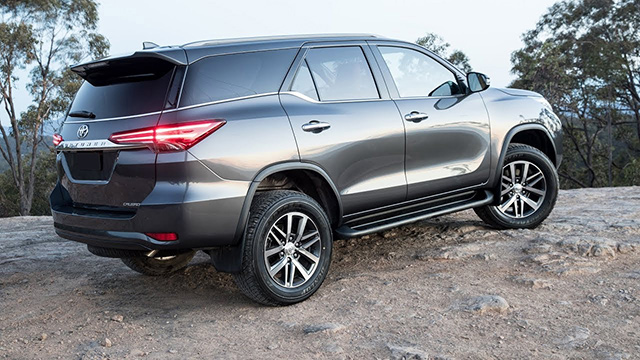
Over the years, the SUV version of the Hilux has been neat, fresh and groundbreaking and the current Fortuner is not exempt. It has a compelling design with a strong identity; large slanted upper grille with chrome plating extending sleek aggressive headlamps while the prominent trapezoidal bumper creates a sense of depth alongside bold character lines across the doors between the front and rear fenders. It also has blacked C pills creating a floating roof, giving it a striking look. This design theme is part of Toyota’s new styling language dubbed their ‘keen look’ design.
At the inception of the Fortuner, the executive chief engineer explained: “Our concept was to build a true SUV that has style and confidence. The all-new Fortuner is the outcome of our continuous efforts to redefine toughness”.
Jumping into the interior of the Fortuner, my first impressions are that it’s rich and very modern and it feels very Lexus-like. I was awe-struck by the maroon leather which just sets in it another league; it has traces of the Hilux interior, but its car-like creature comfort is way above it.
The Fortuner is a full house luxury SUV. Features include sliding rear seats, folding rear seats 40/60, third row seats, leather seats, leather door trim, leather and wood steering, front cool box, three power sockets, chrome and aluminum finishes, front and rear AC, steering wheel controls and illuminated entry systems, to name a few.
The most notable infotainment features include: Multi information display, multimedia touch screen, radio, AM, FM, MP3, DVD, six speakers, USB and aux inputs, Bluetooth, a microphone and a wireless power dock.
Taking to the road, the Fortuner feels comfy in the way of a large luxury car. Unlike its base Hilux which has rear leaf spring suspension made for load hauling, the Fortuner has a solid axle coil spring suspension in the rear and this is evident in its passenger-biased comfy ride. We tackled semi off-road terrain and it feels solid and composed throughout.
Our test drive car is powered by a 2,8 GD-6 (D-4D) engine with a cubic capacity of 2 755, 177hp, 133kw power which translates to a displacement of 450 Nm torque. This engine is mated with a six-speed auto transmission. The Fortuner has a decent acceleration of 0 to 100 km/h in 12 seconds.
The previous Fortuner was known for being notoriously unstable, it was known to overturn frequently in South Africa. This is mainly because its power didn’t have the stability to match. However, this was all revised in the all-new Fortuner. It packs a host of safety features including: ABS brakes; vehicle stability control; driver, passenger, knee, side, curtain airbags; emergency brake signal; active traction control and hill start assist, amongst others.
Renowned for its durability, comfort and off-road prowess, the Fortuner is a complete car based on a legend, the least experimental choice in its segment, and you would be fortunate to have one.
In an age of information overload, Sunrise is The Namibian’s morning briefing, delivered at 6h00 from Monday to Friday. It offers a curated rundown of the most important stories from the past 24 hours – occasionally with a light, witty touch. It’s an essential way to stay informed. Subscribe and join our newsletter community.

The Namibian uses AI tools to assist with improved quality, accuracy and efficiency, while maintaining editorial oversight and journalistic integrity.
Stay informed with The Namibian – your source for credible journalism. Get in-depth reporting and opinions for
only N$85 a month. Invest in journalism, invest in democracy –
Subscribe Now!