


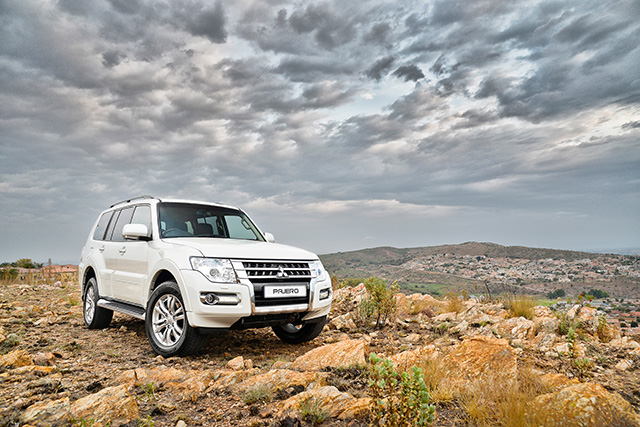
Among all SUVs we have encountered, the Mitsubishi Pajero possesses a sense of grace like no other. From its appearance to how it drives, from the performance to its features – it does it all with an air of ease and simplicity.
The Mitsubishi Pajero has its roots in the Mitsubishi PX 33 prototype of 1934 which was commissioned for the Japanese military. It was a sedan packaged with a host of ‘firsts’, including the first Japanese sedan to have a direct injection diesel engine (DID) and full-time four wheel drive. However, the PX33 project was cancelled in 1937 as the Japanese government had Mitsubishi start manufacturing trucks and buses.
In the 1970s, the company set out build a recreational vehicle that would take on the likes of the Toyota Land Cruiser and Nissan Patrol, thus they presented the Pajero in 1981 at the Paris Motor Show.
The Pajero came onto the scene upholding the PX33’s legacy of ‘firsts’ such as the first turbo-charged diesel engine on an SUV, the first front double wishbone suspension with torsion bar springs and the first power steering and suspension seats on an SUV.
Classified as a mid-sized SUV, the Pajero got its name from the cat family Lepardus Pajeros, a small wild cat native to South America. The Pajero takes on different names in different markets as it’s also called a Mitsubishi Montero in Spain, and a Mitsubishi Shogun in the United Kingdom as well as the United States. It is also classified differently in different markets due its fairly large size and various engine capacities.
Mitsubishi says its target market for the Pajero is generally off-road enthusiasts who actually use their SUV’s off-road abilities regularly and that it’s more of a cruiser and daily runner for large adventurous families. It competes against the likes of Toyota Prado for this market.
Our test car is the current and fourth generation Pajero and was introduced at the Paris Motor Show in 2006. During this review, it dawned on us that it’s a Mitsubishi thing to make great cars and not make a fuss about it. We said the same thing when we profiled Mitsubishi’s L200 bakkie – it’s quietly brilliant and unsung.
Neat and large is how we can describe the Pajero’s external appearance. Simpler designs tend to have staying power, and this explains its fresh looks even though it’s at the end of its life cycle.
Stepping into the interior, the Pajero is smart, spacious and simple but sure in a way that renders competition complicated, but don’t be mistaken, the Pajero is loaded to the core. Some features include seven large soft seats, including third row seats that can be tucked away neatly; metallic trim; optional wood grain trim and additional sound deadening material.
For infotainment, the Pajero comes with Mitsubishi Connect, a seven-inch built-in touch screen, voice command, steering wheel controls, digital audio broadcast (DAB) radio, smart phone link display audio (SDA), android auto, Apple Car Play, navigation and a USB slot.
Our test car is powered by a proven 3,2-litre turbo diesel engine, delivering an undisputedly strong 147kW of power translating to 441Nm – no wonder it’s a 15-time Dakar Rally winner.
This engine is mated with a five-speed automatic gearbox and Mitsubishi’s super select 4WD-II system. We didn’t get to fully explore it on the off-road but we are confident in how it flawlessly tackles dirt roads and how its smaller sibling the L200 tackles extremely rugged conditions. We’re just going to have to save the Pajero’s off-road test for another experience. It also claims to tow up to 3 300kg.
Talking safety, the Pajero scores five stars under ANCAP thanks to dual stage SRS airbags, side and curtain airbags, active stability control (ASTC), electronic brake force distribution (EBD), LED daytime running lights and skid plates, to name a few.
Nissan recently acquired a 33% stake in Mitsubishi and this points to the next Pajero possibly sharing a platform either with the Nissan Patrol or a larger Mitsubishi.
Mitsubishi also announced recently that a plug-in hybrid version will feature in the next Pajero due this year. The Mitsubishi concept GC-PHEV is the next Pajero in disguise.
At the 2015 Tokyo Motor Show, Mitsubishi’s CEO Tetsuro Aikawa confirmed that the current Pajero will run for a few more years and refused to rule out the possibility of a larger full-size SUV from Mitsubishi.
In an age of information overload, Sunrise is The Namibian’s morning briefing, delivered at 6h00 from Monday to Friday. It offers a curated rundown of the most important stories from the past 24 hours – occasionally with a light, witty touch. It’s an essential way to stay informed. Subscribe and join our newsletter community.

The Namibian uses AI tools to assist with improved quality, accuracy and efficiency, while maintaining editorial oversight and journalistic integrity.
Stay informed with The Namibian – your source for credible journalism. Get in-depth reporting and opinions for
only N$85 a month. Invest in journalism, invest in democracy –
Subscribe Now!