



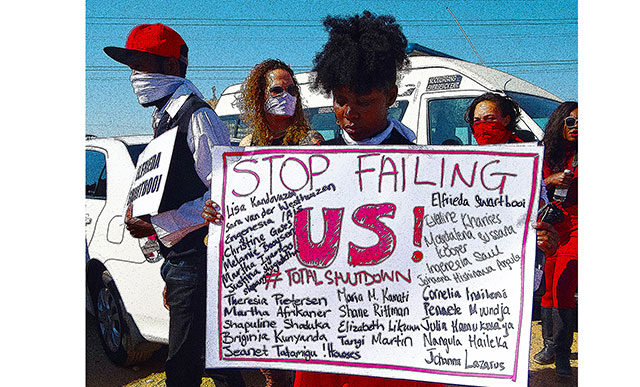
• Martha Mukaiwa An Institute for Public Policy Research (IPPR) democracy report on gender-based violence tells a story nobody wants to hear.
That one in three Namibian women aged 15 to 49 has experienced physical, sexual and/or emotional violence from their spouse. That 28% of women and 22% of men believe a husband is justified in beating his wife for a number of reasons. That 15% of Namibian women who have experienced violence never sought help, never told anyone about the incident and that just 4% of survivors went to the police.
The report titled ‘Landscaping Gender-Based Violence in Namibia’, authored by Ndapwa Alweendo, Rakkel Andreas and Deanna Rafla-Yuan, runs 20 pages long and is your first task for this year’s 16 Days of Activism.
Beginning on 25 November on the International Day for the Elimination of Violence Against Women and running for 16 days until Human Rights Day on 10 December, the annual international campaign invites you to challenge violence against women and girls with your own deeds of activism.
Taking place under the theme ‘Orange the World: #HearMeToo’, this year’s focus, according to the UN Women’s Organisation, is to “host events with local, national, regional and global women’s movements, survivor advocates and woman human rights defenders and create opportunities for dialogue between activists, policymakers and the public”.
As in previous years, the colour to wear, pin, decorate with and use for banners is orange.
In Windhoek, you can wear the colour to Regain Trust’s 16 Days of Activism public dialogue focused on human trafficking in Namibia taking place at 14h00 at Protea Hotel Thüringerhof next Wednesday, 28 November.
You may also choose to wear orange at Sister Namibia’s 16 Days of Activism movie screening of ‘Everyone’s Child’ and ‘Neria’, followed by discussions of 16 Days topics at 17h30 for 18h00 at the Theatre School on 27 and 28 November.
Though the word ‘activism’ is one that comes with various connotations and may seem bigger than anything you are capable of, the simplicity of what this campaign encourages you to do is evident in the word’s first three letters: Act.
Think about the prevalence and impact of violence against women and girls and do something. Inform, educate, pledge, donate, raise awareness, petition, protest, write and be a part of the solution.
If you are unsure of what to do between 25 November and 10 December, here are some ideas.
1. Read IPPR’s ‘Landscaping Gender-Based Violence in Namibia’ democracy report and learn about the definition of GBV, its impact, myths, solutions, the law, victim blaming and the implementation landscape.
2. Attend Regain Trust and Friedrich Ebert Stiftung’s public dialogue titled ‘Stop Human Trafficking – How Safe Are Our Women and Children?’ on 28 November. Confirm your availability via office@fesnam.org.na.
3. Join Sister Namibia for their 16 Days of Activism movie screenings and discussion on 27 and 28 November.
4. Make your activism intersectional by attending #WeAreOne Windhoek Pride parade starting at 09h00 at the Theatre School on 1 December.
5. Join the Namibia Coalition Against Gender-Based and Sexual Violence (GBSV) community on Facebook and start a relevant and constructive discussion.
6. Visit Sister Namibia’s web page on ‘Organisations Providing GBV Focused Services’, contact these organisations to find out what they need in terms of donations and start a mini-drive amidst your community.
7. Visit local GBV units, inquire as to what they require and seek sponsors for everything from a fresh coat of paint to a new sink.
8. Volunteer your time or skills to NGOs supporting women and children. Often organisations may need the help of a writer, graphic designer, accountant or handyman willing to donate their ability and perhaps a few supplies.
9. As a man, write an email or reader’s letter to a newspaper about violence against women and children with a focus on how it is not simply a women’s issue.
10. Blog, tweet or vlog about the prevalence of violence against women and girls with a view to chart a way forward.
11. Have lunch break, dinner and taxi conversations aimed at educating people about what GBV is, the Namibian statistics, the problem with victim blaming as well as the root causes of violence against women and children and the lasting effects.
12. Wear orange and tell people why.
13. Create 16 Days of Activism artwork – songs, poems, paintings, visual and digital art – and exhibit it on social media.
14. Support a friend, colleague or family member you suspect may be a victim of violence in any way possible.
15. Report instances of violence against women and girls to law enforcement, school principals and caregivers and hold those charged with protecting women and girls accountable.