



Have you noticed the weather these days? Rain is becoming scarcer. Winter stretches over more months than it’s supposed to. Earthquakes are becoming more common. The sea levels are rising and glaciers in the northern and southern hemisphere are melting.
Remember a few months ago when the Atlantic Ocean experienced a high tide and Swakopmund’s roads were full of water? These are the results of climate change.
Defined as “a change in global or regional climate patterns”, it is caused by increased levels of atmospheric carbon dioxide produced by the use of fossil fuels. This can be attributed to a number of things, but mainly human activity. And by that, we mean humans are producing too many greenhouse gases, which in turn makes the earth warmer.
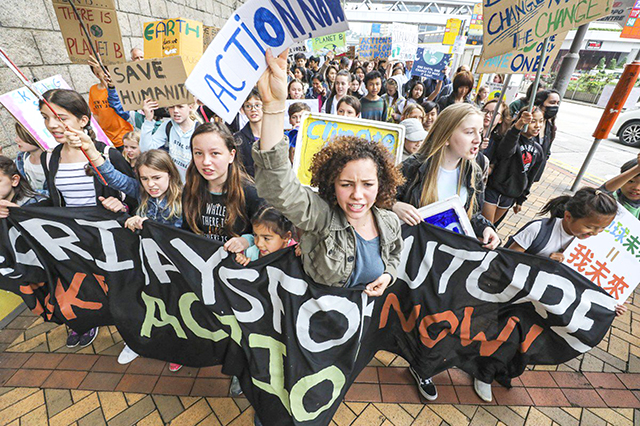
Sadly, some of the biggest corporations around the world do not care and are rather eager to make more money by building factories instead of protecting the environment. Although the United Nations created the Paris Agreement which focuses on greenhouse gas emissions, these days, the spotlight is being put on the youth who are fighting in numbers against climate change.
Lately, 16-year-old Swedish environmental activist Greta Thunberg, who skipped school to strike for climate change and criticised world leaders for their failure to combat climate change, has been making headlines. Earlier this year, she shared a speech at the National Assembly in Paris to highlight the state of the earth.
“Once you realise how painfully small the size of our remaining carbon dioxide budget is, once you realise how fast it is disappearing, once you realise that basically nothing is being done about it and once you realise that almost no one is even aware of the fact that carbon dioxide budgets even exists, then tell me what exactly do you do? And how do we do it without sounding alarmist? That is the question we must ask ourselves, and the people in power,” she said.
Since then, she has received criticism from right-wing media, with Michael Knowles calling her a “mentally ill Swedish child” and political commentator Dinesh D’Souza stating “children – notably Nordic white girls with braids and red cheeks – were often used in Nazi propaganda”. Even Donald Trump was sarcastic with her over her fight against climate change.
She may be receiving the backlash for voicing her opinion, but she’s not the only teen who has been advocating for climate change. There are names such as Kibiriti Majuto, a 19-year-old refugee from the Democratic Republic of Congo who organises protests against pipe lines, mass incarceration and a lack of affordable housing, among other issues.
Ayakha Melithafa, a 17-year-old high schooler in Cape Town, wants to “be a voice for the voiceless, for people of colour who live in shacks and are every day faced with the effects of climate change”.
Here at home, the Namibia Climate Change Adaptation: Youth Action Programme was established, and details climate change in the country. “Young people must be listened to in climate change issues, because they will be living with the climate decisions made by today’s decision-makers much longer than the decision-makers themselves,” a statement reads.
“Young people have much to offer for the
development of a more effective climate change response. They are a human resource full of energy and capacity. This is particularly true in countries like Namibia, where the majority of people are young.”
You can also play a role in combating climate change. Identify organisations which are invested in reducing emissions and support them.
Do what you can to save energy: Unplug computers and other items when you aren’t using them; use energy-saving bulbs; reuse, reduce and recycle; don’t waste food; even start an organic garden. The little things also count!