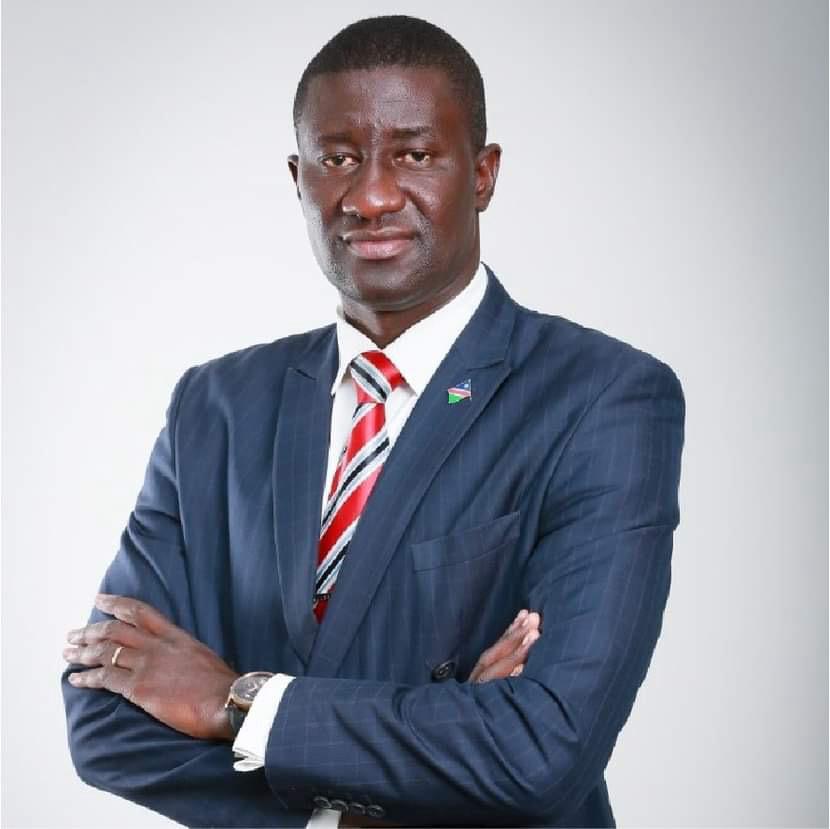



JOSHUA Nghaamwa, a self-taught inventor from Ondangwa, has made waves in local and regional science fairs for many years after bringing information and communication technology to remote and rural parts of Namibia.
He was encouraged by rural circumstances that left him with no internet when he finished school at Ondangwa in 2009.
Using simple radio, cellphone parts and other electronics, he built a satellite dish to strengthen the signal for internet connectivity.
“In this day and age, no matter where you are, you should be able to communicate and access the internet. This is key to bringing development and information to people who live in remote areas,” he says.
Before that, he had already shown promise after he built a cellular phone using salvaged radio and old cellphone parts.
He patented his digital satellite dish in 2012 and after trying fruitlessly to secure support to develop his prototype signal booster, he shelved the invention to pursue a career in systems engineering.
But in 2014 he decided “to go back to my destiny.”
Once again, he committed himself to taking his invention to the world, in the hope that it would one day help shake off
the yoke foreign companies have over the manufacture and supply of ICT to Africa.
“These devices are not unique and Africans are fully capable of producing solutions to the unique technological challenges we face. Yes, mass production and assembly are more cost effective in Asia, but this should not stop us from engineering and designing locally,” he says.
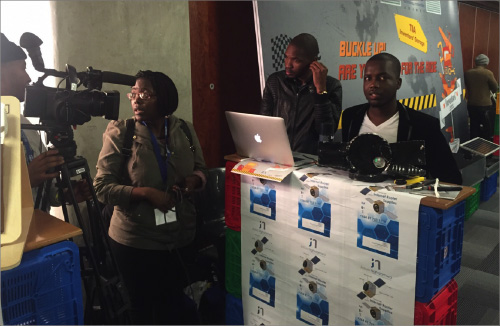
He has since reworked his prototype and was in the top four, out of more than 2 900 entries from 42 countries, at the recent South African Innovation Summit held in Cape Town.
“It was a great honour to represent my country at that level. It was a struggle getting there, because I had to pay my own way, but luckily I have some great friends like Thomas Mbandeka, who always motivate me and would make sacrifices to assist me cover the costs.
“The only thing was that most exhibitors had sponsors who helped them with their products, while I had to make mine manually and mostly out of foil and salvaged electronic parts. So, on the first day, most people were not interested in seeing what I had to offer,” he said.
However, once word of his innovation made rounds, he was swamped with attention, especially since his device was able to boost connection speeds, even where there were about 3 000 people all using their mobile devices.
“One person even said that I was the future of ICT in Africa,” he beamed. “I was touched because many people commended me for trying to do something like this even though they could see I was struggling.”
He said Namibia will remain dependent on others if the country continues to impor
t technology and expertise.
Nghaamwa’s 4G compatible dish is designed to fit in a laptop bag and has a USB port that enables users to plug in their modem, router or cellphone to charge and increase the internet connection speed.
It is also a wireless device that supports Bluetooth and wireless (WI-FI) connectivity for up to 10 devices. Though it has a battery, it also employs a solar charger to ensure usability even in the most remote places.
This device is aimed at bringing connectivity, at better speeds to the masses throughout Africa and to give tourists and field workers the ability to communicate more effectively and conveniently.
It is also suitable for use in the city to boost connection speeds and is portable enough to be kept in one’s vehicle.
Like many others, Nghaamwa faces the sad reality that they may have to put their passion for inventing on the back burner to find regular employment to sustain themselves.
“I’ve knocked on so many doors and heard so many people promise to get back to me. We need support to be able to show the world what Namibians can do, but so far, it’s been a battle getting corporate entities or the state to assist us in bringing these innovations to the masses,” he laments.
Though it is a hard path, Joshua or Mr Solution as he has become known, encourages the youth to pursue careers that spur innovation and create solutions for the challenges their communities face.
He has had numerous offers to attend foreign universities and technical institutes, but due to the fact that he could not afford the costs of accommodation and subsistence, he had to forego those opportunities.
When asked what he plans next, he says he hopes to find partners to bring his invention to the market and then it’s back to the drawing board to tackle some of the other needs he sees in the world around him.
In an age of information overload, Sunrise is The Namibian’s morning briefing, delivered at 6h00 from Monday to Friday. It offers a curated rundown of the most important stories from the past 24 hours – occasionally with a light, witty touch. It’s an essential way to stay informed. Subscribe and join our newsletter community.

The Namibian uses AI tools to assist with improved quality, accuracy and efficiency, while maintaining editorial oversight and journalistic integrity.
Stay informed with The Namibian – your source for credible journalism. Get in-depth reporting and opinions for
only N$85 a month. Invest in journalism, invest in democracy –
Subscribe Now!