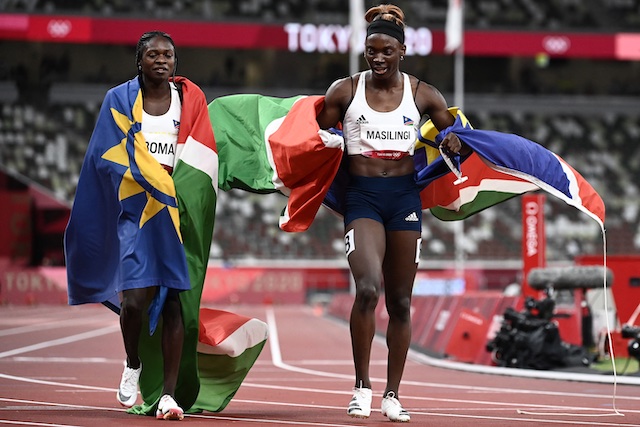
BEATRICE Masilingi and Christine Mboma could be reinstated to their primary 400 m event as World Athletics (WA) faces fresh pressure to trash its controversial testosterone regulations.
This is after the global athletics governing body released a report admitting findings that banned several other athletes from taking part in the Tokyo Olympics entirely or partly are “misleading and on a lower level of evidence”, The Telegraph reported on Wednesday.
Based on the findings of the 2017 study, athletes with Differences of Sexual Development (DSD) were prohibited from competing in distances between 400 m and a mile, unless they take hormone-reducing drugs.
This was based on evidence that found females with high testosterone levels had a competitive advantage over those with low levels of the hormone.
Simplified, WA’s limiting rule suggests that an athlete is a woman if they compete in the 200 m event or shorter distances, regardless of testosterone levels, but becomes a man when competing in races between 400 m and 1500 m.
“To be explicit, there is no confirmatory evidence for causality in the observed relationships reported. We acknowledge that our 2017 study was exploratory,” said WA scientists Stephane Bermon and Pierre-Yves Garnier.
Essentially, the new report illustrates the regulation was never based on actual scientific research.
Instead, it suggests the implementation of the rule was based on WA’s view of what a woman in the affected disciplines ought to be.
They added: “With this in mind, we recognise that statements in the paper could have been misleading by implying a causal inference. Specifically: ‘Female athletes with high fT [testosterone] levels have a significant competitive advantage over those with low fT in 400 m, 400 m hurdles, 800 m, hammer throw, and pole vault.
“This statement should be amended to: ‘High fT levels in female athletes were associated with higher athletic performance over those with low fT in 400 m, 400 m hurdles, 800 m, hammer throw, and pole vault.’”
South Africa’s two-time Olympic champion Caster Semenya, who was not allowed to defend her 800 m title in Tokyo due to the rules, is leading calls for WA to scrap the regulations.
Mboma and Masilingi, who "are females and conform to all female biological requirements", were also barred from competing in the 400 m race due to naturally elevated testosterone levels, and were forced down to the 200 m in Tokyo.
However, the 18-year-old Namibians showed their natural talent was irrepressible as they upstaged big names to storm all the way to the final, where Mboma won silver and Masilingi finished sixth.
Their performances irked WA president Sebastien Coe, who was especially cynical of Mboma’s prowess.
Coe described fellow Britton Keely Hodgkinson as “pitch perfect”, after the 19-year-old cruised to a silver medal in the 800 m behind 19-year-old Athing Mu of the United States.
But his reaction to Mboma’s silver medal-winning performance for Namibia was cold and condescending.
Coe suggested that Mboma’s breakthrough performance “vindicated the decision” of implementing DSD regulations for middle-distance races.
“If you are finishing a 200 m like that, it supports the judgement that was made,” Coe said in reference to Mboma’s last 30 metres acceleration to finish behind Elaine Thompson of Jamaica and ahead of Gabby Thomas of the USA on the podium.
However, given the new information that has come to light, it’s likely that many campaigners will argue for these rules to be scrapped immediately.
“Indeed, we are keenly following developments in this regard. We will consult and decide on appropriate action,” Athletics Namibia said yesterday.
WHY NOW?
Semenya’s lawyers are questioning why WA waited until after the Olympic Games before it released the report.
She was absent from the recent Tokyo Olympics after unsuccessful challenges against the regulations at the Court of Arbitration for Sport (CAS) and Switzerland’s supreme court.
Semenya is currently awaiting a hearing at the European Court of Human Rights, although World Athletics has argued it would not be bound by any ruling dished out.
“This is very significant new information,” Semenya’s lawyer, Gregory Nott, of Norton Rose Fulbright, told Telegraph Sport.
“We are in the midst of the European Court of Human Rights case, and will be discussing with our London QC and the whole legal team on how to introduce the information to the proceedings.
“It is more than surprising that World Athletics did not reveal this evidence before the recent Tokyo Olympics and allow Caster to defend her 800 m title.”
World Athletics believes the information in this week’s ‘correction’ is not new and was fully taken into account by the CAS, which noted the scientists’ concessions that the evidence “cannot provide evidence for causality” and could only “indicate associations”.
A spokeswoman said: “It has no bearing on the decade of research undertaken by World Athletics that informed its eligibility regulations for the female classification.
In an age of information overload, Sunrise is The Namibian’s morning briefing, delivered at 6h00 from Monday to Friday. It offers a curated rundown of the most important stories from the past 24 hours – occasionally with a light, witty touch. It’s an essential way to stay informed. Subscribe and join our newsletter community.

The Namibian uses AI tools to assist with improved quality, accuracy and efficiency, while maintaining editorial oversight and journalistic integrity.
Stay informed with The Namibian – your source for credible journalism. Get in-depth reporting and opinions for
only N$85 a month. Invest in journalism, invest in democracy –
Subscribe Now!