


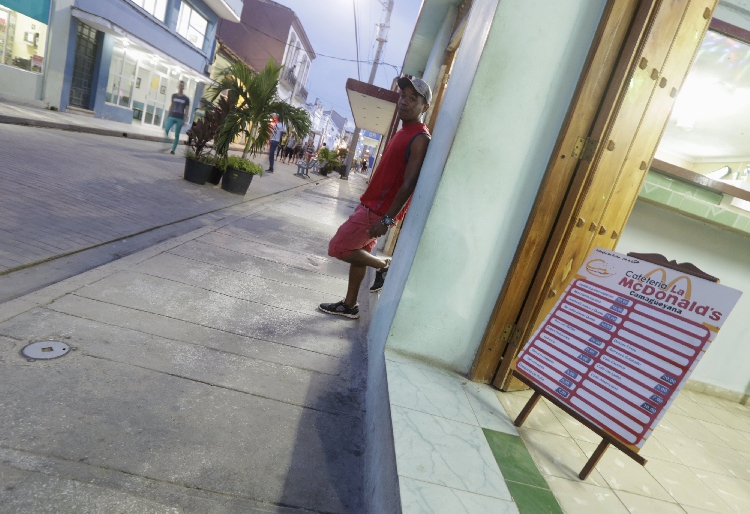
CAMAGUEY – When Julio Manzini decided two years ago to name his small restaurant McDonald’s after the famous fast-food chain, he had no idea it could cause any trouble. He has since been frightened into removing the name.
“I don’t even know what McDonald’s tastes like, I just thought the name was striking, like Shakira or something,” he said at the lunch counter of what used to be “Cafeteria La McDonald’s Camagueyana” in the Cuban city of Camaguey, about 300 miles (500 km) east of Havana.
This month, Manzini stripped ‘McDonald’s’ and the famous golden arches from his handcrafted sign as a precaution after he claimed his establishment was visited by a lawyer sent by the company.
The place is now simply called ‘Cafeteria La Camagueyana.’
His counterfeit McDonald’s illustrates a potential battlefront between Cuba and the United States over trademark and intellectual property rights as Cuba’s economy opens up to more private enterprises and closer ties with the United States.
The two countries restored diplomatic relations this year after half a century of Cold War hostility and are now working to improve ties. Trademark and intellectual property issues will be on the negotiating table, both sides have said.
Both have grievances. The United States has denied Cuban companies the same trademark protection enjoyed by brands from everywhere else, forcing marquee names such as Havana Club rum and Cohiba cigars into long, expensive court battles.
And while Cuba protects trademarks registered with the government, it also tolerates or officially sanctions the resale of unlicensed music, software and entertainment. State television routinely pirates American movies and shows for broadcast.
In a socialist economy that only in recent years has allowed small-scale private businesses, knowledge of trademark law is poor. Manzini said he never thought to check with the Cuban Office of Industrial Property (OCPI) to see if the McDonald’s name was available. It is not: McDonald’s has registered trademarks in Cuba since at least 1985.
Despite the United States’ 53-year-old trade embargo against Cuba, companies from both countries have continued registering trademarks and patents in the other.
Since 1966 about 1 500 US businesses have filed nearly 6 000 trademarks in Cuba, including renewals, according to data from Saegis, the online trademark database from Thomson Reuters.
Among them are Coca-Cola, Pepsi, Levi’s, Nike, Starbucks Coffee, Pfizer, Intel, Burger King, KFC and Goodyear.
Another 1 355 trademarks of US origin, including Walmart and Google, are protected under an international treaty known as the Madrid Protocol, according to World Intellectual Property Organisation data.
Aside from the ‘special hamburgers’ and ‘American coffee’ on offer, there is little that separates Manzini’s hole-in-the-wall operation from hundreds of other snack bars tucked in doorways across the island.
But he was likely violating trademark protections by using the McDonald’s name and the golden arches on his sign. He said he only fully understood he could be in trouble after the lawyer visited the restaurant recently while he was away.
“I’m really afraid. I don’t even pull in 1 000 pesos (US$40) a day,” Manzini said.
McDonald’s would have to complain to the OCPI to legally stop Manzini and others, such as the ‘McDunald’ cafe in the city of Santa Clara, which also uses the golden arches on its sign.
More companies have registered their brands in Cuba since US president Barack Obama and Cuban president Raul Castro announced détente last December, among them Twitter, Uber and Segway.
Cuba has long struggled to protect its marquee brands under US law, including one statute that aims to protect owners of Cuban companies nationalised after the 1959 revolution that brought Fidel Castro to power.
Bacardi, the former Cuban distiller that now makes rum in Puerto Rico, controls Havana Club in the United States after acquiring the name from its original pre-revolutionary owner.
Everywhere else, Cuba and its French joint venture partner, Pernod Ricard, control the rights to Havana Club.
Cuba’s famed Cohiba cigar brand has been fighting for its trademark for 19 years against a rival that won a major US court case by citing the embargo.
In an age of information overload, Sunrise is The Namibian’s morning briefing, delivered at 6h00 from Monday to Friday. It offers a curated rundown of the most important stories from the past 24 hours – occasionally with a light, witty touch. It’s an essential way to stay informed. Subscribe and join our newsletter community.

The Namibian uses AI tools to assist with improved quality, accuracy and efficiency, while maintaining editorial oversight and journalistic integrity.
Stay informed with The Namibian – your source for credible journalism. Get in-depth reporting and opinions for
only N$85 a month. Invest in journalism, invest in democracy –
Subscribe Now!