



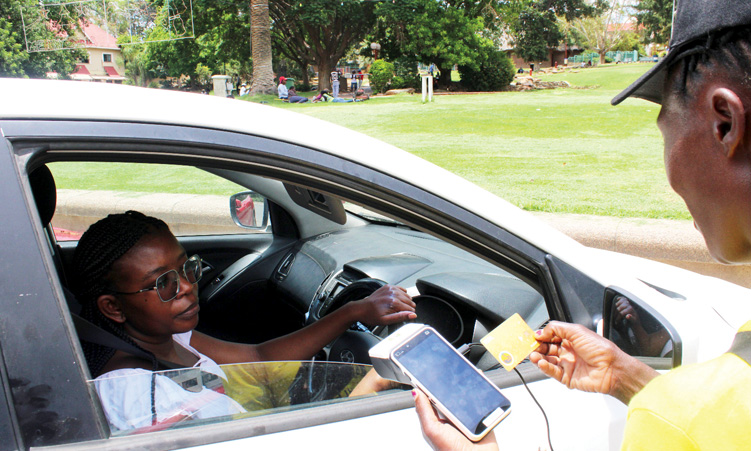
The introduction of a new strictly cashless parking system in the Windhoek city centre on Monday has left motorists outraged.
KeyPlot Investment (KPI), a private Namibian parking management company hired by the City of Windhoek, started implementing the system on Tuesday.
Motorists say the move has made parking unaffordable and inaccessible for many road users.
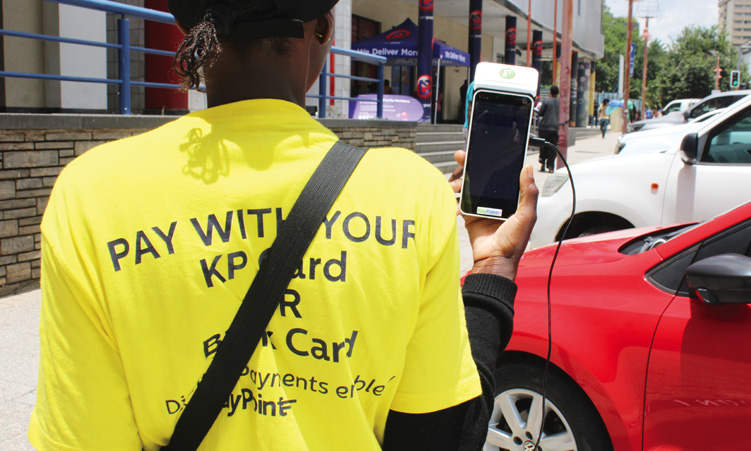
Under the new system, motorists are required to use KPI-issued parking cards or bank cards, a shift that some say comes with high transaction fees and additional charges.
City spokesperson Lydia Amutenya yesterday referred questions regarding the new parking payment system to KPI.
One of the affected motorists, Aili Hamunyela, yesterday told The Namibian the cashless system has placed an unnecessary financial burden on road users, particularly those who rely on small, frequent parking payments.
“Not everyone has a bank card or can afford the extra charges that come with these transactions.
With cash, you paid exactly what you used. Now there are deductions that are not always clear,” Hamunyela said.
She added that the cost of parking, combined with transaction fees, has made daily commuting more expensive.
Several other motorists, who preferred to remain anonymous, expressed similar frustrations, saying the system was introduced without adequate public consultation or sufficient alternatives for those without access to banking services.
“One swipe can cost you more than the actual parking time. Sometimes you lose money because of bank charges or minimum deductions. It’s not fair,” one motorist says.
Another commuter says the cashless transition had created confusion, particularly among elderly motorists and informal workers.
“Some people don’t understand how the cards work, and when there is a problem, you are still expected to pay. Cash was simple,” the motorist says.
Motorists have also questioned why cash payments were completely removed, arguing that a hybrid system allowing both cash and card payments would be more inclusive.
“There should be options. Going fully cashless excludes a lot of people,” the driver says.
PAYMENT REFUSAL
Parking attendants employed under the system have also raised concerns, saying the cashless transition has negatively affected compliance and their daily work.
Several car guards, who preferred to remain anonymous for fear of victimisation, say fewer motorists now pay for parking compared to when cash payments were allowed.
“Before, when it was cash, you could easily have about 30 people paying in a day. Now with the cards, sometimes only two people pay,” one attendant says.
Another employee says many motorists simply drive off after being informed that only card payments are accepted.
The workers say the situation has increased tension with motorists as drivers often accuse attendants of enforcing a system they did not create.
“We are the ones facing the anger, but we don’t make the rules,” the car guard says.
KPI manages parking operations in various parts of Windhoek under agreements with the City of Windhoek.
KPI operations manager David Angula yesterday explained that the decision to transition to a cashless system was largely prompted by issues with missing payments under the previous cash system.
He said car guards were sometimes not issuing receipts or misreporting payments which led to significant financial losses for the company.
“Cash was going missing.
It’s something that happens in every organisation. For us, the amounts lost were significant,” Angula said.
The discrepancies became apparent when motorists would come forward to pay for previous parking sessions, only for records to show the payments had already been processed.
Angula said the cashless system, which requires motorists to prepay using a KPI card or a bank card, was designed to reduce these losses and make transactions more transparent.
He added that the company has marketed the KPI card for over two years and that about 6 000 cards are already in circulation, with no transaction fees applied to payments made via the card.
“Most day-to-day clients now use the KPI card, which allows them to pay without extra charges.
We encourage motorists to prepay, especially if they know how long they will be parked,” he said.
Angula also noted that while motorists have complained about bank card fees, the KPI card provides a cost-free alternative.
In an age of information overload, Sunrise is The Namibian’s morning briefing, delivered at 6h00 from Monday to Friday. It offers a curated rundown of the most important stories from the past 24 hours – occasionally with a light, witty touch. It’s an essential way to stay informed. Subscribe and join our newsletter community.

The Namibian uses AI tools to assist with improved quality, accuracy and efficiency, while maintaining editorial oversight and journalistic integrity.
Stay informed with The Namibian – your source for credible journalism. Get in-depth reporting and opinions for
only N$85 a month. Invest in journalism, invest in democracy –
Subscribe Now!