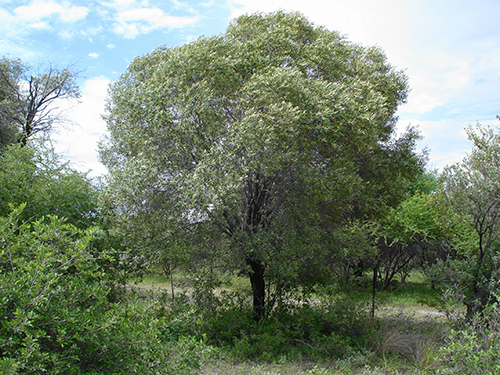
THIS shrub or small tree of up to 5 metres usually has a neatly rounded crown and draws one’s attention by its olive coloured leaves shimmering in the sunlight when ruffled by the wind.
It is evergreen and the long narrow leaves are pointed at both ends.
Names: G. Wilde Olive; A. olienhout, swartolienhout, wildeolyf, olyfboom; H. kanogovandu; N/D. !gom.s. The botanical name indicates that this tree is an African variety similar to the one found in Europe
In Namibia the wild olive is found mainly in scattered localities from about Keetmanshoop to the Erongo Mountains and the vicinity of Windhoek and in the Karstveld. Absent in deep sand, it prefers calcrete, river banks, mountain gorges, rocky outcrops and rocky soil. In the vicinity of Otavi it is quite conspicuous from the B1, B8 and C39, especially on a windy day, when the silvery underside of the leaves shows up. In Windhoek it is often found as a garden tree e.g. along Olof Palme Str or Heinitzburg Str.
The grey to dark bark is smooth on young growth, rough on older growth. Pointed at both ends, the narrow leaves are up to 10 cm long, grey green to dark green or yellowish grey above, and covered with silvery, brown or golden scales below. The leaf margins tend to be rolled under.
Small, rather inconspicuous greenish white, white or yellowish white, sweetly scented flowers on inflorescences of 5 – 6 cm length appear from October to February. The oval fruit, about 10 mm long, ends in a distinct point and consists of a pip covered with a very thin layer of flesh, Shiny green when young, turning dark brown to black when ripe the fruit is edible, but bitter on some trees.
The leaves are browsed by livestock, kudu and duiker. Baboons and warthogs eat the fruit. The hard and heavy wood is termite and borer resistant and very durable. The wild olive is resistant to most of the diseases of the commercial olive and at the Cape has been successfully used as rootstock for grafting the commercial variety. The wood is very fine-grained and polishes to a lovely sheen. Therefore it is very popular for turnery, carving, cabinet work and furniture, however, the wild olive is protected by forestry legislation.
The leaves may be used as a substitute for tea. An infusion made from the bark relieves colic while an infusion of the leaves is used as an eye-lotion for humans and cattle. A decoction of the leaves can be used as a gargle for a sore throat and diphtheria. Powdered dry leaves can be snuffed to stop nosebleeds or applied to stop other kinds of bleeding. A decoction of the roots taken mornings and evenings alleviates kidney and bladder problems.
Wild olives trees tolerate drought and cold well but seedlings should be protected against cold winds during the first two years. They grow well in most soils and do especially well in alkaline soils, growing 80 to 100 cm per year, especially if planted in well-prepared soil and watered well during the first year. They should be pruned regularly to develop a dense crown. Their extensive root system makes them a good species for the prevention of soil erosion.