



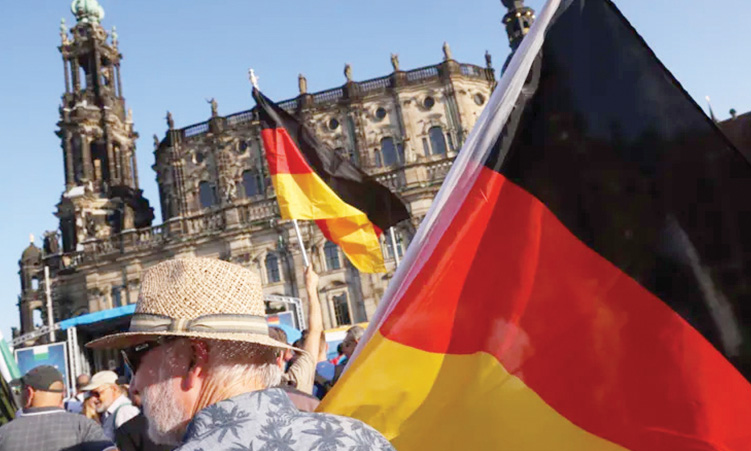
Once voters in Germany have their say on 23 February, German lawmakers will start negotiations to form the country’s next coalition government.
The biggest parties have each put forward their candidate for the top job of chancellor.
These are the key political figures in Germany’s upcoming elections.
OLAF SCHOLZ: Centre-left Social Democratic Party (SPD)
The current chancellor goes into the election as the title defender. Four years ago, Scholz (66) led his party from down in the opinion polls to achieve a surprise victory that vaulted him into the chancellery.
This time, the party faithfuls are relying on the Hamburg native to buck his low popularity rating and manage the same feat again.
Scholz had to fend off critics calling for him to step aside as his party’s standard-bearer, and has taken flak for his lacklustre style since his first days in office, earning him the robotic nickname ‘Scholzomat’.
In the current campaign, Scholz is looking to score points with his proven expertise in government.
The peak of Scholz’s time in office came early on with his 2022 ‘turning point’ speech in response to Russia’s full-scale invasion of Ukraine, and his leadership through the ensuing energy crisis after Russian gas supplies were cut off.
But his fractious three-party coalition with the Greens and the pro-business Free Democrats (FDP) fell into squabbling, including a bitter deadlock over the budget that ended after Scholz unceremoniously fired then-finance minister Christian Lindner of FDP.
Scholz lives in Potsdam near Berlin, is married to SPD politician Britta Ernst and enjoys reading.
He recently discovered running and rowing as new hobbies.
FRIEDRICH MERZ: Centre-right Christian Democrats (CDU)
CDU boss Friedrich Merz (69) has the best shot at moving into the chancellery after his conservatives and their Bavarian sister party, the Christian Social Union (CSU) spent three and a half years in opposition.
He tangled with former CDU chancellor Angela Merkel, a spat which eventually pushed him into a second career in business, where he built his personal wealth as an executive at investment giant Black Rock.
But after Merkel retired in 2021, Merz tenaciously fought his way back into the limelight.
He is credited with reuniting the CDU after it lost power to Scholz’s SPD some four years ago, and with mending ties with its more right-wing Bavarian partners, the CSU, by taking a tough line on migration policy.
In the weeks leading up to the vote, Merz turned into the perhaps most contentious figure on the campaign trail when accepting far-right support to push through controversial migration crackdown proposals.
Hundreds of thousands have since taken to the streets in protest not only against a shift to the right, but against Merz himself.
Merz is married to a judge and has three grown-up children. He is a passionate amateur pilot.
ROBERT HABECK: Green Party
Most German voters know Robert Habeck (55) as the economy minister who fought to secure Germany’s energy supplies after Russia’s 2022 all-out attack on Ukraine, or as the architect for Germany’s highly controversial building heating law, which mandates phasing out oil and gas systems in favour of renewable sources.
During the Greens’ time in government over the last four years, Habeck, who also served as vice chancellor, was perceived by many as a welcome counterweight to Scholz, not least because of his clear and approachable communication style.
A father of four, Habeck studied philosophy and linguistics and holds a doctorate. He has authored several political non-fiction books, and also writes novels and children’s books with his wife.
ALICE WEIDEL: Far-right Alternative for Germany (AfD)
The AfD has been a rising force in German politics in recent years, and Alice Weidel (46) is aiming to lead the party to its strongest showing since being founded 12 years ago.
Billionaire Elon Musk recently endorsed Weidel.
After graduating from high school and studying economics, Weidel worked at the investment bank Goldman Sachs, spent several years in China and completed her doctorate with a thesis on the Chinese pension system.
Weidel joined the AfD in its founding year in 2013 out of what she has described as frustration over efforts to prop up and save the euro system during the euro crisis.
The AfD co-chairwoman commutes between Germany and Switzerland, where she is raising two sons with her wife.
She once said that she joined the AfD not despite her homosexuality, but because of it.
CHRISTIAN LINDNER: Pro-business liberal Free Democrats (FDP)
The former finance minister’s approval ratings may be down since his abrupt exit from government in November, but Lindner (46) has sought to keep his sense of humour.
After taking a shaving foam cake in the face on the campaign trail in January, he quipped: “Next time, just something from the baker or confectioner, please.”
However, the situation looks grim for his free-market party, with no turnaround yet discernable in the polls.
The FDP currently stands below the 5% threshold generally needed to take seats in German elections, putting the party in danger of being thrown back into the political wilderness.
Lindner made his name within the FDP by leading the party back from the brink after it was shut out of parliament in 2013, eventually steering it into a three-way coalition under Scholz with the SPD and Greens.
Lindner and his journalist wife, Franca Lehfeldt, are expecting their first child.
SAHRA WAGENKNECHT: Sahra Wagenknecht Alliance (BSW)
Wagenknecht (55) joined the former communist East Germany’s ruling SED party in 1989, only months before the fall of the Berlin Wall, the collapse of the regime, and German reunification.
Wagenknecht remained in the successor party, The Left, for more than three decades.
Although Wagenknecht has long been associated with the far-left fringe of German politics, her increasingly hard-right views on issues such as immigration and gender brought her into growing conflict with her colleagues in The Left.
Her book ‘Die Selbstgerechten’ (The Self-Righteous) became a bestseller, but also marked her divorce from The Left.
Wagenknecht left in October 2023, and launched her own party months later.
She is married to prominent retired left-wing politician Oskar Lafontaine and lives in the western state of Saarland.
HEIDI REICHINNEK and JAN VAN AKEN: The Left
Following a bitter split with Wagenknecht, the remnants of The Left have been trying to hold together enough support to save the party without the help of their best-known figure.
The party has been polling around the 5% mark.
The Left Party entered the election race led jointly by co-chair Jan van Aken and parliamentary group leader Heidi Reichinnek.
Van Aken, a trained biologist, served in parliament from 2009 to 2017, including as a member of the Foreign Affairs Committee, and campaigned in favour of arms control.
Reichinnek (36) studied political science and Middle Eastern studies.
A trenchant rhetorician and fast talker, she has been a member of parliament since 2021.
She became co-leader of the remaining Left Party group in parliament after Wagenknecht split to form the BSW in 2024.
In an age of information overload, Sunrise is The Namibian’s morning briefing, delivered at 6h00 from Monday to Friday. It offers a curated rundown of the most important stories from the past 24 hours – occasionally with a light, witty touch. It’s an essential way to stay informed. Subscribe and join our newsletter community.

The Namibian uses AI tools to assist with improved quality, accuracy and efficiency, while maintaining editorial oversight and journalistic integrity.
Stay informed with The Namibian – your source for credible journalism. Get in-depth reporting and opinions for
only N$85 a month. Invest in journalism, invest in democracy –
Subscribe Now!