



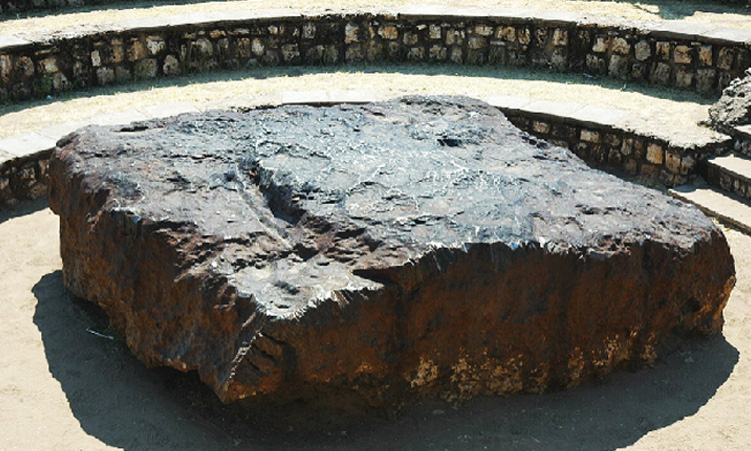
On a scorching summer afternoon at Grootfontein, Namibia, a curious paradox greets every visitor to the Hoba meteorite.
Here lies the largest known intact meteorite on Earth, an 80 tonne iron mass forged in the furnace of deep space, yet it remains cool to the touch even under merciless African heat.
This deceptively simple observation opens a window into the physics of matter beyond our world and challenges our everyday assumptions about the nature of metal, heat, and the very formation of planets.
Ironically, this giant block of iron-nickel alloy behaves nothing like the corrugated roofing sheets that blister our fingers on hot days.
Why? Because the Hoba meteorite is not ordinary metal. It contains the kind of dense, slowly responding alloy that once resided in the core of a long-dead asteroid.
Its thermal inertia, i.e its resistance to rapid temperature change, is far higher than most Earth-bound metals.
It absorbs heat slowly and radiates it steadily, mimicking the behaviour of planetary interiors rather than terrestrial scrap.
AN EXTINCT MINI-PLANET
This unique thermal quality provides clues about how matter formed in the early solar system.
As microscopic dust grains collided, stuck, and fused under gravity, the densest materials migrated inward.
Over millions of years, these materials coalesced to form metallic cores inside young planetesimals.
Every large iron meteorite is a fossil core, a surviving fragment of these ancient worlds destroyed in cosmic collisions long before Earth itself fully formed.
Apparently, standing on the Hoba meteorite is, in a sense, standing on the exposed heart of an extinct mini planet, but its most fascinating secrets reveal themselves not through touch, but through sound.
Visitors often report a strange acoustic phenomenon.
When they stand near the centre, the meteorite throws your own voice back at you, as though you were speaking inside a metallic vault, yet listeners standing around you hear nothing unusual.
Also surprising is that two people conversing across the meteorite often describe amplified speech, as though the rock itself were acting like a natural loudspeaker.
These effects, while puzzling to casual observers, are expressions of simple physics.
It is simply sound waves reflecting off a curved metallic surface, focusing on certain directions and dispersing in others.
But why does such a phenomenon feel so profound?
Because it reminds us that Earth is not the only environment that shapes the behaviour of sound or heat.
Space-born matter carries along its own conditions (the density, homogeneity, and magnetic properties), which differ significantly from the materials we encounter daily here on Earth.
The meteorite’s acoustic behaviour mirrors what geophysicists observe in dense planetary interiors, where seismic waves bend and reflect depending on material boundaries.
STOP, TOUCH AND LISTEN
In essence, the Hoba meteorite becomes a miniature analogue of the processes that guide our understanding of Earth’s deep structure.
It is rare in our everyday lives to encounter an object that predates human civilisation, the dinosaurs, or even Earth’s continents.
Yet here lies a piece of metal older than the Sun’s planets, older than any mountain range or ocean basin, older than human existence itself.
We often look to the stars and telescopes for glimpses of the universe.
Sometimes, however, space comes to us, quietly lying on a farm in northern Namibia, and whispering stories of cosmic origins to anyone willing to stop, touch, and listen.
- Joseph Odumosu is a geomatics researcher and senior lecturer at the Department of Land and Spatial Sciences, Namibia University of Science and Technology.
- The views expressed in this article are his own and not those of Nust.
- Watch out for more articles on The Namibian’s website on what our meteorite teaches us about our place in the universe.
In an age of information overload, Sunrise is The Namibian’s morning briefing, delivered at 6h00 from Monday to Friday. It offers a curated rundown of the most important stories from the past 24 hours – occasionally with a light, witty touch. It’s an essential way to stay informed. Subscribe and join our newsletter community.

The Namibian uses AI tools to assist with improved quality, accuracy and efficiency, while maintaining editorial oversight and journalistic integrity.
Stay informed with The Namibian – your source for credible journalism. Get in-depth reporting and opinions for
only N$85 a month. Invest in journalism, invest in democracy –
Subscribe Now!