



Our Planet Has been warming for decades, with oceans absorbing more than 90% of this extra heat.
Over the last 40 years, their heat intake has quadrupled, and even higher predictions are forecast for future.
By 2025, global sea surface temperatures had risen by 1.03°C compared to pre-industrial levels, with most of that warming happening since 1970.
Globally, this causes rising sea levels, ocean heatwaves and coral bleaching, which threaten coastal livelihoods.
CURRENT CHANGES
Namibia is home to the northern part of the Benguela Current.
This incredibly productive ecosystem supports our people through fishing and tourism.
Given the current global threats, it is important to ask how the Benguela Current is reacting to the climate crisis on Namibia’s doorstep?
The Benguela depends on strong winds that pull nutrient-rich water to the surface, so-called upwelling favourable winds. These winds are most intense especially close to Lüderitz.
Bordering the Benguela Current in the north and shifting up and down with the seasons, is the Angola-Benguela Front – where the warm Angolan current meets the Benguela.
As this system is naturally changeable, it is a sensitive “early warning sign” for climate change.
However, humans have already left a heavy mark.
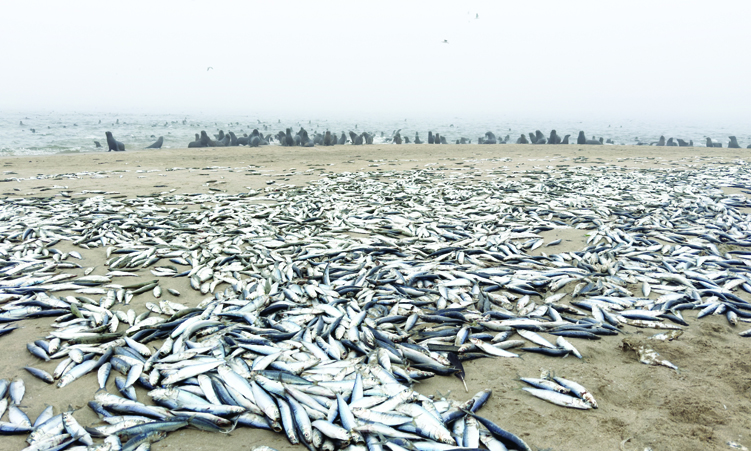
Overfishing in the 1970s caused sardine and anchovy populations to crash. They were replaced by jellyfish and gobies, which disrupted the natural food chain.
Today, constant pressure from pollution, mining, and oil exploration makes it difficult to tell if current changes are caused by the climate crisis or human activities.
With so many factors at play, identifying the root cause of the ecosystem’s struggle is a complex puzzle.
Evidence of climate change is growing.
While sea temperatures south of Walvis Bay remain steady, northern Namibia is warming and the Angola-Benguela Front is moving southward more frequently.
THE ‘BENGUELA NIÑO’
This is driven by ‘Benguela Niño’ events, which push warm, low oxygen water southward.
These shifts make it harder for temperature-sensitive sardines to reproduce, feeding into the non-recovery of sardine populations.
A drop in upwelling favourable winds near Lüderitz is allowing the warm Angola Benguela Front further south, yet phytoplankton production, which is at the base of the food chain, remains stable.
Even with that food supply and careful management since independence in 1990, rock lobster, hake and sardines are still declining or are moving.
This suggests our changing environment is preventing these species from recovering.
Along with Benguela Niños, more toxic sulphur eruptions, algae blooms and low oxygen events are to blame.
As small fish disappear or move away, seabird populations in Namibia and South Africa have crashed.
This has pushed species like the Cape Gannet and African Penguin toward the brink, leaving them endangered and critically endangered respectively.
ECO IMBALANCES
Declining predators are an early warning that our ecosystem is out of balance, putting coastal jobs at risk.
Fishing for lobster, hake and sardines has suffered, hurting businesses at Walvis Bay and Lüderitz.
Increased toxic algae blooms threaten proposed fish farming, while rising sea levels affect coastal towns.
These shifts threaten our economy and way of life.
Because of past overfishing and the Benguela ecosystem’s natural complexity, it’s hard to blame every shift on climate change alone.
Still, Namibia is seeing the same red flags as the rest of the world: rising seas and hotter water. Warm northern currents push south as winds that keep the ecosystem’s natural stability intact, weaken.
We need long-term research to truly understand these trends. This will allow us to manage our resources more wisely and adapt to climate change, protecting both our wildlife and the livelihoods of Namibians along our coast.
- Damian Schreiber, marine conservation communications, field and research officer at Ocean Conservation Namibia; he is involved in seal rescues, education outreach, and beach clean-ups. He holds a master’s in ecology and society from the University for Peace (Costa Rica).
In an age of information overload, Sunrise is The Namibian’s morning briefing, delivered at 6h00 from Monday to Friday. It offers a curated rundown of the most important stories from the past 24 hours – occasionally with a light, witty touch. It’s an essential way to stay informed. Subscribe and join our newsletter community.

The Namibian uses AI tools to assist with improved quality, accuracy and efficiency, while maintaining editorial oversight and journalistic integrity.
Stay informed with The Namibian – your source for credible journalism. Get in-depth reporting and opinions for
only N$85 a month. Invest in journalism, invest in democracy –
Subscribe Now!