





Fillow Nghipandulwa and Petrus Amuthenu went to school together. They were taught the same techniques by the same College of the Arts (Cota) lecturers and, though there is the danger of exhibiting the same thing together, their joint exhibition ‘Welcome to My World’ presents two distinct possibilities within the realms of cardboard print and mixed media.
Though both are stirred by African women, each artist’s reverence is highly personal. Fillow paints mostly maternal figures in traditional dress which speak to his praise of women as nurturers, while Petrus explores all aspects of women from their maternal instincts to their sexuality.
Vibrantly welcoming viewers into their own worlds, Fillow and Petrus exhibit in separate halves of the Franco-Namibian Cultural Centre in pieces that converse with each other with regard to subject matter, vivid use of colour and resolute perfectionism.
Petrus Amuthenu
For his first trick, Petrus shows viewers that cardboard print need not make use of obvious African colour palettes.
Printing in tones of blue in ‘African Blue’, Petrus presents the pixilated profile of an African woman surrounded by gourds and geometric patterns. Eliciting the idea of water through the depiction of it spilling from gourds, as well as through the use of the colour blue, Petrus equates the value of water to the importance of women in a stunning portrait that strikes a grudging balance between rurality and modernity.
Not at all chaste and easily charming, Petrus presents another kind of African woman in ‘Ink My Body’ a ball point pen and spray paint work which depicts a beautiful tattooed woman with cornrows expanding into an undulating monochrome afro contrasting with the browns, blacks and oranges in the rest of the piece. Afro punk in its aesthetic with a subversive element to its subject matter, ‘Ink My Body’ presents a strong, alternative African woman that defies cliché.
That is not to say Petrus doesn’t wander into the hackneyed. Pieces like ‘Sister and her Hair’ and ‘Ghetto Life’ which depict a demure African woman with long braids and a township street respectively are both the usual cardboard print fare but, thankfully, these are few.
Mostly there are intrepid pieces like ‘Goddess’ which draws an assortment of African women together in a ball point pen offering that sees women with dreadlocks, braids, headscarves and straightened hair either crying, showing off their bodies or staring seductively.
‘So Seductive’, a piece presenting a naked, long limbed woman with her legs parted and her vaginal area adorned with flowers, presents women in their full glory as do more demure pieces such as ‘Dancing Girl’, ‘Real Beauty’ and ‘Nangula in the Morning’.
Though each is different, some naked, some dancing, some modern and tattooed and others modest and hailing from the village, Petrus’ women are all beautiful and infused with benevolence.
Petrus’ woman pieces are interspersed between more grim and imaginative offerings such as ‘Dead End Nightmare’, ‘Skate’ and ‘Life is Shocking’ which touch on Petrus’ inner state with regard to the world, his fears and his escapes.
Fillow Nghipandulwa
Oddly, beginning his exhibition with a two-dimensional aerial rendering of the Namib desert, Fillow steps away from what he is good at to present something that seems more like an essay. Certainly an interesting idea but created in a dull palate of yellows and whites that fail the vibrancy and nuance of the Namib, these pieces are woefully out of place and experimental.
Once you have moved past them, however, Fillow picks up the established theme of women and his presentation of them is both romantic and traditional.
As seen in mixed media works such as ‘African Woman 1’ and ‘African Woman 2’, in Fillow’s world, African women are mothers. Both depicting women in traditional dress carrying infants on their back, Fillow celebrates the role of women as nurturers in his work which presents them in long lines, straight backs and doing two things at once.
Another interesting element in Fillow’s exhibition is his depiction of women from different tribes.
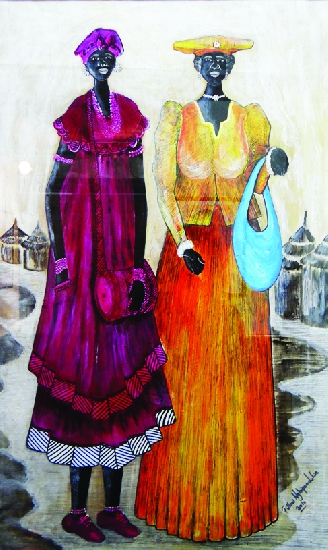
Effortlessly creating images of Himba, Herero and Oshiwambo women in a somewhat cartoonlike aesthetic, Fillow celebrates all women regardless of tribe. This is most evident in a piece titled ‘Wambo and Herero’ in which a woman in bright pink Ondelela and another in yellow Herero dress and headgear stand side by side in a village existing far beyond tribalism.
Just as lovely as his female forms are Fillow’s backgrounds, which are never neglected. Yellow flecked with black, depicting rooftops or proud little huts below peach skies, Fillow’s attention to detail in his negative space is indicative of his perfectionism which runs through most of his exhibition and finds common ground in his company’s.
‘Good Time’ , ‘I Love my World’ and ‘Bushman Art’ are three pieces which depict men, though in far less detail then those depicting women. In ‘Good Time’ a man dances with a woman. In ‘I Love My World’ three faceless men ride a donkey cart. And in ‘Bushman Art’, two anonymous men are drawn in the style of ancient rock painting.
Though it is left out of the title, ‘Welcome to My World’ is a celebration of women – modern, traditional, young and old – within the concurrence of beauty. It is interesting. It is elegant. It is all being sold for a song.
A presentation of immense skill and beguiling colour, Fillow and Petrus’ collaboration is the bright beginning of the 2014 arts calendar at the Franco Namibian Cultural Centre.
‘Welcome to My World’, a joint exhibition by Fillow Nghipandulwa and Petrus Amuthenu will be on display at the FNCC until 12 February.
– martha@namibian.com.na