



On 24 February 2022, Russia invaded Ukraine and Putin called it a ‘special military operation’.
After four years of war, Russia occupies about 20% of Ukrainian territory, and about eight million Ukrainians have been internally displaced and six to seven million Ukrainians have fled the country, creating a refugee’s crisis in Europe.
More than a million civilians and soldiers have been wounded or killed, with no end in sight.
According to the United Nations and international law, the Russian aggression towards Ukraine was unlawful and condemned by the majority of the international community.
During March 2022, 141 member states of the United Nations General Assembly voted for a resolution that Russia should immediately withdraw.
Five member states opposed the resolution of immediate withdrawal and abstention of 35 member states, including Namibia.
The member states which opposed the resolution were Russia, Belarus, Eritrea, Syria and North Korea.
SEVERE IMPACT
The Russian aggression towards Ukraine had a severe impact on Namibia.
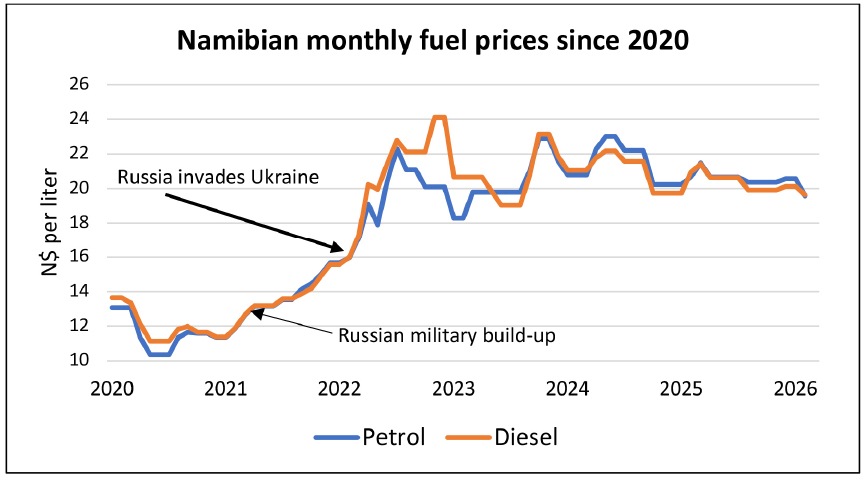
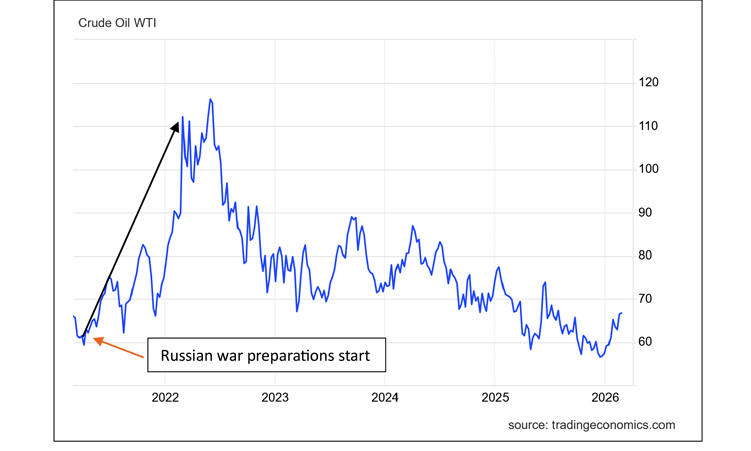
The oil price increased when the Russian military build-up commenced and satellite images revealed already during April 2021 that such a build-up started.
In November 2021 Putin had already amassed 180 000 troops at the borders of Ukraine.
In the beginning of April 2021, the oil price was around US$61 per barrel (see graph above) and the turning point came at the end of November 2021, when it became clear that Russia is serious about the military invasion of Ukraine and the oil price started to rise dramatically and on 24 February 2022 it reached already US$111.62 per barrel and peaked on 30 May 2022 at US$116 per barrel.
The oil price increased from April 2021 to 24 February 2022 by 83%.
What was the impact of the Russian invasion of the Ukraine on the Namibian economy?
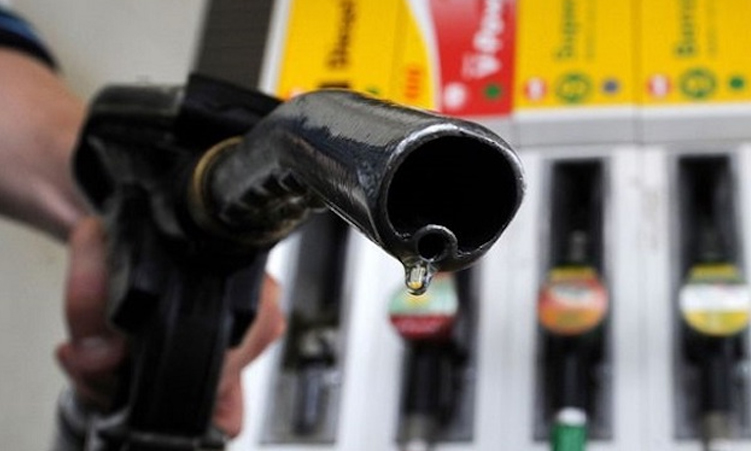
Fuel prices increased substantially from N$13.18 per litre (diesel) in April 2021 to N$24.10 in November 2022, while the increase in the price of diesel was 82.9%.
Average annual fuel prices increased dramatically since the Russian aggression, since sanctions against Russia followed and India and China were the main buyers of sanctioned Russian oil.
Oil prices declined internationally to a low of US$56 on 22 December 2025.
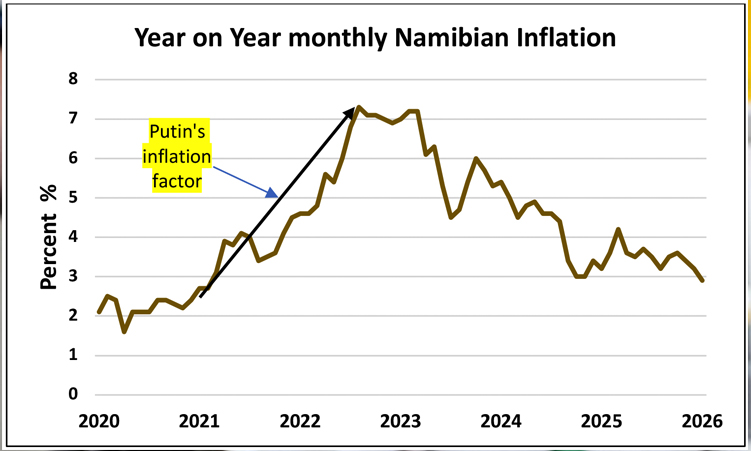
The Namibian inflation rate was 3.1% in March 2021, before the Russian military build-up started in April 2021.
When Russia invaded Ukraine on 24 February 2022 the Namibian inflation was in March 4.8%, already 1.7% higher.
By August 2022, inflation reached 7.3%, with a lag of three months after oil prices peaked in the beginning of June 2022.
Higher inflation has higher interest rates as a consequence, and higher interest rates mean a higher burden on the ordinary man on the street with a higher monthly payment on his home or car.
Investors had to pay higher monthly installments on their loans, with a negative impact on their businesses.
In February 2022, the repo rate was 4%.
Currently, it stands at 6.5%.
The peak was at 7.75% with an average prime lending rate of 11.5%.
An oil-producing country at war can thus have a substantial economic impact on Namibia, as Russia’s aggression has demonstrated.
ISRAEL’S WAR ON GAZA
On 7 October 2023, Hamas invaded Israel and killed 1 195 people, mostly civilians, including 36 children.
Hamas abducted about 250 Israelis as hostages to the Gaza Strip.
Hamas is a proxy of Iran, another major oil-producing country, like Russia.
The oil price was at US$81 per barrel, declining after Israel went into Gaza with the Israeli Defence Forces.
On 31 May 2025, the International Atomic Energy Agency (IAEA) issued a report in which it stated reported that Iran had enough uranium enriched up to 60% for the production of nine nuclear weapons.
Immediately the oil price increased from US$60.7 per barrel to US$63 per barrel.
On 9 June 2025, the IAEA issued a statement that the agency will not be in a position to provide assurance “that Iran’s nuclear programme is exclusively peaceful”.
This statement triggered the Israeli-Iran war from 13 June to 24 June 2025.
On 30 May 2025 the oil price was US$60.74 per barrel and on 23 June 2025 the oil price has increased to US$74 a barrel, an increase of 21.8%.
After America joined the war on 22 June 2025 and bombed atomic sites at Fordow, Natanz and Isfahan, the oil price dropped to US$64.60 on 25 June, after a diplomatic solution was reached and a settlement agreed.
The Russian invasion of Ukraine and the non-adherence of Iran to the stipulations of the IAEA, and the subsequent Israel-Iran war show, that if a major oil producing country is involved in a military escalation and risk to the oil price, Namibia has experienced the economic consequences.
Iran experienced internal unrest from 28 December 2025 and the oil price reacted.
On 27 December 2025 the oil price was US$56.80 per barrel and currently oil is trading at US$66.44.
Background to the oil price hike in the last two months is the brutal suppression of the demonstrations in Iran and the fear of Iran’s nuclear ambitions.
The resultant US military build-up in the Middle East influences the oil price.
Iran is once again on fire when protests started on 28 December 2025 in Tehran’s traditional bazaar.
Market traders closed their shops at the bazaar in response of the collapsing rial, which made daily business impossible.
Iran experienced many mass protests in the past, the most known mass protests were in 2022 when millions of Iranians protested under the theme ‘Woman, Life, Freedom’.
Hundreds were killed in 2022 and over 20 000 arrested.
The current brutal and bloody crackdown by the Iranian regime since 28 December left already at least 3 117 dead (as per the Iranian government) or 35 000, and nearly 50 000 arrested.
The protests come at the weakest moment of Iran.
It was very costly for Iran to support Islamic resistance groups abroad such as Hezbollah, Hamas and the Houthis.
It was also very costly to support Syria before 2024 and after the fall of the Bashar Al-Assad’s regime in Syria and his move to Russian exile, brought some savings in the Iranian financial largesse towards terror groups.
Domestically, Iranians realised that the fall of the Syria’s Bashar al-Assad regime deprived Iran of a major state ally in the Middle East.
Iranian people also experienced in June 2025 that their country was unable to defend itself against Israel and the US.
Israel achieved air supremacy within 48 hours which implied that for 10 days Israeli Air force planes flew over Theran with impunity.
Ordinary Iranians were embarrassed by experiencing a military humiliation. However, things got worse when during a time of food shortages, water crises, electricity black outs, housing shortages, above 45% inflation, rising poverty levels and unemployment.
On 28 December 2025, the local currency, the Iranian rial dropped to 1.42m to the US dollar. That was the breaking point for an already struggling economy and deprived population.
The majority of 92 million people had enough of economic hardship and protests started in every one of the 31 provinces. Food prices were already up by 72% in November last year and many food items are imported, mainly cereals.
The extent of the devaluation of the Irian rial since 2003 is shown in the graph below. In 2003 one would get 8 193 Iranian rials for one US dollar.
In 2010 10 308 rials were exchanged for one US dollar.
In 2020 (10 years later) 253 940 rials were exchanged for one US dollar and when Hamas (proxy of Iran) decided on 7 October 2023 to kill and kidnap Israelis, the rial was worth about 427 000 per US dollar.
Direct military confrontations with Israel and the support of Iran’s proxy terror groups turned out to be ineffective and very costly and the Iraian rial dropped to 1 420 000 for one US dollar on 28 December 2025.
If a country is dependent on food imports, such a poor exchange rate means that the ordinary Iranians had nothing to lose anymore.
The US and Israel know that Iran is currently at its weakest point.
Will there be war in the Middle East, or will a diplomatic solution be reached between the US and Iran?
A prolonged rise in the oil price would be detrimental to the Namibian economy.
In an age of information overload, Sunrise is The Namibian’s morning briefing, delivered at 6h00 from Monday to Friday. It offers a curated rundown of the most important stories from the past 24 hours – occasionally with a light, witty touch. It’s an essential way to stay informed. Subscribe and join our newsletter community.

The Namibian uses AI tools to assist with improved quality, accuracy and efficiency, while maintaining editorial oversight and journalistic integrity.
Stay informed with The Namibian – your source for credible journalism. Get in-depth reporting and opinions for
only N$85 a month. Invest in journalism, invest in democracy –
Subscribe Now!