





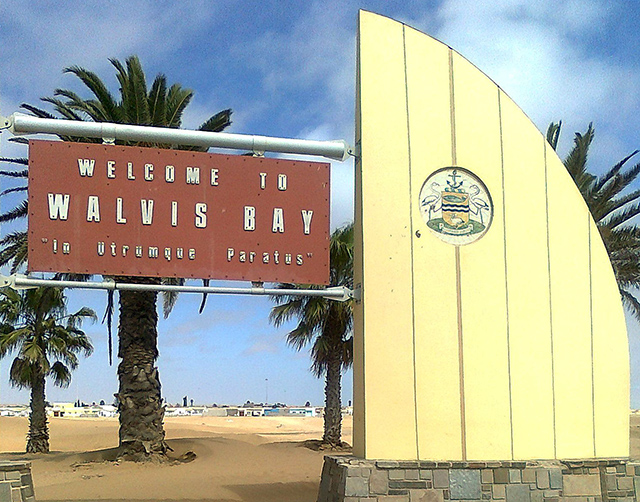
The municipality of Walvis Bay on Monday engaged stakeholders at the town in a meeting to discuss ways to improve residents’ living standards and position the town as an ideal option for global trade and investment.
This forms part of the council’s vision to create the best business environment to attract world-class investment opportunities in line with the town’s economic needs and opportunities to ensure sustainable and resilient economic development.
The discussions form part of the municipality’s Local Economic Development strategy (LED) 2023-2028 which aims to ensure the town is recognised in the global investment market.
The LED strategy aims at crafting initiatives that will address identified challenges, opportunities and aspirations and turn them into realistic, achievable futures.
It will run on some strategic objectives, including identifying programmes that will foster the creation of a conducive business environment; identifying a set of principles required to stimulate inclusive economic growth; creating appropriate incentives to support economic growth; stimulating employment creation and creating special programmes for micro, small and medium enterprises promotion.
The meeting that served as an initial step in addressing important questions, marked the start of crafting the strategy’s implementation plan.
For the next five years, the municipality will work closely with developmental partners, the private sector and all spheres of the government to ensure that the strategic intervention highlighted in the strategies are carried out and brings about the desired development for the town.
The municipality plans to pursue programmes to create an ideal environment to foster business growth. It will then market investment opportunities at Walvis Bay and ensure that the town makes the list of the top 10 African ‘Cities of Opportunity’ by 2033.
The municipality’s chief executive officer, John Esterhuizen, said it was important for the stakeholders to help to transform aspirational ideas into tangible realities.
He highlighted the town’s position in the energy sectors of green hydrogen, oil and gas.
“Our focus is on ensuring that our infrastructure and regulatory frameworks are robust enough to attract significant business and investments in the energy sector while concurrently fostering complementary sectors and sustaining the growth of our existing industries,” he said.
He noted that although the town’s economy has thrived in fishing, tourism and logistics for the past three decades, changing dynamics need transformation in order to maintain relevance around the world.
“Our long-term vision for Walvis Bay is ambitious – to be listed among the Global Competitive Cities for Jobs and
Growth by 2033.
Currently, only Cape Town represents the Southern African Development Community (SADC) in this
category.
Achieving this status demands a collective effort from the council and all of you as our valued stakeholders
and development partners.
We must provide high-quality infrastructure, both physical and institutional, fostering
economic growth through agglomeration effects, cultural vibrancy and environmental competitiveness, transcending mere economic considerations,” he said.
Walvis Bay municipality economic development manager Tulimekondjo Iishitile highlighted challenges at the town and noted the importance of input by stakeholders
“For us to achieve that, we need to change a few things. Let us start now by consulting our stakeholders.
The population has doubled, but our infrastructure is still the same. It is ageing and dilapidated.
We would like to improve, but it is difficult with the slow economy.
Our roads are operated as if they are national, because we host a port.
The amount of traffic compared to other towns is a bit overwhelming.
“We want to grow our economy, but we do not have enough land.
The little that we have needs to be serviced.
We have a high rate of unemployment, lack of housing, good schools, good municipal services and so on,” Iishitile said.
Stakeholders, including the Namibian Ports Authority, Namibia Airports Company, Ministry of Environment, Forestry and Tourism and the National Petroleum Corporation of Namibia presented cases on their institutions and how they will fit in the plan.