




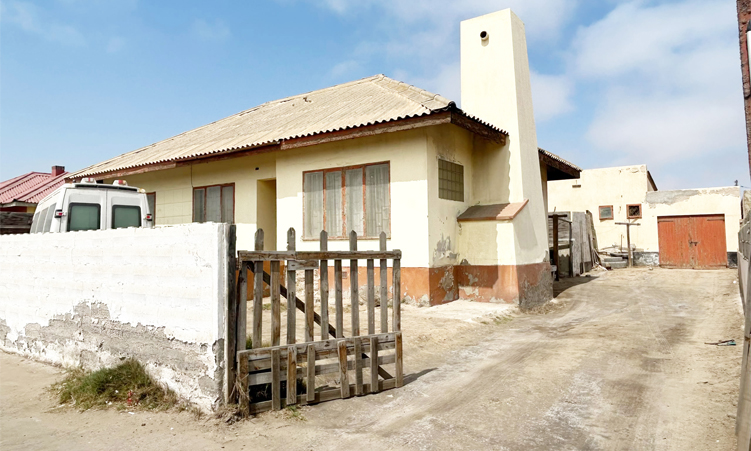
A house and flat at Walvis Bay that were the scene of the sexual abuse of five teenage girls in 2017 have been forfeited to the state in terms of an order issued in the Windhoek High Court on Friday.
According to the court’s order, the house and flat and the erf on which they are situated, all valued at N$2.99 million, are forfeited to the state in terms of the Prevention of Organised Crime Act (Poca).
The court also ordered that the property, 1 250 square metres in size and situated on Hage Geingob Street at Walvis Bay, is to remain under the control and supervision of a police officer attached to the asset recovery subdivision of the police’s Commercial Crime Investigation Unit.
The court has further ordered the officer to sell the property by public auction for an amount not less than its market value and to deposit the proceeds of the sale into the justice ministry’s Poca Asset Recovery Fund account.
The house belonged to Russian citizen Alexander Krylov, who was convicted in the High Court on 10 counts of human trafficking, 10 charges of rape and one count of supplying cigarettes to minors in March 2023.
Krylov, who was employed as a harbour pilot at Walvis Bay, was sentenced to an effective prison term of 35 years in March 2023. He was 62 years old at the time of his sentencing.
Krylov ended his life in prison in August 2023.
In an affidavit filed at the High Court, acting prosecutor general Martha Imalwa, who applied for the forfeiture order, says the property, erf 925 on Hage Geingob Street at Walvis Bay, is registered jointly in the names of Krylov and his wife, who were married in community of property.
Krylov’s wife has made a statement in which she said she had no knowledge of, involvement in or benefit from the criminal activities of her husband.
Imalwa says according to evidence heard during Krylov’s criminal trial the property in question constituted an instrumentality of the offences of human trafficking and rape, as the crimes Krylov was found guilty of were committed in a flat located on the property.
According to the evidence that featured in Krylov’s trial, five minor girls, aged between 13 and 16 years, were introduced to Krylov by a Walvis Bay resident during 2017, Imalwa says.
She also says that Krylov collected the girls and transported them to the flat at his property.
“The flat contained no residential furniture other than a single bed. It was not used as a dwelling or ordinary domestic living space,” Imalwa says in her affidavit.
She continues: “Mr Krylov routinely locked the complainants inside the flat, taking the keys with him, thereby physically detaining and isolating the victims within the structure to facilitate the continuous sexual abuse and prevent escape or detection.”
Imalwa also notes that Krylov admitted during his trial that he engaged in sexual intercourse with the minor complainants at the flat.
The flat at the property was used “to harbour, isolate and sexually exploit the minor complainants pursuant to an organised criminal scheme that spanned several months”, according to Imalwa.
She also says: “The property was not merely incidental to the commission of the offences; it served as the active, indispensable instrument through which the planned scheme of human trafficking and child rape was executed, concealed and sustained.”
In terms of a liquidation and distribution account in Krylov’s estate, his share in the property was to be inherited by his wife.
Imalwa says because Krylov’s wife has not filed a formal application in terms of Poca for her interest in the property to be excluded from a property preservation or forfeiture order, Imalwa was entitled to ask the court for an order for the forfeiture of the property in its entirety.
In its order, the court states that any person whose interest in the property is affected by the forfeiture order may ask the court to vary or cancel its order within 15 days after the person has become aware of the order.